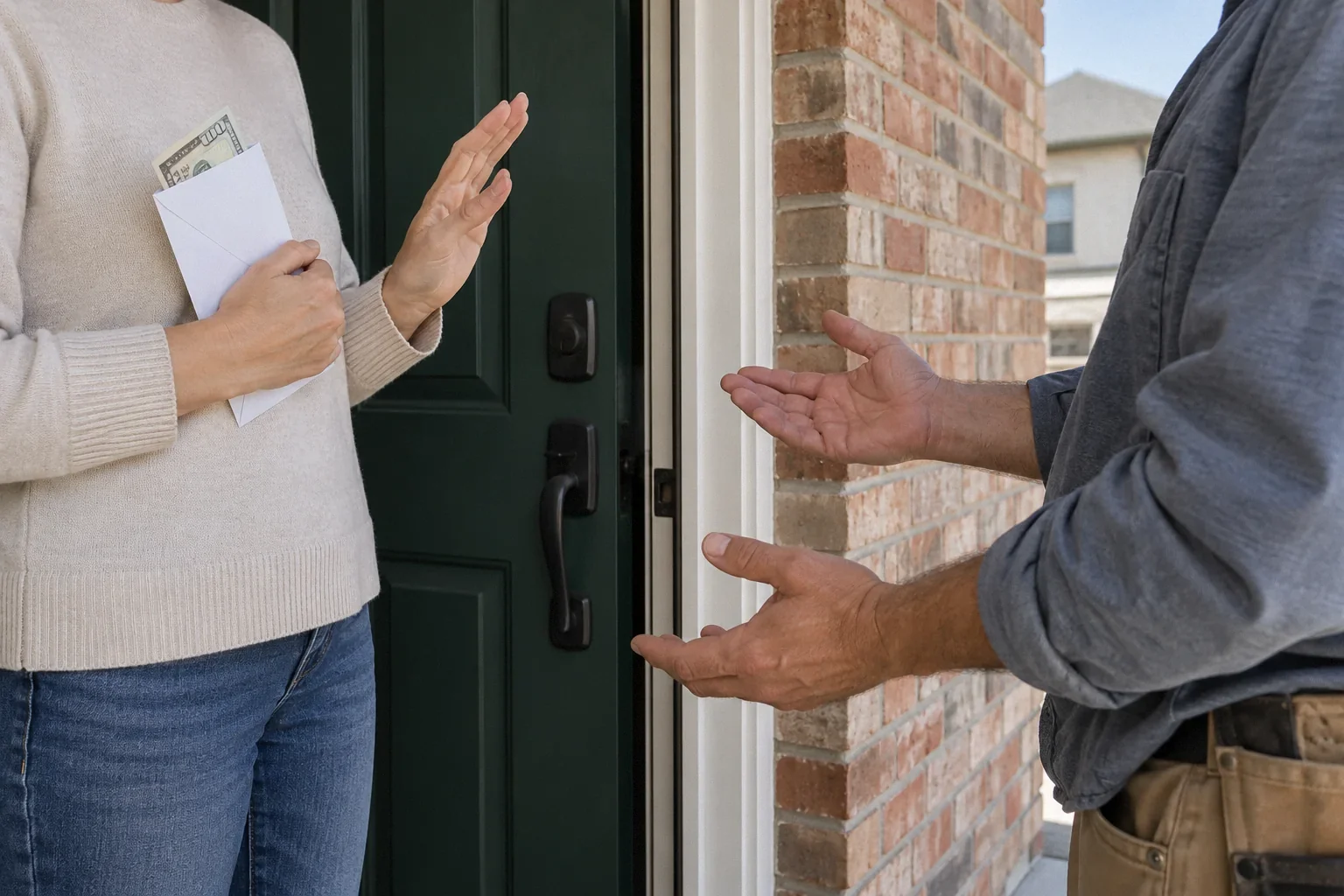
Short answer: CSLB's guidance for seniors lists the warning signs: unsolicited door-to-door offers, pressure to decide immediately, scare tactics after a 'free inspection', demands for cash (sometimes including a trip to the bank), down payments above the legal limit, and verbal-only agreements. California law gives buyers 65 and older five business days to cancel a covered home solicitation contract (Civil Code § 1689.6; age defined in § 1689.5). For ordinary home improvement contracts, the law caps the down payment at $1,000 or 10% of the price, whichever is less (BPC § 7159.5). If you suspect an older relative has been exploited, California's Adult Protective Services takes reports 24/7 at 1-833-401-0832 (CDSS), as does local law enforcement.
This is general information current to 3 October 2026, not legal advice.
How these schemes tend to unfold
An adult daughter described arriving to find that a contractor who came to the door had signed her mother, who had declining memory, to three separate contracts of about $30,000 each: re-piping, kitchen ceiling and skylight repair, and 'mold remediation' that turned into a fully gutted bathroom, with no proof of mold provided. Commenters in that thread described a Southern California case years earlier in which a contractor targeted senior communities, required payment in full, and never did the work. Similar stories from other states and from Canada, such as an elderly couple pressured for payment after a porch was partly dismantled, are analogous concerns only. They are not California cases and not California law. All of these are anecdotal accounts, but they match the pattern CSLB describes.
Warning signs, mapped to protections
| Warning sign (CSLB) | What California law or guidance offers |
|---|---|
| Unsolicited door-to-door offer, often roofing, paving or painting, with 'leftover materials' or a discount | Home solicitation contracts carry a cancellation right: 5 business days for buyers 65+ |
| Pressure to sign today | A real emergency, such as an active leak, a gas smell or a structural hazard, may need an immediate safety response. That is different from pressure to sign a large repair contract on the spot. Separate short-term mitigation from the full repair, and verify the license first on the CSLB lookup |
| 'Free inspection' that finds urgent, expensive problems | Get an independent second opinion before agreeing to anything |
| Demand for cash, or a trip to the bank | CSLB advises paying by check, never cash |
| Large deposit or payment in full up front | Down payment cap: $1,000 or 10%, whichever is less, unless the contractor has a qualifying blanket performance and payment bond on file with CSLB; no payment ahead of work |
| Verbal-only agreement, or several separate contracts | Contracts over $500 must be written with statutory notices. Several contracts on one visit are a red flag for splitting and pressure |
If an older relative has already signed
A note on autonomy first. An older adult who is competent has the right to make their own decisions, including ones their family disagrees with. A relative cannot cancel another competent adult's contract without legal authority, such as a power of attorney that covers it, a conservatorship, or the person's own signed notice. Work with your relative rather than around them: help them read the contract, check the license, and send the cancellation themselves if they choose to. Where capacity is genuinely in doubt, that is a question for an elder law attorney and, if exploitation is suspected, for Adult Protective Services.
- Check the date and the cancellation window. For a buyer 65 or older, a covered home solicitation contract can be cancelled until midnight of the fifth business day after receiving a signed and dated copy. Business days include Saturdays and exclude Sundays and listed holidays. See our cancellation guide.
- Cancel in writing if within the window and if your relative wants to. The buyer, or someone with legal authority to act for them, sends the notice. Notice 'however expressed' is effective if it shows intent not to be bound. Send it to the address or email in the contract and keep proof.
- Stop further payments for work that has not been done, and do not hand over cash. Payments may not exceed the value of work performed or materials delivered.
- Check the license on CSLB's website. Note whether it is active, its classification, workers' compensation status and bond history.
- Secure the house. If work has left a room unsafe, such as a gutted bathroom or open ceiling, get a licensed contractor to make it safe. Where it does not delay safety, photograph and video the conditions before any emergency work, because the evidence of what the first contractor did matters later.
- Report. File a complaint with CSLB, which handles both licensed and unlicensed contractors. If you suspect financial exploitation of someone 60 or older, contact Adult Protective Services at 1-833-401-0832, or local law enforcement.
- Get legal help. Where capacity is in question, an elder law attorney can advise on contract validity and recovery. See CSLB complaints and bond claims.
Prevention for families
- Agree a household rule: nobody signs a home repair contract at the door. Any offer waits 48 hours and a call to a family member.
- Keep a short list of known, licensed contractors for common repairs, with license numbers.
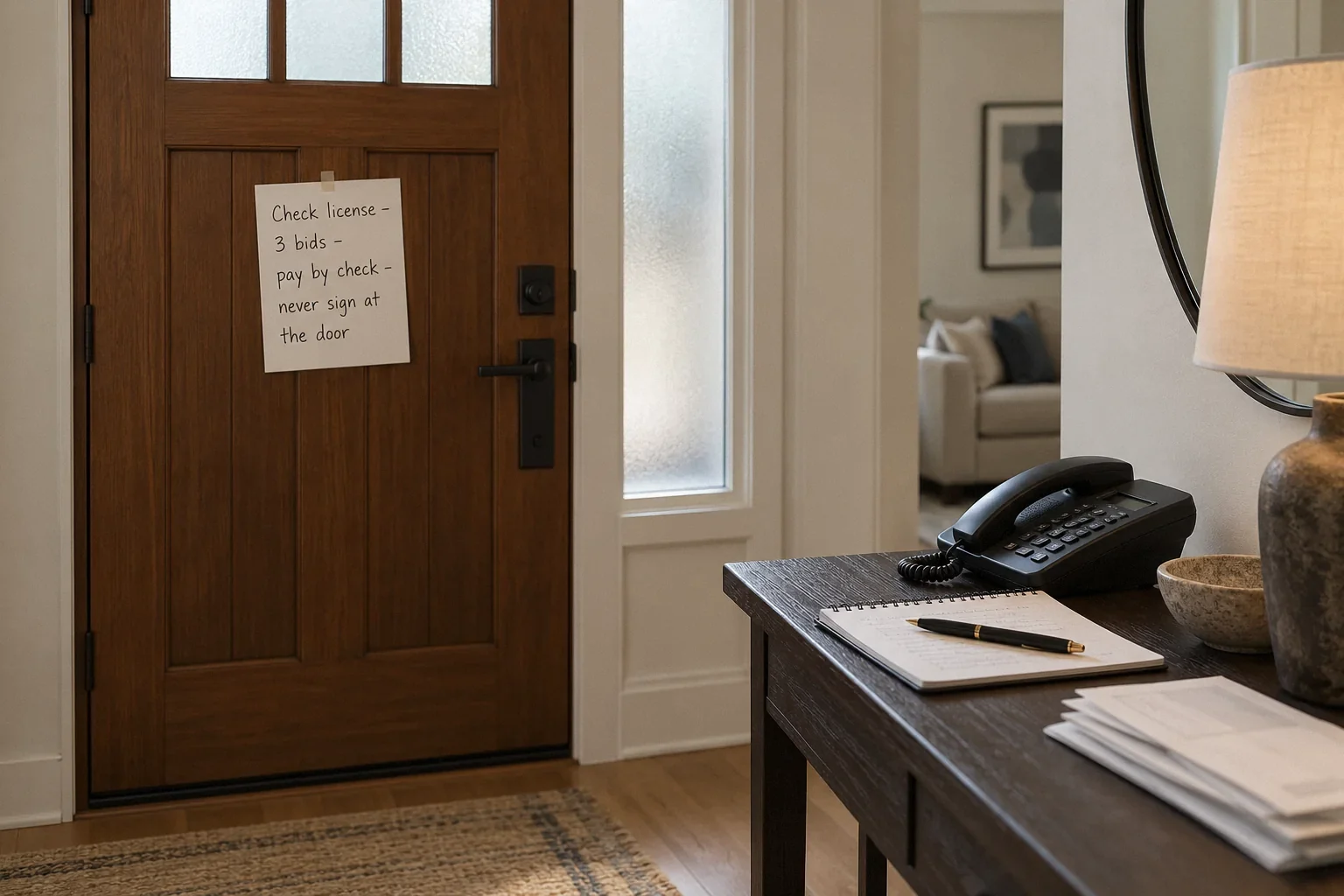
- Post a reminder by the phone and front door: check the license, get three bids, pay by check, never more than $1,000 or 10% down.
- Set up account alerts for large withdrawals, where your relative agrees.
- Attend CSLB's free Senior Scam Stopper seminars, listed on CSLB's senior page.
After a disaster
After fires, floods or storms, CSLB warns that contracting without a license in a declared disaster area is a felony, and repeats its advice: verify the license, do not rush, limit initial payments to 10% or $1,000, avoid cash, get three bids and a written contract. For covered home solicitation contracts to repair or restore a home damaged by a sudden or catastrophic event, Civil Code § 1689.6 gives a seven-business-day cancellation window. Whether a particular contract is covered depends on how and where it was made. See our cancellation guide.
A worked example: the 'free roof inspection'
Hypothetical. A man knocks on a 79-year-old homeowner's door, says his crew is working nearby, and offers a free roof check. Twenty minutes later he shows phone photos of 'cracked tiles' and says the next rain will bring water through the ceiling. He can start tomorrow for $18,000, with $9,000 today, and the price is only good today.
| Claim or request | What to do |
|---|---|
| 'Your roof is about to fail' | Say no to any contract today. If there is visible active leaking, arrange a short-term tarp or patch from a licensed roofer you choose, and document it |
| Photos on his phone | Photos can be of any roof. Ask a second licensed roofer to inspect in person |
| $9,000 deposit today | Over the legal cap of $1,000 or 10%, whichever is less, absent the specific blanket bond exception. Decline |
| 'Price good only today' | A classic pressure tactic. A legitimate contractor will still bid next week |
| No license number on the paperwork | Ask for it and check CSLB. Roofing generally requires a roofing (C-39) or appropriate general license |
| If she has already signed | Count five business days from receipt of the signed copy; she may send a written cancellation; keep proof |
The point is not that every door-knocker is a fraud, but that none of these requests is a reason to decide on the spot.
Emergency response vs. sales pressure
| Genuine emergency | Sales pressure dressed as an emergency |
|---|---|
| You can see the hazard: active water entry, a gas smell, sparking, a sagging ceiling | The alleged hazard is supported only by the salesperson's photos or words; it needs independent verification, not automatic dismissal |
| The response is a limited stabilization: shut-off, tarp, temporary shoring | The response is a full replacement contract |
| You call the utility, the fire department or a contractor you choose | The contractor who found the problem insists only they can fix it |
| Payment is for the limited work, after it is done | Large payment demanded before any work |
For a gas smell or other immediate danger, follow your utility's and fire department's emergency instructions first. Contracts can wait.
Bay Area applicability
The protections are statewide. Locally, use your county's Adult Protective Services office, listed on the CDSS county contact page, and your city or county building department. If a contractor claims a 'permit is handled', ask for the permit number and look it up on the building department's portal before work starts.
Current to 3 October 2026.
Questions that come up next
How long does a senior have to cancel a contractor contract in California?
For covered home solicitation contracts, a buyer 65 or older can cancel until midnight of the fifth business day after receiving a signed and dated copy. Saturdays count as business days; Sundays and listed holidays do not.
What are common signs of a contractor scam aimed at older homeowners?
CSLB lists door-to-door offers, pressure to decide immediately, scare tactics after a 'free inspection', demands for cash, excessive down payments and verbal-only agreements.
Where do I report a contractor who took advantage of my elderly parent?
File a complaint with CSLB. If you suspect financial exploitation of someone 60 or older, contact Adult Protective Services (statewide line 1-833-401-0832) or local law enforcement, and consider an elder law attorney.
Can a contractor demand full payment before starting work?
Not for an ordinary California home improvement contract. The down payment is capped at $1,000 or 10% of the price, whichever is less, unless the contractor has a qualifying blanket performance and payment bond on file with CSLB, and later payments may not exceed the value of work done or materials delivered.
Sources and further reading
Community questions behind this guide
These discussions identify homeowner concerns. Forum comments are personal accounts, not code or legal authority.