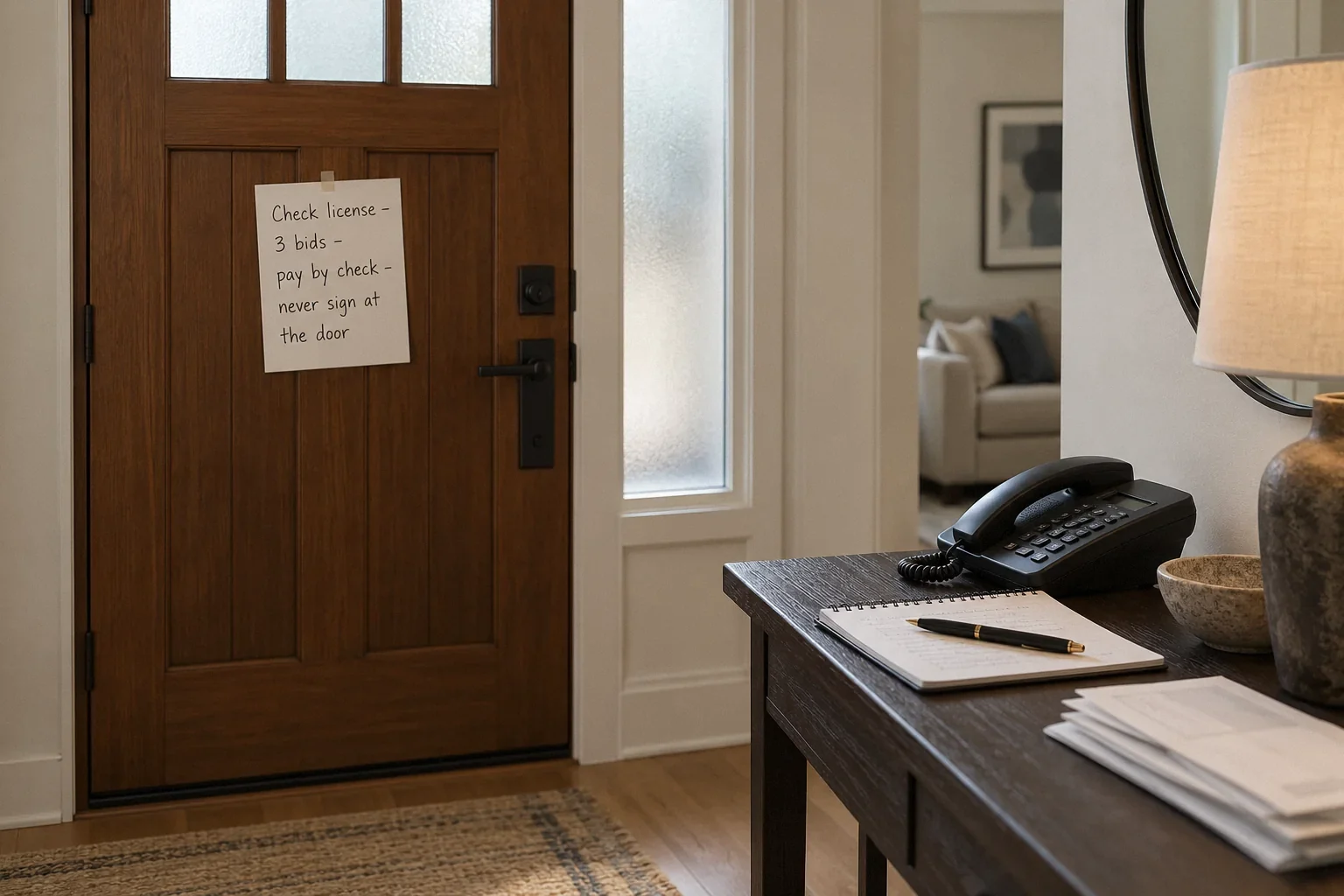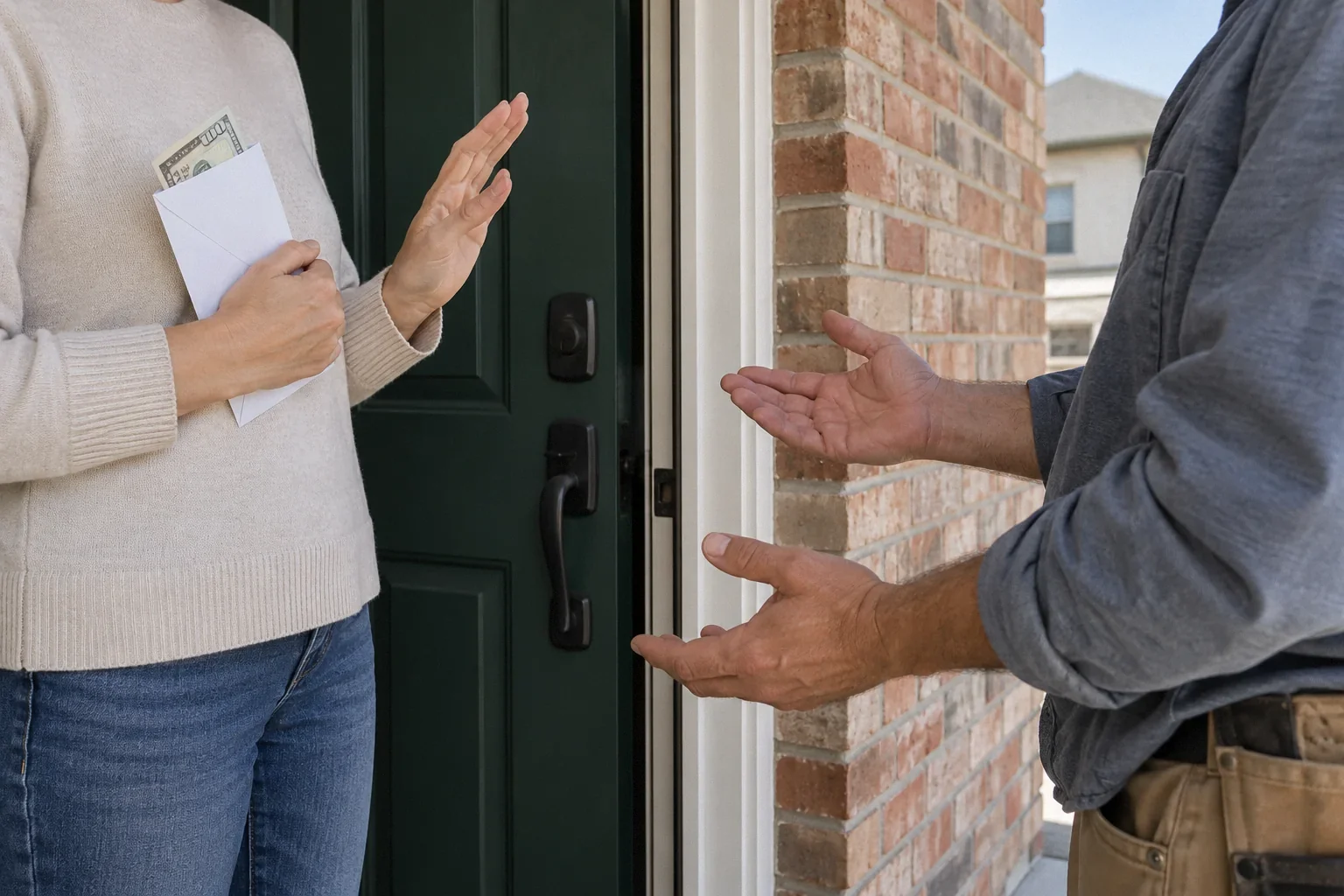
Short answer: the clearest warning signs are a contractor who wants cash, a deposit above California's limit of $1,000 or 10% of the price (whichever is less, with a narrow bond exception), no written contract, pressure to sign today, a license number that does not match the business, and a request that you pull the permit for work they will do. The Contractors State License Board lists several of these on its scam warning page, which is useful for homeowners of any age. A red flag is not proof of fraud: some honest contractors run sloppy paperwork. But each one shifts risk onto you, and several together are a reason to stop before you pay.
This guide gives a fast verification routine, a red flag table that explains what each sign means legally and practically, a worked proposal review, and what to do if you have already paid. It is general information current as of 3 October 2026, not legal advice.
What homeowners report
A homeowner planning a major remodel wrote that a previous contractor took their money after a flood and left. A Los Angeles owner who fired a general contractor midway through a major remodel listed what they found: a deposit of $1,000 plus 10% of the project cost, a contract naming the company but using a different personal license number, a workers' compensation exemption despite a visible crew, and cash payments to workers. A basement remodel bidder told an owner he did not pull permits and wanted the homeowner to do it, so that if the owner disliked the work he could "just walk away"; commenters called it a major red flag. Another contractor offered $1,500 off if the owner listed themselves as general contractor on the permit. In the San Mateo County thread on unpermitted showers, owners said contractors told them permits were not required for retiling. These are personal accounts, not verified findings about any business.
The five-minute verification routine
- Get the license number in writing and the exact business name on the contract.
- Look it up on the CSLB license check. Confirm the license is active, the name matches the contract, the classification fits the work, and review the bond and workers' compensation information shown on the record.
- Check whether the salesperson must be registered and verify the registration where required if someone is selling you the job; statutory exemptions cover certain listed owners, officers, qualifying individuals and other roles, so check the applicable role rather than assuming every representative needs registration; California's contract statute requires the salesperson's name and registration number on the contract (BPC § 7159).
- Read the deposit and payment terms against BPC § 7159.5: deposit no more than $1,000 or 10%, whichever is less, and no payments ahead of completed work or delivered materials.
- Ask who pulls the permit and get it written into the contract, as CSLB contract guidance recommends.
Red flags and what they actually mean
| Red flag | Why it matters | What to do |
|---|---|---|
| Door-to-door offer, "leftover materials," free inspection that finds an emergency | CSLB lists door-to-door solicitation and scare tactics as common scam patterns | Do not decide on the spot; get an independent opinion |
| Pressure to sign today | CSLB lists high-pressure sales; California gives many home improvement buyers a cancellation window (three business days, five for seniors) for covered contracts | Take the contract home; see cancellation rights |
| Cash only, or driving you to the bank | CSLB lists cash demands; cash leaves little record | Pay by check or traceable method, against invoices |
| Deposit over the legal limit | Statutory violation under § 7159.5 unless the contractor qualifies for the blanket bond exception | Refuse; see down payment limits |
| "No need for a contract" | A written contract is required for home improvement jobs over $500, with required terms and notices | Insist on a complete written contract; see contract checklist |
| License number does not match the business, or is expired | You may be dealing with an unlicensed or borrowed license | Stop until resolved; see verifying a license |
| "You pull the permit" for work they will do | Shifts responsibility to you; CSLB warns about people urging owners to become owner-builders | Do not accept owner-builder responsibility just to accommodate a contractor; agree on a lawful permit arrangement; see owner-builder risks |
| "Permits aren't needed" for plumbing, electrical or structural work | May be wrong in your jurisdiction; licensed contractors who willfully disregard permit laws risk discipline under BPC § 7110 | Ask the building department yourself |
| Workers' compensation exemption with a visible crew | An exempt contractor certifies no employees; a crew raises questions about coverage for injuries on your property | Ask for proof of coverage or an explanation; see contractor insurance |
| Payment requests ahead of progress | § 7159.5 bars payments exceeding work performed or materials delivered | Pay against completed, verifiable milestones |
Owner-builder permits can be lawful. The warning sign is being pressured to take responsibility you do not understand, especially as a way around licensing or inspection. Properly licensed subcontractors can also explain a crew working under an exempt prime contractor; verify who employs each worker.
Worked example: reviewing a kitchen proposal
A homeowner receives a one-page kitchen proposal: "Full kitchen remodel, $68,000. 30% to start, balance on completion. Permit if needed by owner. Cash discount available." The business card shows a license number. Running the routine:
- The CSLB lookup shows the license number belongs to an individual whose name differs from the business on the card, and the classification is a specialty unrelated to plumbing or electrical. That alone is a reason to pause and ask questions.
- The 30% deposit would be $20,400, far above the $1,000 maximum for a contract of this size.
- "Permit if needed by owner" shifts the permit, and responsibility, to the homeowner.
- There is no start or completion date, no description of materials and none of the required notices, which § 7159 requires in a covered contract.
- A cash discount alone does not prove misconduct, but cash payments need dated receipts and a clear accounting trail.
None of these proves an intent to defraud. Together they describe a deal where the homeowner carries almost all of the risk. A reasonable response is to decline, or to ask for a compliant written contract with a lawful deposit, a properly matched license and the contractor pulling the permit, and to compare with other bids. See comparing bids.
If you have already paid
- Stop sending money ahead of work, while continuing to pay amounts that are actually earned under your contract.
- Collect the contract, payment records, messages and dated photos of completed work.
- Check the license record again, including bond information.
- Put your concerns in writing to the contractor.
- Consider a CSLB complaint and bond claim; if the person was unlicensed for work requiring a license, BPC § 7031(b) allows an action to recover compensation paid, subject to the statute and case-specific facts; it does not guarantee collection.
- For larger losses or suspected crimes, talk to an attorney and, where appropriate, local law enforcement. See also contractor abandoned the job.
Checklist before you pay anything
- License active, name matches contract, classification fits
- Salesperson registered if applicable
- Complete written contract with required notices and dates
- Deposit within the legal limit
- Payments tied to completed work or delivered materials
- Contractor pulls the permit, stated in the contract
- Traceable payment method
- At least two or three comparable bids
Current as of 3 October 2026. Contract and licensing rules are state law; permit requirements combine state law, local rules and the exact scope.
Questions that come up next
What are the biggest red flags when hiring a contractor in California?
CSLB lists door-to-door solicitation, high-pressure sales, scare tactics after a free inspection, cash demands, illegally large down payments and verbal-only agreements. A license that doesn't match the business and a request that you pull the permit for their work are also strong warning signs.
Is asking for 30% upfront a sign of a scam?
It is a statutory problem: California limits home improvement down payments to $1,000 or 10% of the contract price, whichever is less, with a narrow exception for contractors holding a blanket performance and payment bond. It does not by itself prove intent to defraud, but you should not pay it.
Why would a contractor want me to pull the permit?
Sometimes to avoid responsibility for the work or to avoid permit tasks. If you pull an owner-builder permit for work a contractor performs, you take on responsibilities you may not expect. CSLB warns owners about people urging them to become owner-builders.
How do I check a contractor's license?
Use the CSLB license check online. Confirm the license is active, the name matches your contract, the classification fits the work, and review the bond and workers' compensation information.
Sources and further reading
- CSLB: What Seniors Should Know (scam warning signs and tips)
- CSLB: Check a License
- CSLB: Contracts and Binding Agreements
- California Business and Professions Code § 7159
- California Business and Professions Code § 7159.5
- California Business and Professions Code § 7110
- California Business and Professions Code § 7031
Community questions behind this guide
These discussions identify homeowner concerns. Forum comments are personal accounts, not code or legal authority.