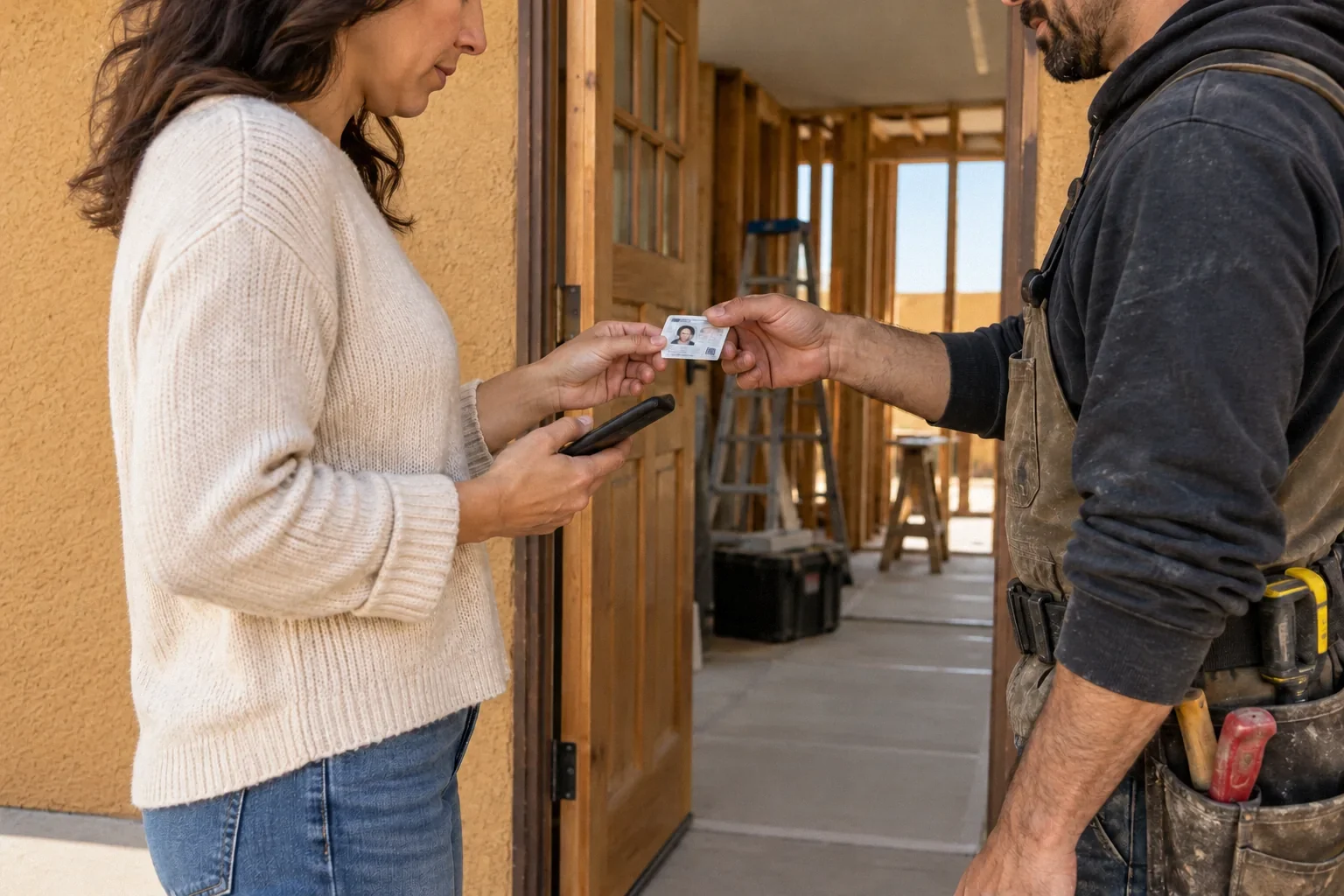
Short answer: two kinds of insurance matter most. Workers' compensation covers injuries to the contractor's employees. California requires every employer to carry it, even with one employee. An eligible contractor with no employees may instead file a signed exemption with CSLB, except in certain classifications (concrete, HVAC, asbestos abatement, roofing and tree service) that must maintain coverage or approved self-insurance regardless (CSLB). SB 1455 (Stats. 2024, ch. 485) made 1 January 2028 the operative date for requiring workers' compensation of all licensees, and directed CSLB to set up, by 1 January 2027, a process to verify which licensees without employees qualify for an exemption (bill text). How exemptions will work from 2028 may be refined before then, so check CSLB's current guidance. Commercial general liability (CGL) insurance can cover third-party bodily injury and accidental property damage. It is not required for most licensees, but every home improvement contract must state whether the contractor carries it (BPC § 7159(e)), and CSLB strongly recommends it. CSLB notes that CGL is not intended to cover the work the contractor performs (CSLB CGL information). Policies commonly exclude the contractor's own work, although exclusions vary and some policies contain exceptions, for example for work performed by subcontractors. It is not a workmanship warranty, and whether a particular loss is covered depends on the policy wording.
This is general information current to 3 October 2026, not legal or insurance advice.
The problems homeowners run into
A Bay Area owner considering an unlicensed worker for a kitchen and bath was warned in replies that if the worker were hurt on the property, the cost could far exceed what a permitted remodel would have cost. A Los Angeles owner who fired a GC said the contractor's license was marked workers' comp exempt, meaning no employees, while a crew was clearly working on site. They also reported an attorney's view that the contractor's liability insurance would not cover defective work unless it caused physical damage. These are anecdotal accounts, but they line up with how the coverages are designed.
What each coverage does and doesn't do
| Coverage | Typically responds to | Typically does not respond to | Required? |
|---|---|---|---|
| Workers' compensation | Injuries to the contractor's employees on your job | Injuries to people who are not the contractor's employees; defective work | Yes for employers; certain classes always; broader requirement scheduled for 1 Jan 2028; recheck the applicable exemption process then |
| Commercial general liability | Third-party bodily injury and accidental property damage, such as damage to other parts of your home | Generally not intended for the contractor's own work product (per CSLB's description); exclusions and exceptions vary by policy | Disclosure required; carrying it generally not, except separate rules for LLC licensees |
| License bond ($25,000) | Claims by eligible homeowners damaged by license-law violations, and unpaid employees | Large losses beyond the bond amount; not insurance | Yes: a $25,000 surety bond, or an approved alternative such as a cash deposit with CSLB |
| Your homeowner's policy | Depends on your policy | Depends on your policy | Often required by your mortgage lender; otherwise your choice |
The exact scope of any insurance policy depends on its wording, exclusions and the facts. Treat this table as orientation, not a coverage opinion.
Reading the contract's insurance notices
Under § 7159(e), the contract must include one of these CGL statements: the contractor does not carry CGL; carries CGL written by a named insurer; is self-insured; or, for LLCs, carries liability insurance or maintains other security as required by law. It must also state either that the contractor has no employees and is exempt from workers' compensation, or that it carries workers' compensation for all employees. These notices may be in an attachment if the contract says so. CSLB's CGL sheet adds that an insured contractor must give you the insurer's name and phone number so you can verify coverage. See our contract checklist.
How to verify
- Look up the license on the CSLB lookup. The license detail shows workers' compensation information, whether a policy or an exemption, and bond history.
- Compare with the contract. The contract's workers' comp statement should match the CSLB record.
- Compare with reality. If the record says 'exempt' and a crew shows up, ask who employs the workers. Each may be a separately licensed subcontractor with its own coverage, which is legitimate. Or they may be the contractor's unreported employees, which is not.
- Call the CGL insurer named in the notice to confirm the policy is active and what operations it covers. Ask whether residential remodeling is a covered operation.
- Ask for a certificate of insurance naming you as certificate holder. A certificate is informational. It does not itself make you an additional insured or change the policy, but it gives you policy numbers and dates. If you want additional insured status, it requires an actual endorsement to the policy, which you should ask for in writing. Also ask whether the policy includes completed-operations coverage, which concerns damage arising after the work is finished, and what its main exclusions are.
- Check your own policy. CSLB suggests asking your homeowner's insurer whether a temporary rider makes sense during the project (Terms of Agreement).
A worked example
Hypothetical. A bathroom contractor's bid includes a CGL notice naming an insurer, and a workers' comp statement: 'no employees and exempt'. The CSLB record also shows an exemption. On demolition day, three workers arrive.
- Question: 'Who employs today's crew?'
- Acceptable answer: they are licensed subcontractors, a demolition firm and a plumber. Ask for their license numbers and check that each shows workers' comp coverage or a valid exemption.
- Concerning answer: 'They're my guys, I pay them cash.' That is inconsistent with an exemption, which certifies the contractor has no employees. Labor Code § 2750.5 creates a rebuttable presumption that a person doing work requiring a license, without one, is an employee. How that plays out after an injury, and who bears the cost, depends on facts and law that need professional advice. CSLB also says failing to maintain required coverage leads to license suspension, with work during suspension treated as unlicensed. Pause, put your concern in writing, and get advice before work continues.
When something goes wrong
| Event | Likely first line of response | Your steps |
|---|---|---|
| A worker is injured | The employer's workers' compensation, if it exists | Make sure the injured person gets care; notify the contractor in writing; notify your insurer promptly |
| A worker damages an undisturbed part of your home, such as flooding the floor below | Possibly the contractor's CGL | Photos, written notice to the contractor, ask them to report it to their insurer; notify your insurer |
| The shower they built leaks | The contractor's obligation to correct defective work; possibly CGL for resulting damage to other property | Written defect notice; independent assessment. See complaints and bond claims |
| Neighbor's property damaged | Possibly the contractor's CGL | Document; notify the contractor in writing; neighbor may also contact their insurer |
Common misunderstandings
- 'Licensed means insured.' A license requires a bond or approved alternative security, not CGL. Workers' comp depends on employees and classification until 2028.
- 'Their insurance will fix bad work.' CSLB's description says CGL is not intended to cover the contractor's own work.
- 'Exempt means they work alone.' Not exactly. An exemption means the contractor certifies it has no employees and meets the exemption requirements. CSLB also disallows it where a Responsible Managing Employee qualifies the license. It may still use properly licensed subcontractors, who carry their own coverage status. A crew of the contractor's own workers, though, does not fit an exemption.
- 'A certificate guarantees coverage.' Verify with the insurer; certificates can be outdated.
Bay Area applicability
These rules are statewide. One local step: building permit applications commonly include a declaration of workers' compensation coverage or exemption, so the permit file may show what the contractor declared. If you are listed as an owner-builder, you may be the one making that declaration, with its own responsibilities. See owner-builder risks.
Current to 3 October 2026.
Questions that come up next
Does a California contractor have to carry workers' compensation?
Employers must carry it, even with one employee. Contractors with no employees may currently file an exemption, except roofing, concrete, HVAC, asbestos abatement and tree service classifications, which must carry it. SB 1455 set 1 January 2028 as the operative date for requiring it of all licensees and directed CSLB to create an exemption-verification process by 2027. Check CSLB for current details.
Is general liability insurance required for contractors in California?
Generally no, though LLC licensees have separate requirements. Every home improvement contract must disclose whether the contractor carries commercial general liability insurance, and CSLB strongly recommends it.
Will the contractor's insurance pay to fix bad work?
Usually not directly. CSLB describes commercial general liability as covering third-party injury and accidental property damage, not the contractor's own work. Defective work is addressed through the contract, warranties, CSLB complaints, the license bond and courts.
How do I check a contractor's workers' comp?
Look up the license on CSLB's website, which shows workers' compensation policy or exemption information, and compare it with the contract statement and the crew actually on site.
Sources and further reading
- CSLB: Workers' Compensation Requirements
- SB 1455 (2024), Ch. 485: workers' compensation for all licensees from 1 Jan 2028
- California Business and Professions Code § 7159(e)
- CSLB: Information About Commercial General Liability Insurance
- California Labor Code § 2750.5
- CSLB: Terms of Agreement
- CSLB: Check a License
Community questions behind this guide
These discussions identify homeowner concerns. Forum comments are personal accounts, not code or legal authority.