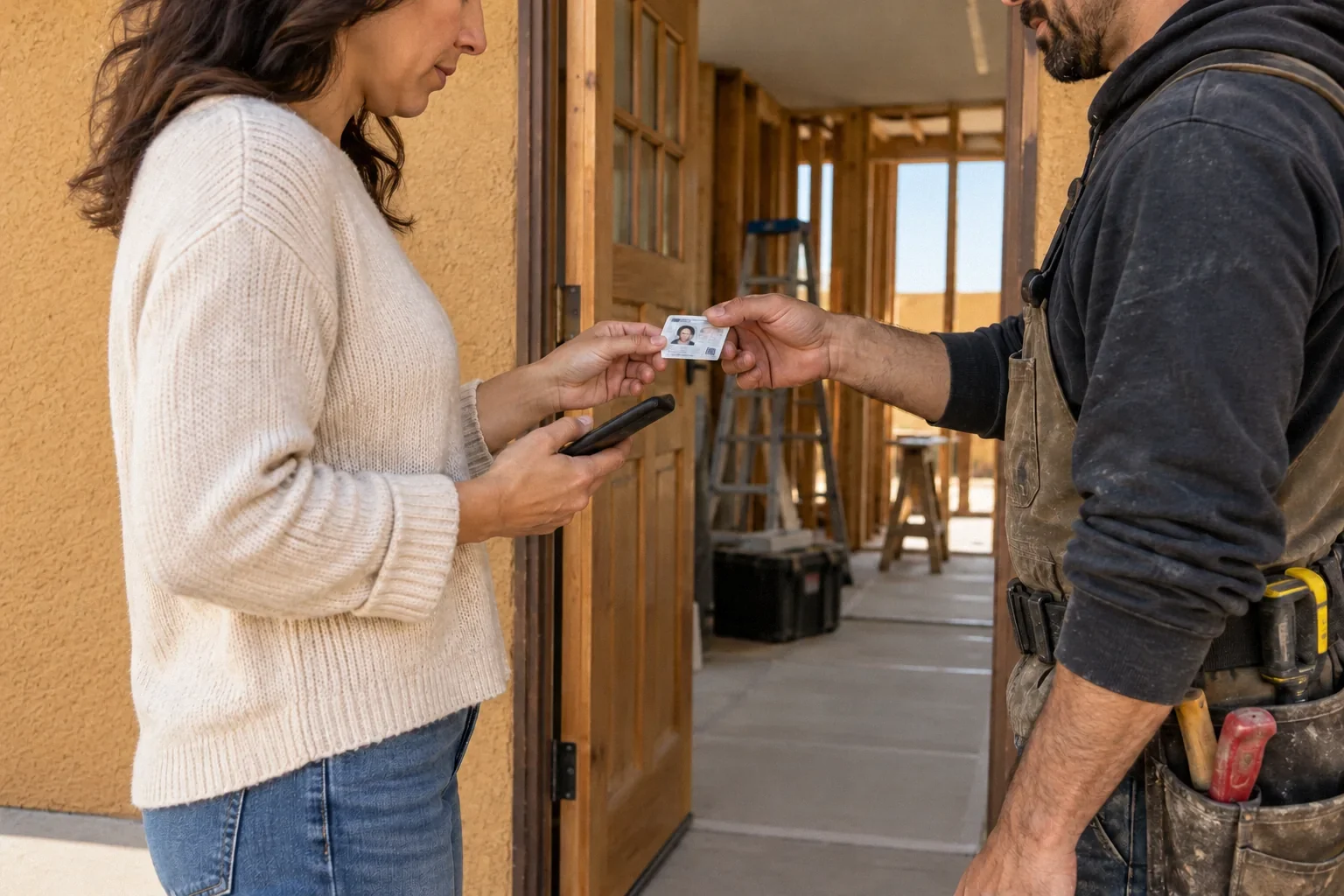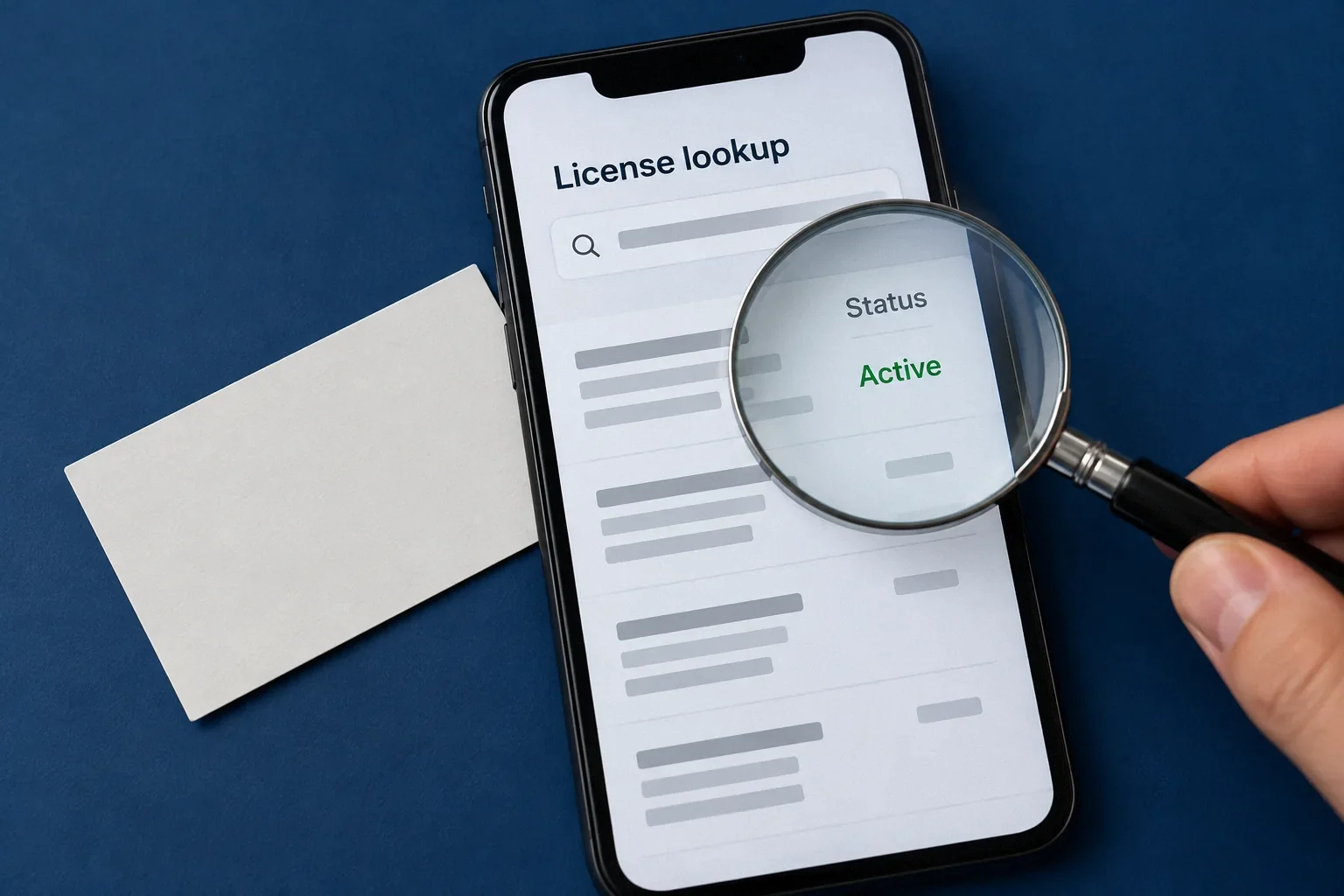
Short answer: look up the license number on CSLB's Check a License page. Confirm that the business name and address match the contract, that the status is active, and that the classifications fit your job. Read the bond and workers' compensation information, and any disciplinary or legal actions shown. If a salesperson sold you the job, check their Home Improvement Salesperson (HIS) registration too. CSLB requires that a company's contracts, advertising and business cards use the business name exactly as it is listed with CSLB (CSLB public information FAQ). A mismatch is a reason to ask questions before signing. A clean lookup is necessary, but it is not a quality rating.
This is general information current to 3 October 2026, not legal advice.
Why a quick lookup matters
A San Mateo County owner, looking back at earlier bathroom work, wrote that the contractors 'said they were licensed but maybe they weren't'. A Los Angeles owner described a contract that listed a company name with a license number belonging to the owner's personal license, marked workers' comp exempt, while a crew worked on site. These are anecdotal accounts. Both mismatches could have been spotted on the lookup page in minutes.
Step-by-step walkthrough
- Get the number in writing. A home improvement contract must show the contractor's name, business address and license number (BPC § 7159). Ask for it on the bid too.
- Search by number, then also search by business name, to see whether the business has other or older licenses.
- Match the identity. Is the business name on the record the same as on the contract and the truck? Is the business type (sole owner, partnership, corporation, LLC) consistent with who is signing?
- Check the status. Active, or expired, suspended or revoked? A license can be suspended for reasons such as failing to maintain workers' compensation. CSLB says work performed during a suspension is considered unlicensed (CSLB).
- Check the classifications. Does at least one match your scope? See license classifications explained.
- Read the bond section. Note the surety and bond history. A license requires a $25,000 bond or approved alternative security (CSLB). Which bond applies to a claim is not automatically the one in effect when you signed. The timing of the work and the alleged violation, the bond's period and the surety's claim conditions all matter. If a claim arises, ask CSLB or the surety which bond covers your situation, and keep the bond history showing coverage over the project period.
- Read the workers' compensation section. Policy or exemption? Compare it with who will actually do the work. See contractor insurance.
- Look for disciplinary or legal actions disclosed on the record, and read what they concern.
- Check the salesperson. If someone other than an owner or officer sold you the contract, check their HIS registration. The contract must show their name and registration number (§ 7159). Not every person who talks to you must be registered. BPC § 7152 excludes, among others, officers of record of a licensed corporation, LLC managers, members or officers of record, listed general partners, qualifying individuals, appointment schedulers and certain retail and service staff.
- Save a screenshot or PDF of the lookup with the date, and keep it with your contract.
- Recheck during the project. A license that was active at signing can be suspended later, for example over workers' compensation. Look again before major payments and before final payment.
Five mismatch scenarios and what to do
| What you see | Possible innocent explanation | Possible problem | What to ask or do |
|---|---|---|---|
| Contract shows 'ABC Remodeling Inc.' but the number belongs to an individual's sole-owner license | The owner recently incorporated and the corporate license is pending | The contracting entity is not the licensed entity | Ask which entity is contracting and its license number; do not sign until they match |
| Status: expired or suspended | A renewal is being processed | Work during suspension is treated as unlicensed | Wait until the record shows active before signing or paying |
| Classification: C-54 tile, but the bid covers a full bathroom with plumbing and electrical | The company holds other classifications not yet shown, or the bid was meant to cover tile only | Contractor is bidding outside its classifications. Naming subcontractors does not by itself cure this | Ask which classifications cover each part of the scope; consider a B or B-2 contractor for the whole job, or separate contracts with each properly licensed specialty |
| Workers' comp: exempt, but a crew of four arrives | The crew are licensed subcontractors with their own coverage | Unreported employees | Ask who employs them; check the subs' licenses |
| Disciplinary actions listed | An old, resolved citation | A pattern relevant to your project, such as abandonment or payment violations | Read the details; ask the contractor to explain; weigh against references |
What the lookup does not tell you
- Quality and communication. Check references and recent, similar projects.
- CGL insurance. The contract must disclose it, and you can verify with the insurer. It is not a license requirement for most contractors.
- Who will actually be on site. Ask, and get subcontractor details where the contract indicates subs will be used.
- Whether a permit has been pulled. Check your building department's online permit records.
- Every complaint ever filed. Public disclosure of complaints and actions follows CSLB's rules. A clean record is good news, not a guarantee.
A worked example: a three-minute check
Hypothetical. A bid arrives for a kitchen remodel from 'Bayview Kitchens'. The license number on the bid returns a record for 'Bayview Kitchens and Baths, Inc.', status active, classification B, bond on file, workers' comp policy listed, no disclosed actions. The salesperson who visited is not an officer, so the owner checks her HIS registration and finds it active. The owner saves PDFs of both lookups. The only follow-up: ask the company to put its full legal name on the contract exactly as listed with CSLB. Three minutes, one clarification, and the file is ready.
Red flags at a glance
- No license number offered, or reluctance to give it
- A number that returns a different name, or an inactive status
- Classifications that don't fit the work. Work outside a contractor's permitted scope is not cured merely by naming subcontractors
- Pressure to sign before you have time to check
- A suggestion that you pull the permit as owner-builder 'to save time'. See owner-builder risks
Bay Area applicability
The license check is statewide. Locally, cross-check the contractor's name and license number on any permit your building department issues for your project. Many departments offer online permit lookups, though coverage and completeness vary. If the record isn't online or looks incomplete, ask the department. The contractor of record on the permit should match your contract.
Current to 3 October 2026.
Questions that come up next
How do I check if a contractor is licensed in California?
Search the license number on CSLB's Check a License page, then confirm the name and address match the contract, the status is active, the classifications fit your job, and the bond and workers' compensation information is in order.
What if the business name doesn't match the license?
CSLB requires contracts and advertising to use the business name exactly as listed. Ask which entity is contracting and get its license number; do not sign until they match.
Do salespeople need their own registration?
A person who sells home improvement contracts for a licensed contractor generally needs a Home Improvement Salesperson registration, with exceptions in BPC § 7152, for example corporate officers of record, LLC managers, members or officers of record, and appointment schedulers.
Does a clean license record mean the contractor is good?
No. It confirms licensing basics. Check references, recent similar work, insurance disclosures and the contract itself.
Sources and further reading
Community questions behind this guide
These discussions identify homeowner concerns. Forum comments are personal accounts, not code or legal authority.