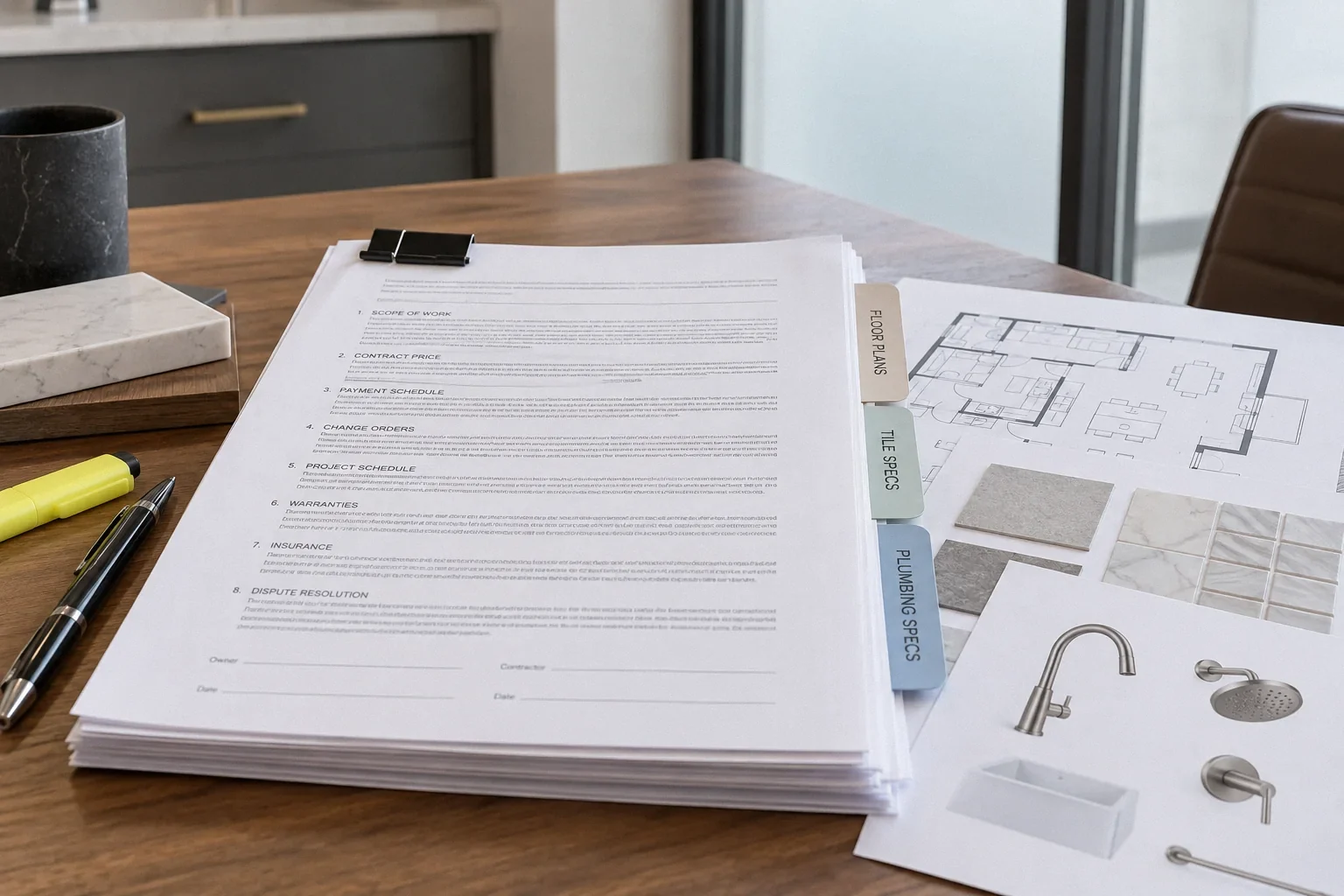
Short answer: in California, a home improvement contract with an aggregate price over $500 must be in writing. Under Business and Professions Code § 7159 it must include, at a minimum: the contractor's name, business address and license number; the contract price; a description of the work that names significant materials and equipment; approximate start and completion dates and what counts as substantial commencement; a payment schedule tied to work and materials; and several required notices about down payments, change orders, mechanics liens and cancellation. A contract missing these items is a warning sign, whatever the bid price.
This article goes through a typical remodel contract section by section. For the payment rules in detail, see our guide to contractor down payment limits. This is general information current to 3 October 2026, not legal advice.
How thin contracts turn into disputes
Several of the homeowner disputes we reviewed began with a contract that did not say enough. One owner who had signed for a full gut kitchen remodel found afterwards that items they had asked for were missing from the itemized list, and was offered either an amendment or a change order. Another, planning a second-floor bathroom after a leak, asked what guarantees a contract should contain that the new shower would not leak. A thread on California ADU contracts described a contract with no change order, preliminary lien or right-to-cancel language. These are anecdotal accounts, but they show the same gap: the paperwork did not record what each side expected.
CSLB's consumer guide Terms of Agreement calls the contract the most important communication tool between you and your contractor, and advises: describe everything.
The checklist: what § 7159 requires
| Contract element | What to check | Why it matters |
|---|---|---|
| Contractor identity | Name, business address and license number. If a salesperson sold the job, their name and Home Improvement Salesperson (HIS) registration number | Lets you confirm the license on the CSLB lookup. CSLB says a salesperson cannot legally sign for the contractor without a valid HIS registration. Not everyone who talks to you about the job needs one. § 7152 excludes, among others, corporate officers of record, LLC managers, members or officers of record, general partners listed on the license, qualifying individuals, appointment schedulers, certain fixed-location retail salespeople, and service repairpersons limited to the requested repair |
| Heading and copy notice | The words 'Home Improvement' as a heading, and a notice that you are entitled to a completely filled-in copy | Statutory formatting signals that the contract was written for California home improvement work |
| Contract price | Price in dollars and cents; any finance charge stated separately | The price can then change only through a written change order |
| Description of work | Scope, plus significant materials and equipment to be installed | Vague scope can lead to disputed extra charges |
| Schedule | Approximate start date, approximate completion date, and what constitutes substantial commencement | Gives you a basis to raise delays and abandonment |
| Payment terms | Down payment within the legal cap; a schedule linking each payment to specific work or delivered materials | Keeps your money from running ahead of the work |
| Change order notice | Statement that extra work and change orders become part of the contract once written and signed before the changed work begins | Gives you a written mechanism for any price change |
| Mechanics lien warning | The statutory notice explaining that unpaid subcontractors and suppliers may have lien rights | See our lien release guide |
| Cancellation notice | Notice of the right to cancel, where it applies (three business days, five for seniors, seven for certain disaster repairs), and a cancellation form | Covered contracts must explain how to cancel. See cancelling a contract |
| Commercial general liability insurance notice | One of the statutory statements in § 7159(e)(1): the contractor does not carry CGL insurance; carries it, written by a named insurer; is self-insured; or is an LLC that carries liability insurance or maintains other security as required by law | The notice tells you whether the contractor carries it, not that every contractor must. CSLB's CGL information sheet says this insurance is not required for all contractors, though CSLB strongly recommends it. It can protect against third-party bodily injury and accidental property damage, and is not intended to cover the contractor's own work. If an insurer is named, you can call it to confirm coverage. LLC licensees have separate statutory insurance or security rules, which is why they have their own option |
| Workers' compensation notice | One of the statements in § 7159(e)(2): the contractor has no employees and is exempt, or carries workers' compensation insurance for all employees | Compare the statement with the contractor's record on the CSLB lookup and with who actually shows up to work. A contractor declaring no employees but arriving with a crew is a question to raise before signing. See contractor insurance in California |
| Subcontractor disclosure | Whether subcontractors will be used. If the contract indicates they will, § 7159(c)(7)(B) requires a statement that a list of subcontractors, with names, contact information, license numbers and classifications, must be provided on request | Lets you know who may send you preliminary notices and whose licenses to check. Ask for the list before work starts |
| Lien release statement | A statement that, once satisfactory payment is made for a portion of the work, the contractor will provide a full and unconditional release for that portion before any further payment (§ 7159(c)(7)(A)) | Supports your lien-release routine at each payment |
The two insurance notices may be placed in an attachment, as long as the contract itself states that a notice concerning commercial general liability insurance, or workers' compensation insurance, is attached. If the contract has no such statement and no notice appears anywhere, ask for it. The statute also sets type sizes for notices and headings. Most homeowners do not need to measure fonts. What matters is noticing when required notices are missing altogether.
Items the law does not spell out, but you should
A contract can meet § 7159 and still leave a lot unsaid. CSLB's guidance adds several items worth writing in.
Who pulls the permit
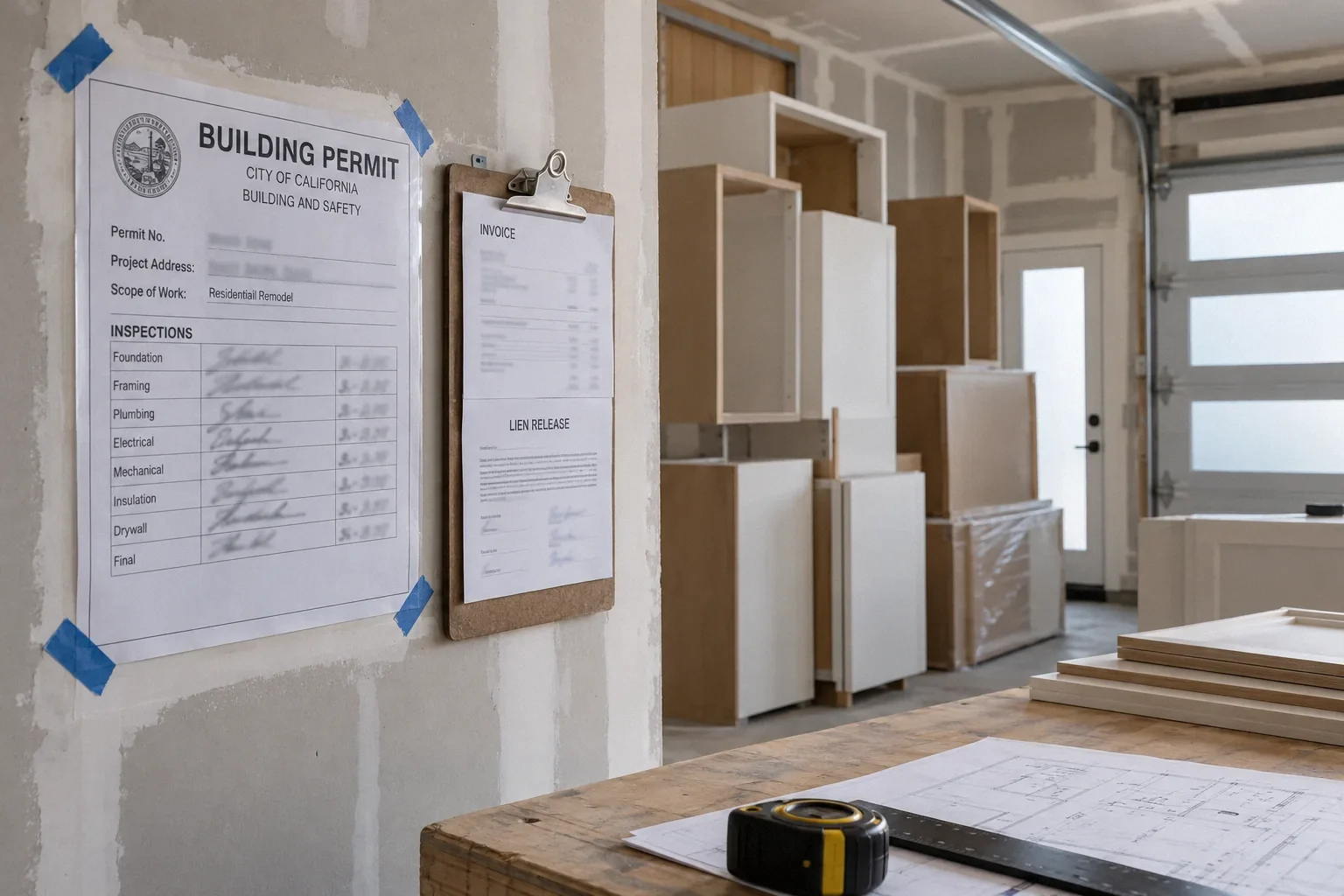
CSLB's contract guidance says the contract should state who obtains building permits, and its homeowner checklist asks whether permit fees are included in the price. This matters in the Bay Area because permit scope can bring in extra work. In Pleasanton, for example, the city's kitchen alteration handout says that when a remodeling permit is issued, existing non-compliant plumbing fixtures throughout the home must be upgraded to current water-efficient standards. A contract that is silent on this can lead to an argument about who pays. Your own city's rules may differ, so ask the contractor to name the permit-driven items they have priced.
Materials described precisely
CSLB's guide contrasts 'install kitchen cabinets' with a description that gives manufacturer, model, style and color, hinges and hardware, quantities, and a reference to the plan dimensions. Apply the same approach to tile (product, size, finish, layout pattern), plumbing fixtures (brand and model), and flooring (product line, underlayment, transitions).
| Vague | Specific enough to enforce |
|---|---|
| Retile shower | Remove existing tile and substrate to studs; install named waterproofing system per manufacturer instructions; flood test before tile; specified tile, size and layout; specified grout and sealant at changes of plane |
| New vanity | Named model, width and finish; faucet model; reconnect to existing supply and drain; patch and paint wall behind |
| LVP flooring | Named product line; subfloor flatness checked against the manufacturer's tolerance and corrected; expansion gap per instructions; transitions specified |
Allowances and unknown conditions
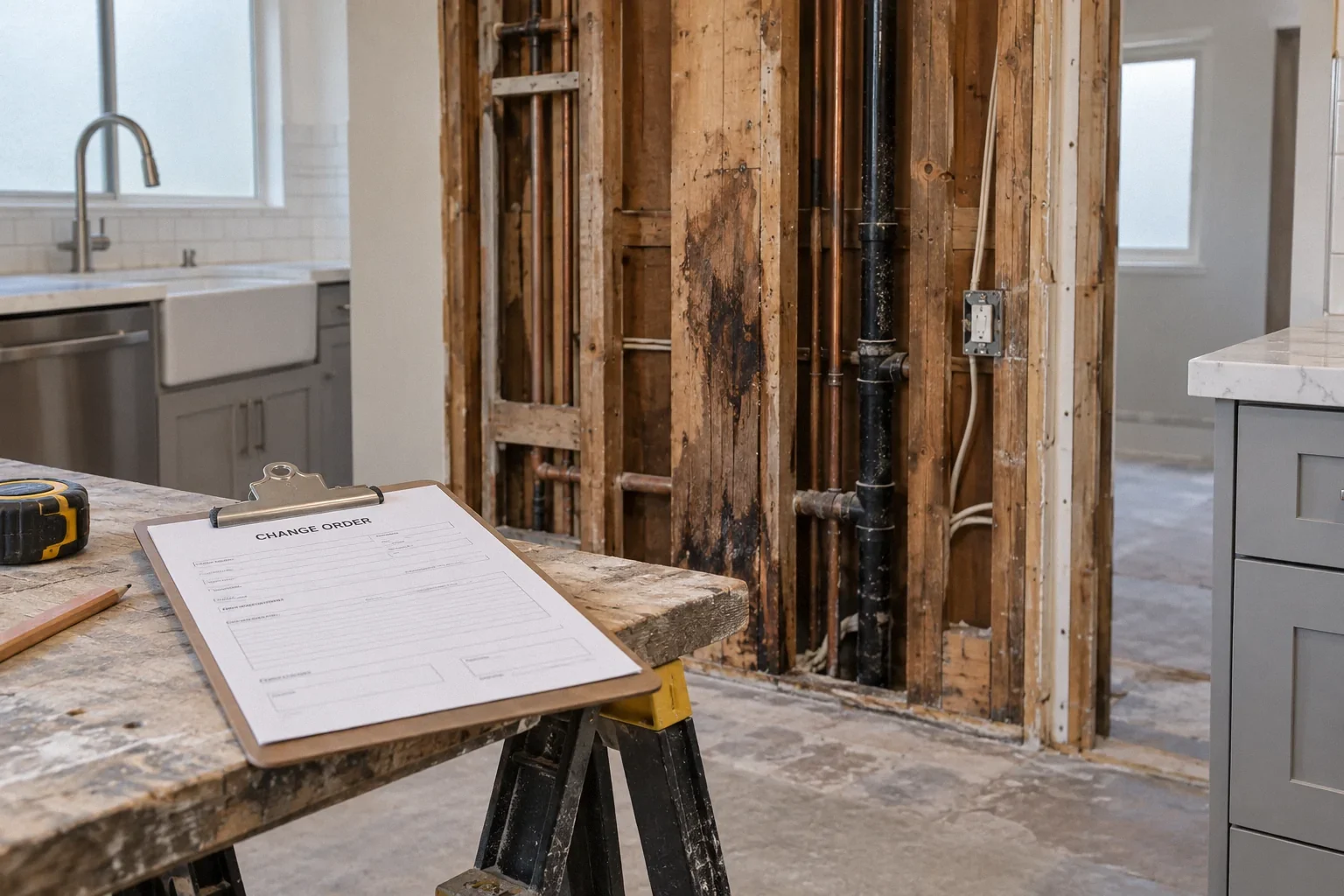
If items are not yet selected, the contract should state an allowance figure and how overages or credits are handled. It is also worth stating how concealed conditions found during demolition will be priced and approved, because hidden conditions came up repeatedly as a source of disputed change orders in the homeowner discussions we reviewed. See our change order guide.
Warranties and testing
CSLB advises getting any labor or materials warranty in writing, specifying what is covered and for how long, and collecting the manufacturers' written warranties for installed products. For wet areas, the bathroom owner's question above about leak guarantees is best handled by writing the test into the scope, for example a flood test of the shower pan before tile, and saying what happens if it fails.
Cleanup, protection and site rules
CSLB suggests including complete cleanup and debris removal, and any special requests such as keeping certain materials. Also consider dust protection for occupied rooms, working hours, where materials will be stored, and which bathroom workers may use.
Common mistakes when reviewing a contract
- Relying on the proposal instead of the contract. Emails and conversations before signing may not count if the signed contract says otherwise. Put promises into the contract itself. CSLB says that if something is promised verbally, you should make sure it is included in writing.
- Signing with blanks. CSLB warns never to sign a blank or partially completed contract.
- Accepting 'per plans' with no plans attached. If the scope points to drawings, attach them or identify them by date and revision.
- Ignoring the payment schedule. A schedule that is just percentages and dates does not do what the statute expects, which is to link each payment to work or delivered materials.
- Not checking the license against the contract. The license number on the contract should match the business name, and the classification should cover the work. See how to verify a contractor's license.
Bay Area applicability
Section 7159 is state law and applies the same way in every Bay Area city and county. Local practice shows up in the parts the statute leaves open: whether a project goes through over-the-counter or full plan review, which inspections it needs, and which upgrades a permit triggers. Pleasanton's handout, for instance, separates like-for-like remodels (application only) from layout changes and wall removal (plans required, with structural calculations for load-bearing walls). Other departments draw these lines differently. When you compare bids, check that each contractor has priced the same permit path, or the cheapest bid may simply have left it out. Our guide to comparing remodel bids covers this in more detail.
One-page pre-signing checklist
- Contractor name, address and license number match CSLB records; salesperson's HIS number if applicable
- Price stated; finance charges separate
- Scope names significant materials and equipment by brand and model where possible
- Drawings or plans attached or identified
- Approximate start and completion dates, and the definition of substantial commencement
- Down payment within the statutory limit; each progress payment tied to specific work or delivered materials
- Change order notice present; you know who approves changes and how
- Mechanics lien warning and lien release statement present; you plan to request lien releases with payments
- Commercial general liability and workers' compensation notices present in the contract or a referenced attachment; insurer name checked if one is given
- Subcontractor use indicated; if subcontractors will be used, the contract says the list (names, contact information, license numbers, classifications) is available on request, and you have asked for it
- Right-to-cancel notice and form present where the right applies
- Permit responsibility and permit fees stated
- Allowances, unknown-condition handling and any testing (such as a shower flood test) written in
- Warranty terms in writing
- Cleanup, protection and site rules written in
- No blank spaces; you have a fully completed copy
Current to 3 October 2026. Section 7159 as amended by SB 517 (Stats. 2025, ch. 585), effective 1 January 2026. Check the linked text for later changes.
Questions that come up next
Does a small job need a written contract in California?
If the aggregate contract price for the home improvement exceeds $500, § 7159 requirements apply and the contract must be in writing with the statutory content. Certain service and repair contracts follow separate rules under §§ 7159.10–7159.14.
Is a contractor's emailed proposal the same as a contract?
Not necessarily. What counts is the signed agreement and its required content. If a proposal includes details you rely on, make sure they appear in, or are attached to, the signed contract.
What if my contract is missing required notices?
Missing notices are a red flag about how the contractor operates. Ask for a compliant contract before work starts. If work is under way, keep records and consider asking CSLB or a California attorney how the omission affects your situation.
Should the contract say who gets the permit?
Yes. CSLB recommends stating who obtains the building permits and whether permit fees are included. Permit scope can also trigger required upgrades that should be priced in advance.
Sources and further reading
- California Business and Professions Code § 7159
- CSLB: Terms of Agreement, A Consumer Guide to Home Improvement Contracts
- CSLB: What Should I Look For in Contracts and Binding Agreements?
- CSLB: Check a License or HIS Registration
- California Business and Professions Code § 7152 (home improvement salesperson; exclusions)
- CSLB: Information About Commercial General Liability Insurance, Home Improvement
- City of Pleasanton: Residential Kitchen Alteration Requirements (JLA 01.26)
Community questions behind this guide
These discussions identify homeowner concerns. Forum comments are personal accounts, not code or legal authority.