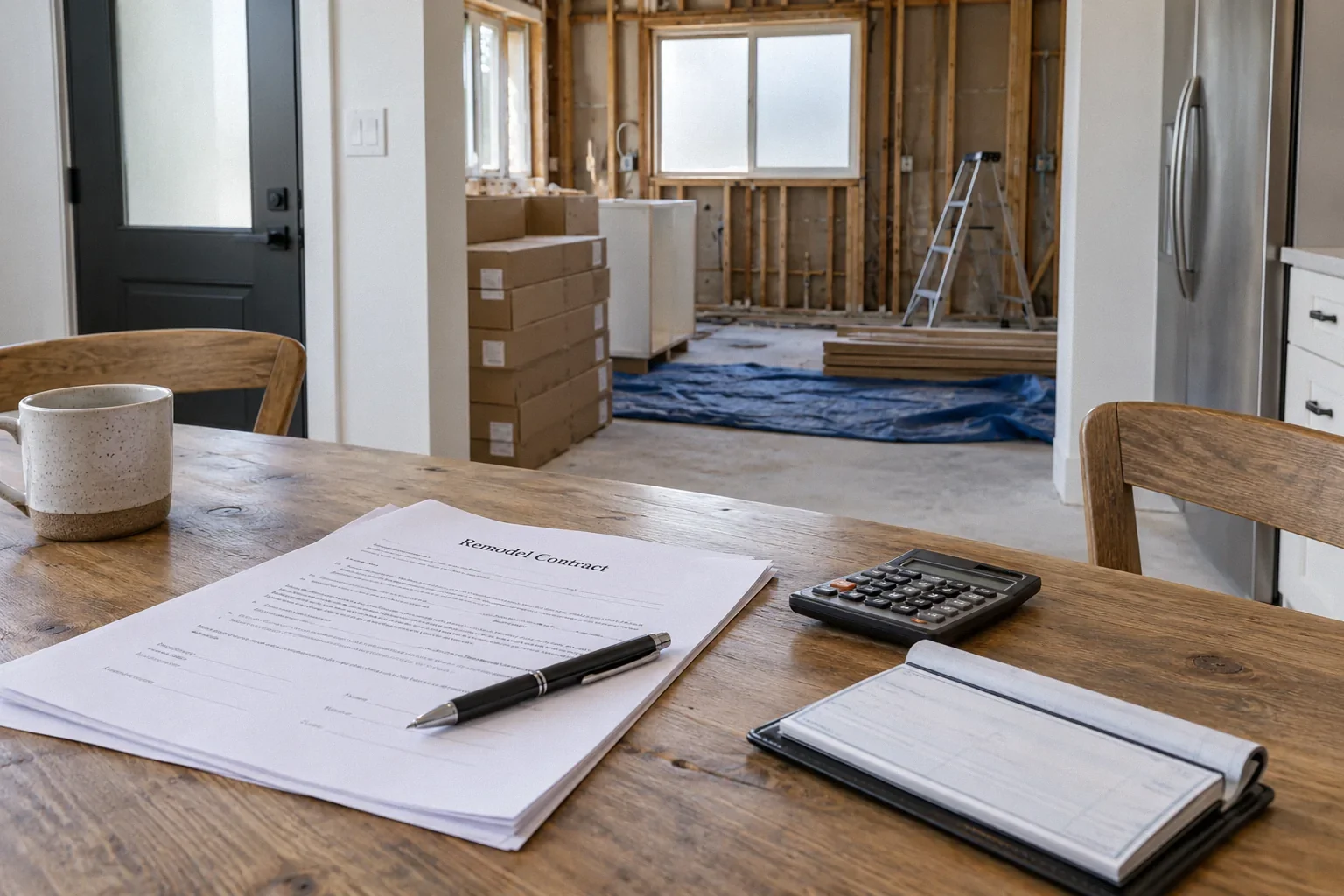
Short answer: build the schedule around work you can verify, such as a passed rough inspection, delivered cabinets or installed countertops. Monthly payment applications and percentage-of-completion billing are fine, as long as each payment reflects work actually completed or materials actually delivered. What the law prohibits is payment in advance of earned work, not percentages or calendars as such. California law caps the down payment at $1,000 or 10% of the price, whichever is less, and bars payments that exceed the value of work performed or materials delivered (BPC § 7159.5). It also requires the schedule to state what each payment covers (§ 7159). At each payment, collect a short paperwork package: an itemized invoice, photos, the inspection record where relevant, and a conditional lien release.
Our separate guide covers the down payment cap itself. This article covers what comes after it. It is general information current to 3 October 2026, not legal advice.
Why schedules go wrong
The schedules homeowners describe online are often front-loaded. One owner of a roughly $50,000 remodel was offered a $1,000 deposit followed by 45% at the start. Another had signed 50% at signing and 50% at completion, then faced a request for an extra draw. In the same thread, a commenter described a schedule they considered better: 25% upfront, 25% at rough-in, 25% at tile and cabinets, 25% at punch-list completion. It is a useful illustration, but note that a 25% upfront payment on a California home improvement contract would itself exceed the down payment cap. Reddit advice is not tailored to California rules. In a dispute shared in a contractor forum, an owner said the GC demanded a full phase payment for electrical and plumbing that was only half done before continuing work.
Contractors describe the lawful version too. One wrote that they take a 'scheduling' down payment under the CSLB rule and a progress payment once demolition is complete, and noted that contractors are not supposed to be significantly ahead of progress or to charge for materials before they are delivered on site.
Principles of a lawful, workable schedule
- Small deposit. No more than $1,000 or 10%, whichever is less. CSLB's consumer guide Terms of Agreement says there are no exceptions for special-order materials. The only exception it describes is for contractors with a blanket performance and payment bond.
- Every payment names its work. The guide says the schedule should show the amount of each payment and the work, materials or services it covers.
- Milestones are observable. If you cannot see it, inspect it or hold an invoice for it, it is a weak milestone.
- Materials are paid on delivery. A commenter in a Bay Area thread about paying contractors recommended paying for materials when they are delivered to your home, with the receipt. That matches the statutory language about materials delivered.
- Each payment comes with a conditional lien release. More on this below.
Example milestone structures
These are structural templates, not price recommendations. The amount at each milestone should reflect the value of the work completed at that point, which the contractor should be able to show in an itemized breakdown.
Kitchen remodel (no structural changes)
| Milestone | Evidence to collect |
|---|---|
| Down payment at signing | Signed contract; amount within statutory cap |
| Demolition complete and debris removed | Photos; invoice line items |
| Rough plumbing, electrical and ventilation passed | Inspection record or signed permit card |
| Insulation and drywall complete (and inspected where your jurisdiction requires) | Inspection record if applicable; photos |
| Cabinets delivered to site | Delivery receipt; damage check |
| Cabinets installed; countertops templated and installed | Photos; fabricator invoice if separate |
| Backsplash, fixtures and appliances installed | Photos; appliance model list |
| Final inspection passed and punch list complete | Final sign-off; conditional final releases with the final payment, then unconditional final releases once it has cleared |
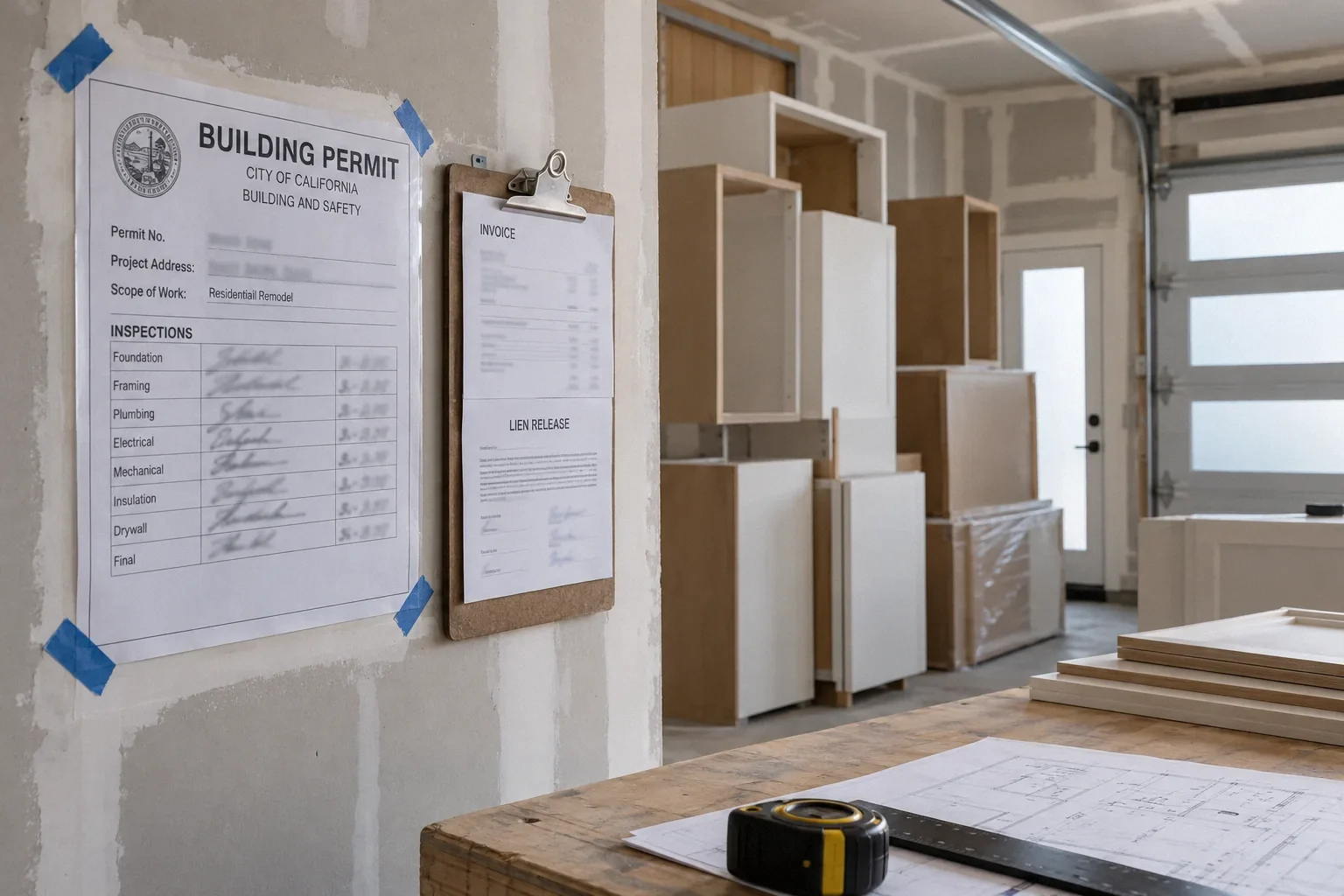
Inspection names and sequences vary by city. Pleasanton's kitchen alteration handout, for example, lists rough frame, insulation, drywall (only where a fire-rated assembly is altered) and final inspections. Use the sequence on your own permit card.
Bathroom remodel
| Milestone | Evidence to collect |
|---|---|
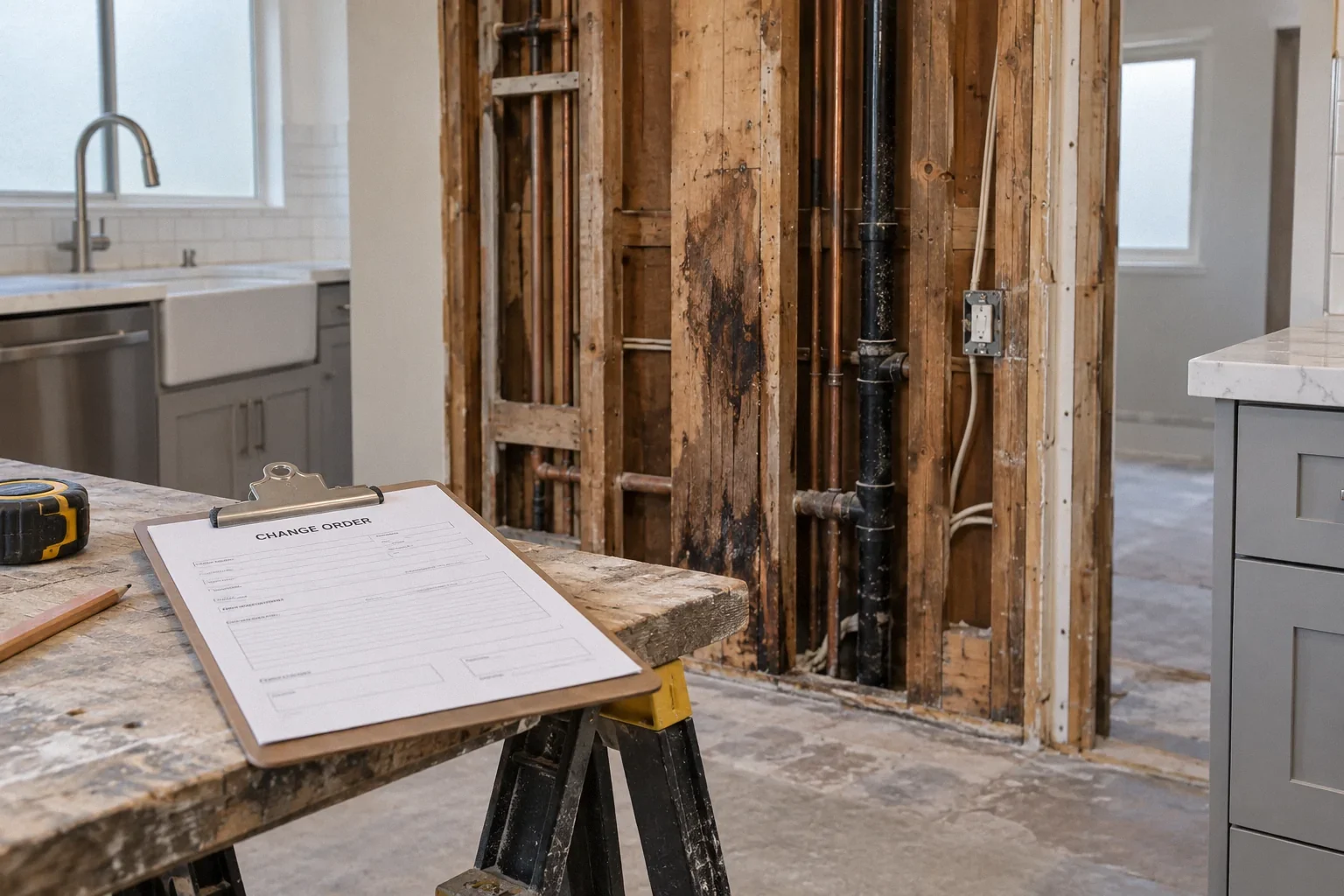
| Demolition to studs complete | Photos of exposed framing and subfloor; any hidden condition handled by written change order |
| Rough plumbing and electrical passed | Inspection record |
| Shower waterproofing installed and flood-tested | Photos; test result; inspection where required locally |
| Tile set and grouted | Photos |
| Fixtures, vanity, glass installed | Model list; photos |
| Final inspection and punch list | Sign-off; conditional final releases with payment, unconditional after it clears |
A waterproofing milestone is especially useful. It forces a check at the stage that is hardest to verify once tile goes on. See shower pan flood tests.
Larger remodels and additions
Add milestones for foundation, framing, roofing and dry-in, and window installation. Each corresponds to a recognizable inspection or visible stage. For long projects, a monthly payment application is common. It still needs to be backed by an itemized percentage-complete breakdown, so that every payment matches work actually done.
The paperwork package for each payment
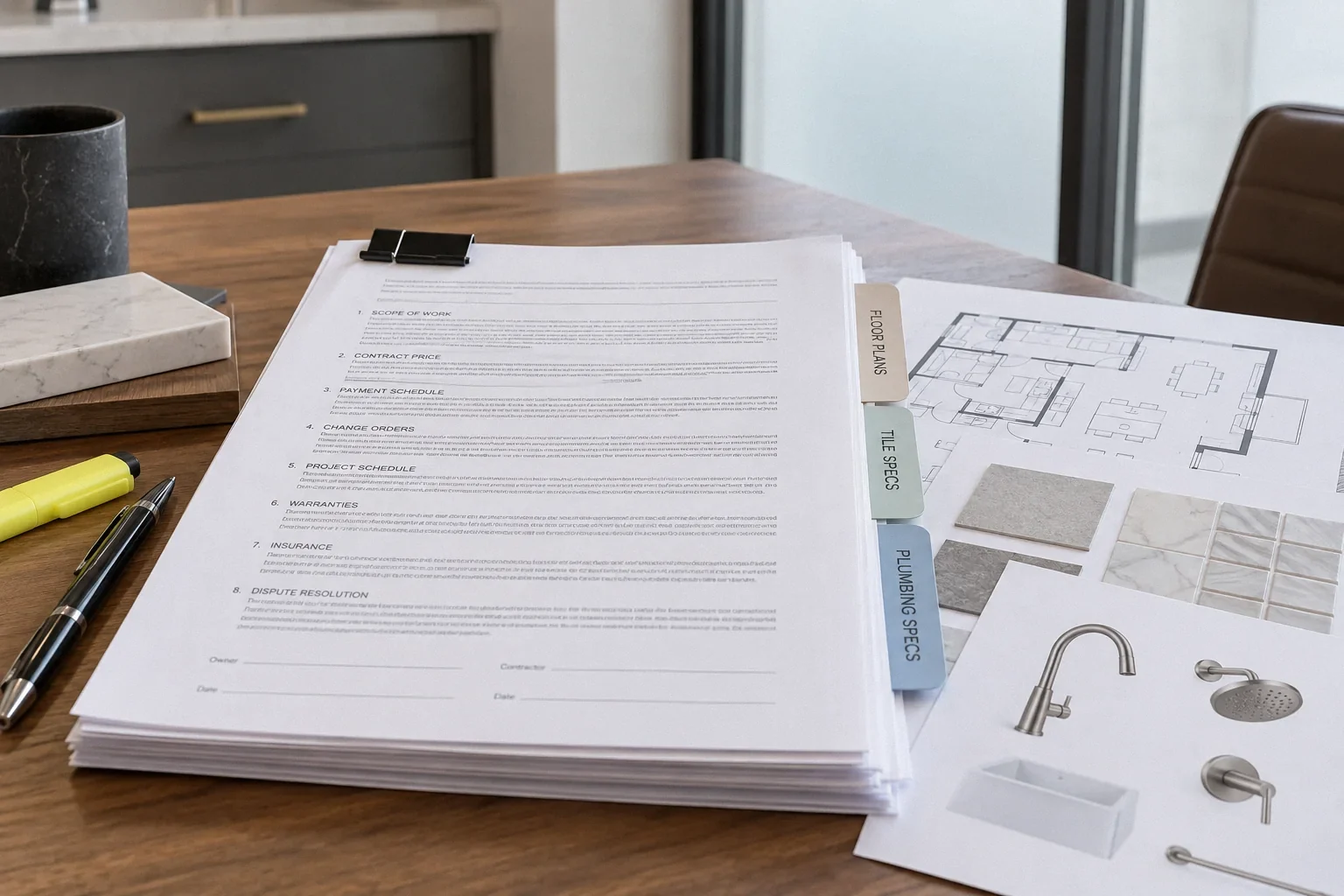
- Itemized invoice that ties to the contract schedule and lists any approved change orders separately.
- Photos of the completed milestone, dated.
- Inspection record where the milestone is an inspection.
- Conditional waiver and release from the contractor, and from subcontractors and suppliers where you have received preliminary notices.
- Unconditional release for the previous payment once that payment has cleared.
Conditional vs. unconditional releases
California uses statutory release forms. The conditional progress-payment form in Civil Code § 8132 takes effect only when the claimant actually receives payment from the bank on which the check is drawn. The unconditional form in § 8134 warns the signer that it is enforceable even if you have not been paid, and tells them to use a conditional form if they have not been paid. In practice: collect a conditional release with each payment, then an unconditional release after the funds clear. Check the through date and any listed exceptions, because a release covers only what the form states. The contract must say the contractor will provide an unconditional release for each paid portion before further payment (§ 7159(c)(7)(A)), and CSLB explains you may withhold the next payment until you receive unconditional releases for the previous one. That is a right to releases for amounts already paid, not a general right to withhold any payment until every release you would like is in hand. Agree in the contract any further release requirements, such as subcontractor releases or joint checks. Our mechanics lien guide explains why subcontractor and supplier releases matter even when you pay the contractor in full.
When the contractor asks for the next draw early
- Ask for an itemized statement of work completed and materials delivered to date, valued against the contract.
- Compare it with what you can see. Visit the site, take photos and check inspection records.
- Pay what is earned, if anything. If part of the next milestone is genuinely complete and the contract allows partial payments, paying for that portion with releases is consistent with the law. Paying for unfinished work is not.
- Respond in writing, briefly and factually. A cash-flow problem may be real, but under the statute it is not a reason for you to pay ahead.
- Watch for signs of abandonment, such as long gaps in attendance or unreturned calls. See when a contractor abandons a job.
Retention and the final payment
Some owners negotiate a final payment large enough to cover the punch list and payable after final inspection. That is a term you negotiate and write into the contract, not an automatic statutory right. Separately, recording a notice of completion after the work is complete shortens lien deadlines. Under Civil Code § 8412, a direct contractor must record a lien before the earlier of 90 days after completion or 60 days after the owner records a notice of completion. Under § 8414, other claimants have 90 days after completion or 30 days after the notice. Notices of completion have their own formal requirements, so ask the county recorder or an attorney before relying on one. See withholding final payment for the limits on holding money back.
Bay Area applicability
The payment rules are statewide and identical across the Bay Area. Local differences affect how you write milestones: inspection names and sequences, whether a fire-rated drywall inspection applies, and how long plan review takes before work can start. Write milestones using your own department's inspection terms, and make sure the first progress payment cannot fall due before the permit is issued if permit work is part of the job.
Mistakes to avoid
- Percentages tied to dates rather than work
- Paying for special-order items before delivery
- Accepting unconditional releases before money has cleared, or collecting no releases at all
- Mixing change order payments into milestone payments without itemizing them
- Paying in cash, which CSLB's senior guidance lists among warning signs
Current to 3 October 2026.
Questions that come up next
What is a reasonable payment schedule for a kitchen remodel in California?
A deposit within the $1,000 or 10% cap, then payments tied to verifiable milestones such as demolition complete, rough inspections passed, cabinets delivered and installed, and final inspection. Each payment should match the value of completed work or delivered materials.
Should I get a lien release with every payment?
Collect a conditional release with each payment and an unconditional release after payment clears. Check the through date and exceptions. CSLB explains that you may withhold the next payment until unconditional releases for the previous payment are provided.
Can a contractor charge for cabinets when they are ordered?
The statute ties payment to materials delivered, and CSLB says there is no down payment exception for special-order materials. Payment for cabinets normally becomes due when they are delivered to the site.
Is 25% upfront legal on a California remodel?
Not as a down payment on an ordinary home improvement contract. The down payment is capped at $1,000 or 10% of the price, whichever is less, unless the contractor has a qualifying blanket performance and payment bond.
Sources and further reading
- California Business and Professions Code § 7159.5
- California Business and Professions Code § 7159
- California Civil Code § 8132 (conditional waiver on progress payment)
- California Civil Code § 8134 (unconditional waiver on progress payment)
- California Civil Code § 8412
- California Civil Code § 8414
- CSLB: Terms of Agreement
- CSLB: How to Prevent a Mechanics Lien
- CSLB: What Seniors Should Know
- City of Pleasanton: Residential Kitchen Alteration Requirements (JLA 01.26)
Community questions behind this guide
These discussions identify homeowner concerns. Forum comments are personal accounts, not code or legal authority.