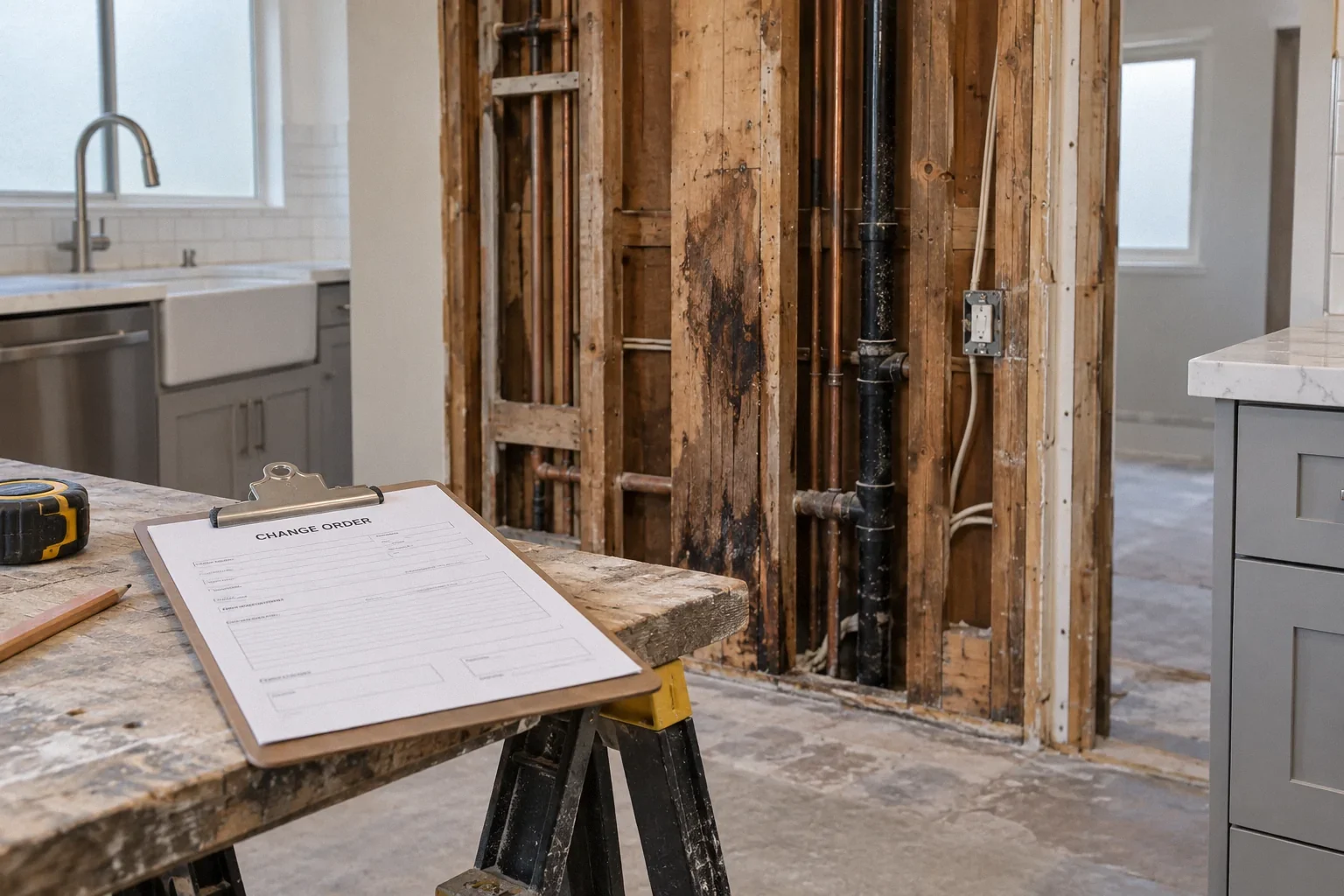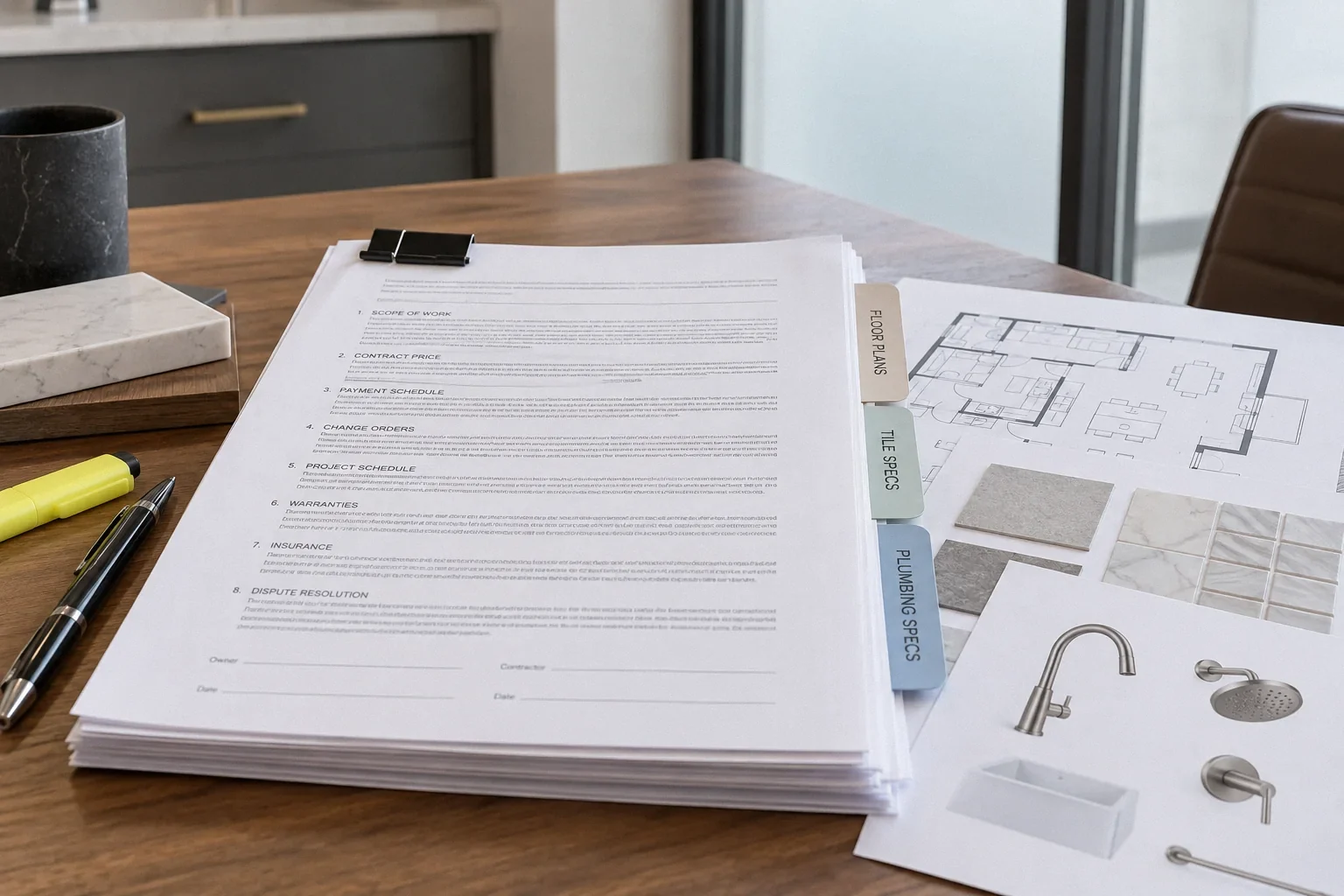
Short answer: a fixed-price (lump-sum) contract puts the risk of underestimating on the contractor and gives you a predictable number. It works best when the scope is fully defined. A time-and-materials (T&M) or cost-plus arrangement puts more risk on you but can be fairer when the scope is uncertain, for example after opening walls in an older house. In California, any home improvement contract over $500 must still state the contract price and a payment schedule tied to work, and payments may not exceed the value of work done or materials delivered (BPC § 7159, § 7159.5). Open-ended T&M can sit awkwardly with those rules, so a common middle path is a fixed price for defined work, plus clearly stated allowances and agreed unit prices or T&M rates for unknowns, with a not-to-exceed figure. Have a California attorney review any non-standard structure.
This is general information current to 3 October 2026, not legal advice.
How the choice shows up in disputes
An owner on a fixed-price renovation described about $9,000 of extras added late in the job, including lumber price increases reported after the fact. Commenters asked whether the contract had a cost escalation clause. It did not. Before a $300,000 remodel, another owner asked how to be sure change orders would be fairly priced. One reply argued that T&M is the 'best deal' for both parties if you trust the contractor, while a lump-sum change order puts risk on the contractor and so tends to cost more. These are opinions in a discussion, not data. They frame the trade-off well.
The structures compared
| Structure | How price is set | Who carries estimating risk | Best for | Watch for |
|---|---|---|---|---|
| Fixed price (lump sum) | One stated price for defined scope | Mostly contractor | Well-defined scope, finished plans, selections made | Gaps in scope become change orders; contractor may price in a cushion |
| Fixed price with allowances | Stated price; selected items carried at allowance figures | Shared: overages and credits on allowance items | Projects where some finishes are not yet chosen | Unrealistically low allowances that guarantee overages |
| Unit prices for defined unknowns | Agreed rate per unit (per linear foot of framing, per outlet) | Shared, quantity-driven | Likely hidden conditions in older homes | Quantities must be documented with photos |
| Time and materials (with not-to-exceed) | Labor hours at stated rates plus materials and a stated markup, capped | Mostly owner, up to the cap | Exploratory work, repairs of unknown extent | Needs daily logs, receipts and trust; the cap needs a change order to exceed |
| Cost-plus | Actual costs plus a fee or percentage | Mostly owner | Complex custom work with a trusted builder | Open books, audit rights, an estimate and a cap |
How California's contract rules interact with each structure
- Price. Section 7159 requires the contract price in dollars and cents. CSLB's guide Terms of Agreement says the job must be completed for the agreed price, and any price change must be made through a written change order. With T&M components, a not-to-exceed figure and stated rates make the price more definite and auditable. They do not, by themselves, guarantee that a contract meets every § 7159 requirement. The full contract still needs the required content and notices. Ask an attorney how your specific structure is treated.
- Payments. Under § 7159.5, whatever the structure, payments may not exceed the value of work performed or materials delivered. The down payment is capped at $1,000 or 10%, whichever is less, unless the contractor qualifies for CSLB's blanket performance and payment bond exception. T&M billing in arrears, after the hours are worked and the materials delivered, is consistent with that. Advances are not.
- Changes. Changes in scope or price, including raising a T&M cap, need a signed written change order before the work. See our change order guide.
Choosing for your project: a decision sequence
- How complete is the design? Finished plans and selections favor fixed price. Open decisions favor allowances.
- How much is hidden? In a home with old wiring, plumbing or framing, ask for fixed price on the visible scope plus unit prices or T&M rates for defined categories of hidden conditions.
- How much do you trust the contractor's record-keeping? T&M needs daily time records, receipts and photos.
- How much variance can you absorb? If you cannot absorb overruns, fixed price with a realistic contingency set aside on your side may be better than T&M.
- How will disputes be resolved? The clearer the pricing method, the fewer disputes. See comparing bids.
Reading a T&M invoice: what to check
If part of your project is billed on time and materials, review each invoice against the contract the same way every time:
| Line | Check against | Red flag |
|---|---|---|
| Labor hours by person and trade | Daily logs and photos; the agreed rate for that trade | Round numbers every day with no log; helper time billed at a journeyman rate |
| Materials | Supplier receipts; items actually on site or installed | Lump 'materials' line with no receipts |
| Markup | The stated percentage, and what it applies to | Markup applied twice, on materials and again on the subtotal |
| Equipment and disposal | Contract terms for these items | Charges the contract does not mention |
| Running total vs not-to-exceed | The cap in the contract or the latest change order | Total approaching the cap with no warning or change order |
| Rework | Whether the hours are fixing the contractor's own errors | Correcting failed work billed as new time |
Edge cases
- The scope is fixed, but you keep changing your mind. A fixed price only holds for the scope it describes. Frequent owner changes erode it through change orders. Settle selections before signing where you can.
- The contractor proposes switching to T&M mid-job. That is a contract change. It needs a written, signed agreement stating rates, markup, cap and how work already done is valued. Do not drift into it through invoices.
- A fixed-price bid is far below the others. Ask what is excluded. Low fixed bids sometimes depend on thin allowances or broad exclusions that come back as change orders.
- Cost-plus with a guaranteed maximum price. This hybrid can cap the defined cost exposure; the contract must say whether savings return to you or are shared. It needs a clear definition of what counts as cost, and audit rights.
Clauses to look for
- Allowance schedule: each allowance item, its amount, and how overages and credits are calculated, including whether markup applies to the overage.
- Unit prices: defined units, rates and how quantities are verified.
- T&M rates: labor rates by trade, the materials markup, equipment charges, and a not-to-exceed figure.
- Escalation clause: if the contractor wants protection against material price swings, it should be explicit, with a trigger, documentation and a cap. Without one, as commenters in the fixed-price thread pointed out, a later price increase is the contractor's problem unless you agree otherwise.
- Records and audit: for cost-plus or T&M, your right to see invoices, timesheets and receipts.
Common mistakes
- Choosing fixed price on an incomplete design, then paying for every gap through change orders
- Accepting allowances well below what your selections will actually cost
- Agreeing to T&M with no cap and no daily records
- Paying T&M invoices in advance of work
- Comparing a fixed-price bid with a T&M estimate as if they were the same thing
A worked example: one bathroom, three structures
Hypothetical, for structure only. A second-floor bathroom in an older house: remove tub, build a tiled shower, new vanity and toilet, new fan circuit. The visible scope is clear. What is under the floor is not.
- Pure fixed price: the contractor prices the visible scope and adds a cushion for the unknown subfloor. If the subfloor is sound, you have paid for a risk that never happened. If the joists are rotted, you face a change order anyway, because hidden structural repair is usually excluded.
- Pure T&M: you pay only for what happens, but the tile work within an already defined scope, is billed hourly with no incentive for efficiency, and you need daily logs.
- Hybrid: fixed price for the defined scope; allowances for tile and vanity based on your preliminary selections; unit prices for defined subfloor replacement and separately designed structural repairs; a not-to-exceed figure on hidden-condition work that cannot be passed without a signed change order. If demolition reveals two damaged joists, the repair first needs an appropriate structural design and any permit approval; its cost can then be computed from applicable agreed units and documented before anything is covered.
For many remodels of older homes, the hybrid is easier to administer than either pure form. It still needs a compliant contract and signed change orders when quantities exceed the cap.
Bay Area applicability
The legal framework is statewide. Projects that involve permits and plan review may evolve between bid and approval, for example when plan checkers request corrections. Decide in the contract how such changes are handled. Who pays for a correction depends on its cause. If an inspector requires a correction because the contractor's work did not conform to the approved plans or code, that is generally the contractor's responsibility, not an owner-paid change. If the correction comes from a scope change you requested, or from a requirement neither party could reasonably have anticipated, the contract's change provisions apply. Spell out that distinction rather than leaving it to argument later.
Current to 3 October 2026.
Questions that come up next
Is time and materials cheaper than fixed price for a remodel?
Not necessarily. Time and materials shifts estimating risk to you, so it can cost less when things go smoothly and more when they don't. A fixed price shifts risk to the contractor, who may price in a cushion.
Can a California home improvement contract be time and materials?
Home improvement contracts over $500 must state the contract price and tie payments to work done or materials delivered. Structures with T&M components typically use stated rates and a not-to-exceed figure. Have an attorney review non-standard terms.
What is an allowance in a remodel contract?
A budget figure for an item not yet selected, such as tile or fixtures. The contract should state how overages or credits are calculated when the final selection costs more or less.
Can a contractor charge more if material prices rise?
Under a fixed-price contract without an escalation clause, price changes require a written change order you agree to. If you accept an escalation clause, it should define the trigger, documentation and cap.
Sources and further reading
Community questions behind this guide
These discussions identify homeowner concerns. Forum comments are personal accounts, not code or legal authority.