Short answer: sort each task by four questions: Do you have the skill and time? Could a mistake hurt someone or damage the house? Does it need a permit and inspection? Will doing it yourself affect a product warranty or another trade's work? Tasks that score low on all four, such as painting, simple trim, assembling cabinet boxes, or removing identified non-structural finishes once hazardous materials are cleared and utilities isolated, are common DIY choices. Tasks that score high, such as structural changes, gas, most electrical and plumbing, waterproofing, and anything involving suspect asbestos or lead, are usually better hired out to licensed trades. If you take responsibility for permitted work as an owner-builder, you take on the contractor's legal role for that permit, so understand California's owner-builder rules first.
This is general information verified on 3 October 2026, not legal advice.
What DIY owners say
A couple who did most of a kitchen themselves, hiring out only drywall and flooring installation, said it took about 90 days from demolition to completion and was like having two full-time jobs, while the labor savings paid for better appliances. An owner two years into a DIY gut renovation of a bathroom described how a laser level helped with framing and openings and wished they had checked door openings earlier. A Bay Area owner whose general contractor asked them to pull an owner-builder permit for the whole job, with subcontractors who might not be licensed, was urged by most replies not to. Another owner was told by a contractor that he doesn't pull permits and has the homeowner do it so he can walk away; replies called it a red flag. A California owner asked whether to act as owner-builder even if a contractor does most of the work. Forum accounts are anecdotal; together they show that DIY decisions are about time, skill and legal role, not only money.
The four-question sort
| Task | Skill/time | Safety risk | Permit | Warranty/coordination | Typical choice |
|---|---|---|---|---|---|
| Demolition of identified non-structural finishes (cabinets, trim) | Low | Moderate; only after hazardous materials are assessed and cleared and utilities are isolated | Often part of a permitted remodel | Low | Sometimes DIY once those conditions are met |
| Painting and patching | Low to moderate | Low (pre-1978 homes need lead-safe practices) | Usually no | Low | Common DIY |
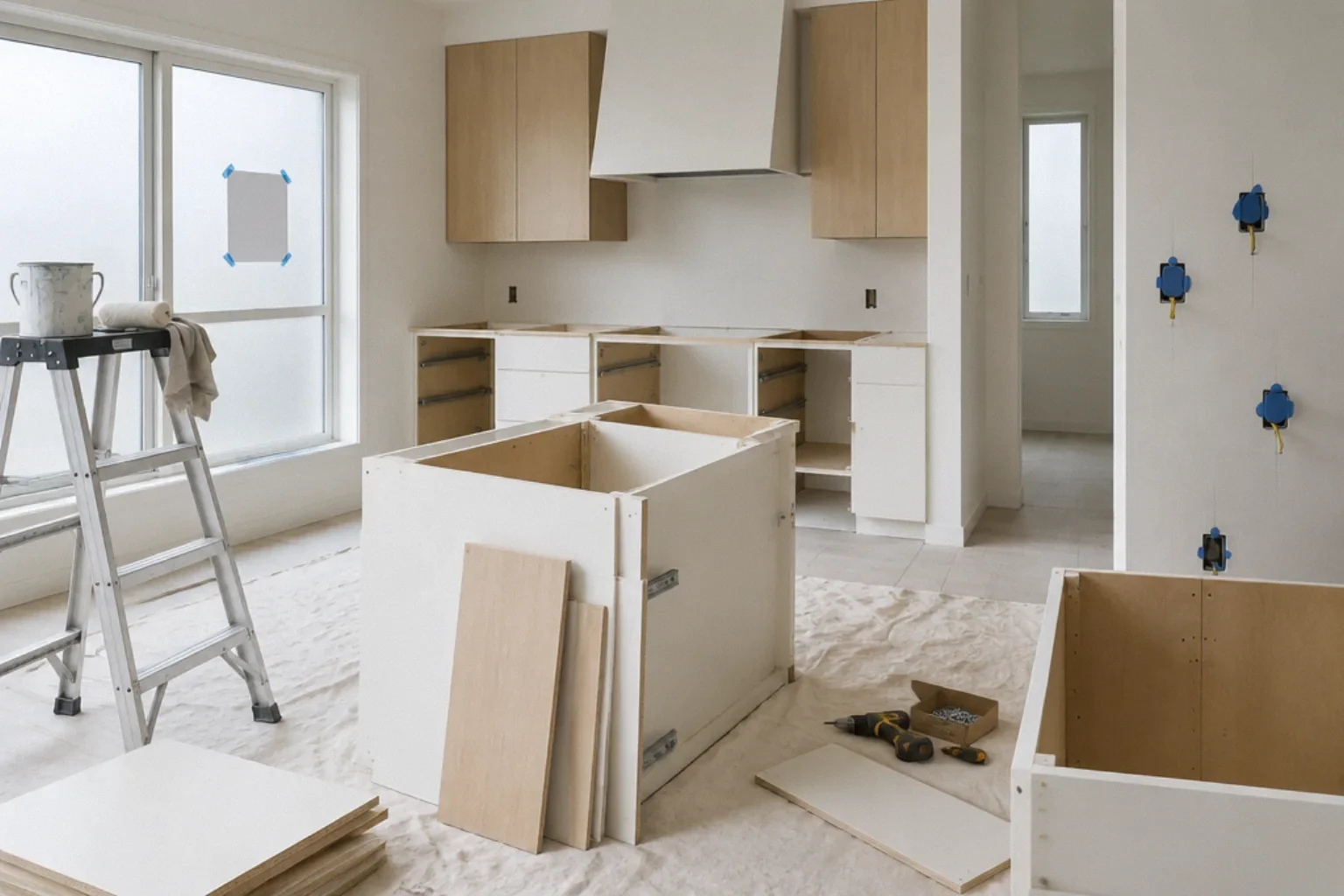
| Cabinet box assembly | Low to moderate | Low | No | Follow maker's instructions | Common DIY |
| Cabinet installation and wall anchoring | Moderate to high | Moderate (heavy wall cabinets must be anchored to framing correctly) | Depends on scope | Countertop templating depends on level, secure cabinets | DIY possible with experience; many hire out |
| Flooring (floating) | Moderate | Low | Usually no | Warranty depends on following instructions | DIY possible; subfloor prep is the hard part |
| Tile and shower waterproofing | High | Low to self, high to house | Often inspected | System warranty depends on method | Usually hire out |
| Electrical | High | High | Depends on scope; new or altered circuits generally need a permit, while some like-for-like replacements may not under local rules | Inspection | Usually licensed electrician |
| Plumbing and gas | High | High (gas especially) | Depends on scope; new or relocated plumbing and gas work generally need a permit, and some fixture swaps may be exempt locally | Inspection, testing | Usually licensed plumber |
| Structural (walls, beams, openings) | High | High | Yes, with engineering | Engineer and inspector | Hire out |
| Asbestos or lead disturbance | Specialized | High | Regulated | Clearance and records | Trained, certified professionals |
The "typical choice" column reflects editorial judgment, not a rule. Your skills and your building department's requirements decide.
California's owner-builder rules, in brief
California generally requires a licensed contractor for construction work, with exemptions. The owner-builder exemption in Business and Professions Code § 7044 lets an owner improve their property if they do the work themselves or through their own wage employees and the improvements are not intended for sale, or if they contract with appropriately licensed contractors, subject to conditions. A principal-residence version has its own residency and frequency limits, and selling within a year after completion can create a presumption that the work was for sale. Read the statute for the exact conditions.
The Contractors State License Board warns owners about the risks of becoming an owner-builder, including people who urge owners to pull owner-builder permits for work they will not really control (CSLB: owner-builder risks). As an owner-builder you may be treated as the responsible party for the permitted work, for code compliance, and potentially as an employer of anyone you hire who is not a licensed contractor, with workers' compensation and tax implications. See owner-builder permit risks.
Red flag: "you pull the permit"
When a contractor will do the work but asks you to pull the permit as owner-builder, ask why and get the answer in writing. Possible problems include: the contractor may be unlicensed or not properly insured, may be avoiding responsibility for code compliance, or may be planning to use unlicensed workers. CSLB's construction checklist suggests asking whether the contractor will obtain the building permits and schedule inspections, and states that the contractor should pull all necessary permits (CSLB Construction Project Checklist). Check the license on CSLB's site before signing.
Small jobs and handymen
California's minor-work licensing exemption is narrow (BPC § 7048). It applies only when the total for labor, materials and everything else is under $1,000 and the work does not require a permit, and it is lost if the work is part of a larger project or split into smaller contracts to stay under the limit, if the person advertises as a contractor, or if they employ others to do the work. A small job that needs a permit is not exempt. See what a handyman can legally do.
Splitting a project between you and a contractor
- Define the line in the contract. State exactly what you will do, by when, and to what standard; California contracts must describe the work (BPC § 7159).
- Sequence carefully. If your work delays the contractor, schedule and cost can change; agree how that is handled.
- Warranty boundaries. A contractor may exclude your work from their warranty, such as cabinets you installed under their countertops. Exclusions do not erase the contractor's duty to do their own work properly, and before covering your work, the contractor should inspect it and either accept it or tell you in writing what must be corrected.
Handoff between your work and the contractor's
The handoff between DIY work and a hired trade deserves its own check. For each handoff, agree in writing on:
- Completion standard. For example, cabinets level within the installer's stated tolerance, anchored to framing, and ready for templating.
- Inspection before cover. Who checks your work, and when, before the next trade builds on it.
- Permitted items. Any of your work that is part of a permit must be ready for and pass inspection, and you must know whose name is responsible for it.
- Schedule. The date your work will be done and what happens if it slips.
- Cleanup and protection. Who protects finished work from the next trade.
Writing this down turns vague expectations into checkable steps and helps assign responsibility if something goes wrong.
- Permits. Agree whose name is on which permit and who schedules inspections.
Walkthrough (hypothetical)
A homeowner planning a kitchen remodel decides to do demolition, painting and cabinet assembly themselves, and hire a licensed general contractor for electrical, plumbing, drywall, countertop coordination and the permit. Before demolition they have suspect materials assessed by a qualified professional and the contractor's trades disconnect and cap plumbing, gas and electrical in the work area; the owner removes only the cabinets and trim identified for removal. The contract lists the owner's tasks with completion dates, states that the contractor pulls the permit and schedules inspections, and notes that countertop templating requires cabinets set level and secure, which the contractor will verify before templating. When the owner's cabinet assembly runs a week late, the change in schedule is handled as the contract describes.
Mistakes to avoid
- Underestimating time; DIY schedules often run alongside a full-time job.
- Demolishing before testing suspect materials.
- Pulling an owner-builder permit for work someone else controls.
- Hiring helpers without understanding employer obligations.
- Doing work that a product warranty requires a certified installer to do.
- Leaving the DIY/contractor boundary undefined in writing.
Checklist
- Each task sorted by skill, safety, permit and warranty
- Suspect materials tested before DIY demolition
- Owner-builder role understood before signing any permit
- Contractor pulls permits for work they perform
- License checked; insurance confirmed
- DIY scope, dates and standards written into the contract
- Inspection responsibilities agreed
Questions that come up next
What remodel tasks can I safely do myself?
Common DIY tasks include painting, trim, cabinet box assembly, and removing identified non-structural finishes once hazardous materials are cleared and utilities isolated. Structural, gas, most electrical and plumbing, waterproofing and hazardous-material work are usually better left to licensed or certified professionals.
Should I pull an owner-builder permit if my contractor asks?
Be cautious. CSLB warns about the risks of becoming an owner-builder, and its checklist says the contractor should pull necessary permits. As owner-builder you may take on responsibility for the work and potentially employer obligations. Ask why and check the license.
What does California's owner-builder exemption require?
BPC § 7044 allows owners to improve their property if they do the work themselves or with wage employees and it is not for sale, or if they contract with licensed contractors, with conditions. A principal-residence provision has residency and frequency limits. Read the statute for exact terms.
Can a handyman do small jobs without a license?
Only within BPC § 7048's narrow exemption: total under $1,000 for labor and materials, no permit required, not part of a larger project or split to stay under the limit, no advertising as a contractor, and no employees doing the work.
How do I split work between me and a contractor?
Write your tasks, dates and standards into the contract, agree who pulls which permits and schedules inspections, and clarify warranty boundaries where the contractor's work depends on yours.
Sources and further reading
Community questions behind this guide
These discussions identify homeowner concerns. Forum comments are personal accounts, not code or legal authority.