Short answer: when your kitchen remodel includes new or altered lighting under a permit, plan for four things required by California's 2025 Energy Code, which applies to permit applications from 1 January 2026: light sources that meet the state's high-efficacy (JA8) requirements, recessed ceiling downlights that are airtight and have no screw-in sockets, wall-mounted dimmers for kitchen lighting, and under-cabinet lighting controlled separately from the ceiling lights. These come from the California Energy Commission's 2025 single-family mandatory measures summary, § 150.0(k). None of them dictates how bright or attractive your kitchen will be. They do decide which fixtures and switches you can buy and where the electrician puts boxes during rough-in.
This is general information verified on 3 October 2026. How the rules apply to a particular alteration depends on scope and on your building department.
The regret people mention
Lighting is a quiet but repeated theme in remodel threads. In a long thread about kitchen remodel regrets, one owner listed having no under-cabinet lighting. A widely shared before-and-after noted under-cabinet lighting still on the finish list, and a Milpitas owner's budget refresh added it as one of the few upgrades. In a bathroom thread, one owner said their top priority had been putting all lighting on dimmers with warm bulbs. These are individual accounts, but the pattern makes sense: lighting is cheap to plan before drywall and costly to add after.
The rules that shape a kitchen plan
High-efficacy light sources
Under § 150.0(k)1A, installed luminaires and light sources must meet Reference Joint Appendix JA8, with listed exceptions such as lighting built into range hoods and exhaust fans and some lighting inside cabinets and drawers. In practice this means buying fixtures and lamps that are marked as JA8-compliant, typically LED. Pleasanton's current kitchen handout states it simply: kitchen lighting fixtures shall be high-efficacy (Pleasanton JLA 01.26). Cupertino's 2025-code handout says the same and cites § 150.0(k)(1) (Cupertino kitchen remodel handout).
Recessed downlights
Under § 150.0(k)1C, recessed ceiling luminaires must not contain screw-base sockets, must be airtight to a stated leakage limit, and must have leak paths sealed with a gasket or caulk. Pleasanton adds that recessed fixtures must be IC-rated (rated for insulation contact), airtight and sealed to the ceiling. This rules out reusing old screw-in recessed cans with LED bulbs as a compliant new installation. Look for integrated LED downlights or retrofit kits listed for the application, and ask your electrician to confirm the product meets JA8 and the airtightness requirement.
Dimmers
Under § 150.0(k)2F, lighting in habitable spaces, including kitchens, must have readily accessible wall-mounted dimming controls, with exceptions including hood lighting, small navigation lights, qualifying cabinet lighting with automatic-off controls, circuits below 20 watts of controlled lighting power, and lighting controlled by an occupancy or vacancy sensor. The summary also says forward-phase-cut dimmers controlling LED sources must comply with NEMA SSL 7A. For a homeowner, the takeaway is to buy dimmers and LED fixtures that are listed as compatible, because incompatible pairs flicker or buzz.
Separate control for under-cabinet lighting
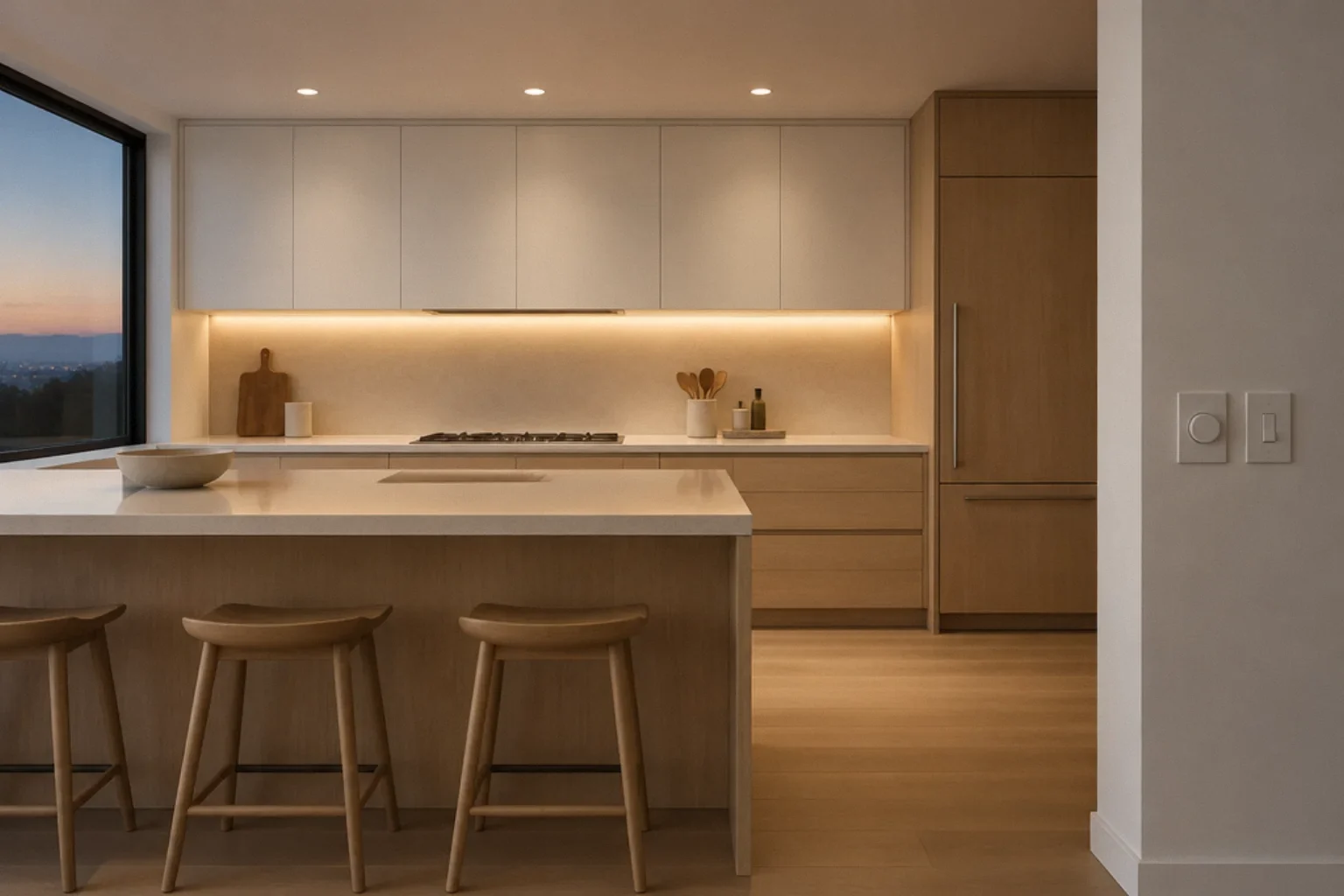
Under § 150.0(k)2G, lighting under cabinets or shelves, lighting in display cabinets, and switched outlets must be controlled separately from ceiling-installed lighting. Cupertino's handout lists this explicitly. This is good design anyway: task lighting on its own switch lets you light the counters without the whole room.
Lights inside cabinets and drawers
Under § 150.0(k)2E, lighting inside drawers and cabinets with opaque fronts or doors must turn off when the drawer or door is closed. Many cabinet lighting kits use door switches or sensors for this.
Empty ceiling boxes
Under § 150.0(k)1E, the number of electrical boxes more than five feet above the floor that do not contain a luminaire or other device is limited to the number of bedrooms, and those boxes must be served by a dimmer, vacancy sensor, low-voltage wiring or fan-speed control. If you are roughing in boxes for future pendants over an island that you will not hang right away, check how this applies to your plan.
Does all of this apply to my remodel?
The summary describes mandatory measures for single-family buildings subject to the Energy Code. Units in multifamily buildings, such as many condos, fall under the code's multifamily provisions, so confirm which requirements apply to your building type. Alterations are covered by separate rules that depend on what you change. Pleasanton's handout notes that lighting alterations or envelope modifications may require Energy Code compliance documentation (CF2R forms). If you are replacing every fixture and switch in a gutted kitchen, expect the full set of requirements to apply. If you are swapping one pendant, ask your building department. Product certification, the applicable code, approved plans and installation all matter; a compliant lamp alone does not establish compliance of the complete installation.
A practical layered plan
| Layer | Purpose | Code points to remember |
|---|---|---|
| Ceiling ambient (downlights or surface fixtures) | General light, cleaning | JA8 sources; recessed must be airtight, no screw base; wall dimmer |
| Under-cabinet task | Shadow-free counters | Separate control from ceiling lighting; JA8 sources |
| Island pendants | Task light over island, visual focus | JA8 sources; dimmer; box count rules if left empty |
| In-cabinet / drawer | Visibility inside deep storage | Automatic off when closed |
| Hood light | Cooktop task light | Lighting integral to range hoods is excepted from the JA8 and dimmer requirements in the summary |
Decisions to make before rough-in
- Fix the cabinet layout first. Check where downlights cast light relative to the counter and the person standing at it, so the layout avoids deep task shadows. Pendant boxes depend on the final island size.
- Choose under-cabinet fixtures and where their driver goes. Some systems need a transformer or driver in a cabinet; plan the space and access.
- Decide switch locations at each entry, with separate controls for ceiling and under-cabinet lighting.
- Pick compatible dimmers and fixtures together, and keep the compatibility list.
- Specify color temperature and color rendering in writing if they matter to you; mixing different color temperatures in one room is a common visual complaint, and countertops and backsplashes can look very different under different light. See sampling finishes before you commit.
- Write fixtures into the contract or attach a lighting schedule, since a California home improvement contract must describe the work and significant materials (BPC § 7159).
Mistakes to avoid
- Buying attractive fixtures online and finding at inspection that they are not JA8-compliant.
- Reusing old screw-base recessed cans in a remodel that requires new compliant downlights.
- Putting under-cabinet lights on the same switch as the ceiling lights.
- Pairing LED fixtures with an incompatible dimmer.
- Placing downlights on a grid that ignores where people stand at counters.
- Leaving the lighting plan to the last week before drywall.
Bay Area notes
The Energy Code is statewide; the Bay Area does not have a separate lighting standard. Local differences show up in how each building department documents and inspects compliance. Both handouts cited here are from Bay Area cities (Pleasanton and Cupertino) and are specific to them. In older homes with plaster ceilings or little attic access, adding downlights can be disruptive, and surface-mounted or track fixtures may be worth comparing; they still need to meet the source and control requirements. If you live in a condo, the association may restrict ceiling penetrations into fire-rated assemblies.
Checklist
- All fixtures and lamps JA8-compliant (check markings and spec sheets)
- Recessed downlights airtight, IC-rated where required, no screw-base sockets
- Wall dimmers for kitchen lighting, compatible with the fixtures
- Under-cabinet lighting on separate control from ceiling lighting
- In-cabinet lighting turns off when doors or drawers close
- Empty high boxes counted and controlled per code
- Lighting schedule attached to the contract
- CF2R or other Energy Code forms handled if your department requires them
Questions that come up next
Do I need dimmers on kitchen lights in California?
Under § 150.0(k)2F of the 2025 Energy Code, lighting in habitable spaces including kitchens must have readily accessible wall-mounted dimming controls, with listed exceptions such as range hood lighting. Ask your building department how it applies to your alteration.
Does under-cabinet lighting need its own switch?
Yes. Under § 150.0(k)2G, lighting under cabinets or shelves must be controlled separately from ceiling-installed lighting. Cupertino's current kitchen handout lists this requirement.
Can I keep my old recessed cans and use LED bulbs?
For new or altered recessed downlights covered by the code, § 150.0(k)1C prohibits screw-base sockets and requires airtight luminaires. Reusing old screw-base cans generally does not meet that requirement where it applies. Confirm with your building department.
What does JA8 mean on a light fixture?
JA8 is the California Energy Code's Reference Joint Appendix for high-efficacy light sources. Section 150.0(k)1A requires installed luminaires and light sources to meet it, with listed exceptions. Look for JA8 compliance on the product or spec sheet.
Will a lighting change trigger extra paperwork?
It can. Pleasanton's kitchen handout says lighting alterations may require Energy Code compliance documentation (CF2R forms). Requirements vary by scope and department.
Sources and further reading
- California Energy Commission: 2025 Single-Family Residential Mandatory Requirements Summary
- City of Pleasanton: Residential Kitchen Alteration Requirements (JLA 01.26)
- City of Cupertino: Kitchen Remodel Handout (2025 codes, rev. 01.15.2026)
- California Building Standards Commission: Codes (2025 edition effective January 1, 2026)
- California Business and Professions Code § 7159
Community questions behind this guide
These discussions identify homeowner concerns. Forum comments are personal accounts, not code or legal authority.