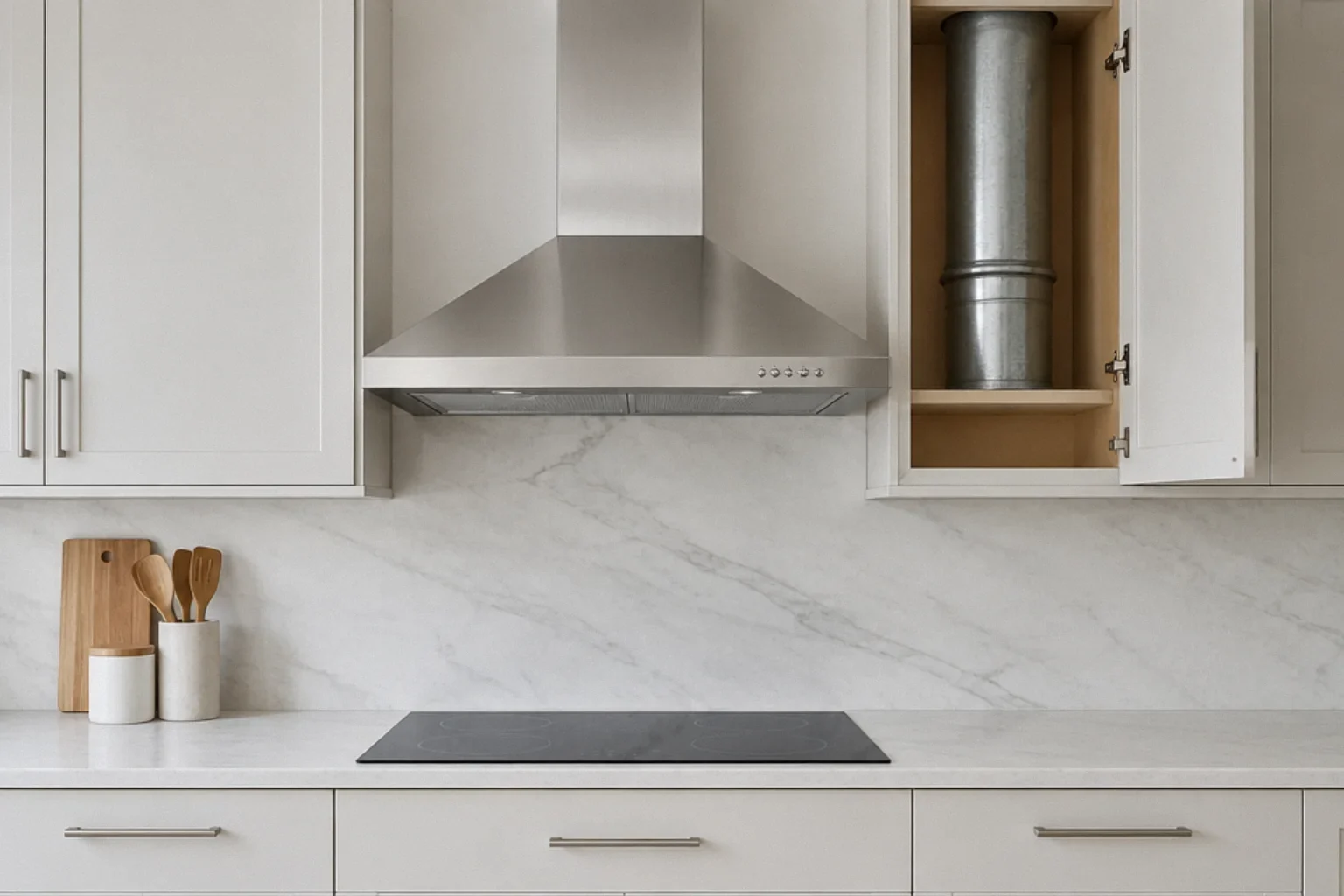
Short answer: it can be, but only if the specific model is ducted to the outdoors and carries a rating that meets the airflow or capture-efficiency level your kitchen needs. Many over-the-range (OTR) microwaves are sold to install either ducted or recirculating, and their published airflow and sound figures vary. A recirculating installation does not discharge to the outside, and Bay Area permit handouts we reviewed require kitchen exhaust that discharges outdoors. Gas ranges carry a higher requirement than electric ones, so check any candidate model, microwave or hood, against the value for your kitchen. Your building department makes the final call on your permit.
Under California's 2025 Energy Code, which applies to permit applications from 1 January 2026, kitchens must have local mechanical exhaust, and vented range hoods are verified against a rating from the Home Ventilating Institute (HVI) or the Association of Home Appliance Manufacturers (AHAM) for airflow and sound (CEC 2025 single-family mandatory measures summary, §§ 150.0(o)1G and 150.0(o)2). This article is general information verified on 3 October 2026, not a code determination for your project.
Why this question comes up
Space is the usual reason. A homeowner planning a compact galley conversion said they were considering a microwave option because the room already felt full of cabinets. An investor who remodeled a rental kitchen regretted the cabinet height over the range because the hood ended up looking too high. And one Bay Area buyer described a later permitted remodel in which the inspector noticed an earlier, unpermitted kitchen; they reported having to remove a gas line and an incorrectly sized hood vent before sign-off. Forum accounts are anecdotal, but they show that hood choice affects layout, appearance and inspections at the same time.
What the 2025 California Energy Code asks of kitchen exhaust
Scope first. The summary cited here covers single-family residential buildings. Condominiums and apartments in multifamily buildings fall under the Energy Code's multifamily provisions, and work on an existing home is governed by the alteration rules, so which requirements and which table apply depends on the building's classification and the scope of work. If you live in a multifamily building, ask your building department which provisions govern your unit rather than using the single-family table below.
For single-family homes, the CEC summary sets out the structure:
- Local exhaust is mandatory in kitchens and bathrooms (§ 150.0(o)1G).
- Nonenclosed (open) kitchens must use a demand-controlled exhaust system, meaning one that runs when you turn it on. Enclosed kitchens may use demand-controlled or continuous exhaust.
- The summary says local exhaust airflow is to be measured by the installer under the referenced subsection and that the exhaust must be rated for sound. The full code text contains details and any exceptions; ask your contractor or building department what verification your project needs.
- Vented range hoods are verified under Reference Residential Appendix RA3.7.4.3 to confirm they are rated by HVI or AHAM for the required airflow and sound (§ 150.0(o)2).
For single-family homes, the required performance depends on the dwelling's floor area and whether the range is electric or gas, expressed as either a minimum capture efficiency (CE) or a minimum airflow. The City of Pleasanton's current kitchen handout reproduces Energy Code Table 150.0-G (Pleasanton JLA 01.26). Two rows show the pattern:
| Dwelling floor area | Hood over electric range | Hood over gas range |
|---|---|---|
| Greater than 1,500 sq ft | 50% CE or 110 cfm | 70% CE or 180 cfm |
| Less than 750 sq ft | 65% CE or 160 cfm | 85% CE or 280 cfm |
The middle size bands are in the handout. Two points follow from the table. Gas cooking carries a higher requirement than electric in every band. And in this single-family table, smaller dwellings carry higher requirements, which matters for small houses and cottages. Capture efficiency is a lab measure of how much of the cooking plume a hood actually catches, so a hood with a good CE rating can qualify at lower airflow than one rated only on airflow.
Does this apply to my remodel? The summary is written for single-family buildings subject to the Energy Code, and how alteration rules apply depends on scope. Pleasanton's handout applies the table to kitchen remodels requiring a permit, and the example plan in that handout specifies a minimum 180 cfm hood. Other departments may word their requirements differently, so ask yours.
Duct and termination rules that catch people out
Current Bay Area handouts list practical requirements beyond the rating:
- Discharge outdoors. Pleasanton requires a kitchen exhaust system that discharges directly to the exterior and is installed per the manufacturer's guide.
- Smooth metal duct. Both Pleasanton and the City of Cupertino's 2025-code kitchen remodel handout call for metal ducts with smooth interior surfaces (Cupertino cites California Mechanical Code 504.3).
- Termination distances. Cupertino cites at least 3 feet from a property line and from openings into the building; Pleasanton also lists 10 feet from forced-air intakes.
- Backdraft damper. Pleasanton's rough inspection checks that the hood is ducted to the exterior at the approved location with a backdraft damper.
- Electrical. Cupertino notes the California Electrical Code conditions under which a range hood or OTR microwave may be cord-and-plug connected, including an individual branch circuit and cord length limits.
A recirculating (ductless) setup, whether a hood or an OTR microwave with a charcoal filter, does not discharge outdoors, so it does not fit these handouts' discharge requirement. If you are planning one, ask your building department before buying.
Over-the-range microwave versus dedicated hood
| Question | OTR microwave | Dedicated hood |
|---|---|---|
| Space | Combines two appliances; frees counter or cabinet space | Needs a separate microwave location |
| Coverage of front burners | Typically shallow; check depth against your range | Deeper and wider models available, including ones wider than the range |
| Rating needed for Title 24 | Check the specific model's HVI or AHAM listing for airflow, CE (if rated) and sound | Same check |
| Gas range | Check the model against the higher gas value | Check the model against the higher gas value |
| Mounting height | Set by the manufacturer's clearance to the cooktop | Set by the manufacturer; often adjustable within a range |
| Ducting | Must be installed in ducted mode to discharge outside | Ducted to outside |
The practical test is not the category but the listing. Find the exact model number in the HVI Certified Products Directory or AHAM's listing and compare its certified airflow, any CE rating and sound rating with what your kitchen needs.
How to choose: a short decision path
- Find your requirement. For a single-family home, use floor area and range fuel to locate the row in Table 150.0-G; for any other building type, or if unsure, ask your building department which provision applies.
- Decide fuel early. If you are switching to induction, the electric column applies and the requirement is lower. See switching from gas to induction.
- Plan the duct route before choosing the appliance. A long, bent duct run reduces delivered airflow, and the applicable verification procedure should be agreed before installation. Exterior walls are often easier than roofs in two-story houses; termination distances still apply.
- Check the listing for the exact model, not the product family.
- Coordinate heights. Choose the hood and its mounting height before upper cabinets, so you avoid the high-hood regret above.
- Think about makeup air for big hoods. Model codes cited in NKBA's planning guidelines require makeup air above certain exhaust rates; ask your mechanical contractor whether your chosen hood triggers a makeup-air requirement under the California Mechanical Code as adopted locally.
Mistakes to avoid
- Buying an OTR microwave and installing it recirculating to avoid cutting a duct, then discovering at inspection that exhaust must discharge outdoors.
- Assuming a high advertised cfm figure equals compliance. The Energy Code check is against a certified rating for airflow and sound, or CE.
- Choosing upper cabinets first and forcing the hood to whatever height is left.
- Routing the duct into an attic or soffit instead of to the exterior.
- Ignoring the electrical requirements for the hood or OTR circuit.
Bay Area notes
The Energy Code is statewide. Bay Area variation shows up in how departments present and inspect it: the two handouts cited here are from Pleasanton and Cupertino, and your city may phrase things differently or add local amendments. In multi-unit buildings, condo rules may restrict new wall or roof penetrations, which can rule out a duct route; check with the association before buying. Because the requirement differs by range fuel, choose the fuel early and confirm any applicable local rules before buying.
Checklist
- Building classification confirmed, then requirement identified for your floor area and range fuel
- Exact model's HVI or AHAM listing checked for airflow or CE, and sound
- Ducted to the exterior in smooth metal duct with backdraft damper
- Termination distances from property lines, openings and intakes confirmed
- Mounting height per manufacturer, coordinated with upper cabinets
- Electrical connection meets the appliance instructions and code
- Makeup-air question asked for high-airflow hoods
- Requirements confirmed with your building department
Questions that come up next
Can an over-the-range microwave meet California's range hood requirement?
Some models can, if installed ducted to the outdoors and listed by HVI or AHAM with airflow or capture efficiency and sound ratings that meet the value for your home's size and range fuel. Check the exact model's listing and confirm with your building department.
Is a recirculating range hood allowed in a California remodel?
Bay Area handouts we reviewed, including Pleasanton's and Cupertino's, require kitchen exhaust that discharges to the exterior. A recirculating hood does not. Ask your building department before planning one.
Why do gas ranges need a stronger hood?
California Energy Code Table 150.0-G, as reproduced in Pleasanton's handout, sets higher capture-efficiency or airflow values for hoods over gas ranges than over electric ranges in every floor-area band.
What is capture efficiency?
It is a rated measure of how much of the cooking plume a hood catches. The Energy Code lets a hood qualify either by meeting a capture-efficiency value or a minimum airflow for your home's size and range fuel.
Does the same table apply to my condo?
Not automatically. The table discussed here is from the single-family provisions. Units in multifamily buildings are covered by the Energy Code's multifamily provisions and the alteration rules, so ask your building department which requirement applies, and check your association's rules on new exterior penetrations.
Sources and further reading
- California Energy Commission: 2025 Single-Family Residential Mandatory Requirements Summary
- City of Pleasanton: Residential Kitchen Alteration Requirements (JLA 01.26)
- City of Cupertino: Kitchen Remodel Handout (2025 codes, rev. 01.15.2026)
- California Building Standards Commission: Codes (2025 edition effective January 1, 2026)
- NKBA: Kitchen Planning Guidelines with Access Standards
- Home Ventilating Institute: Certified Products Directory
Community questions behind this guide
These discussions identify homeowner concerns. Forum comments are personal accounts, not code or legal authority.