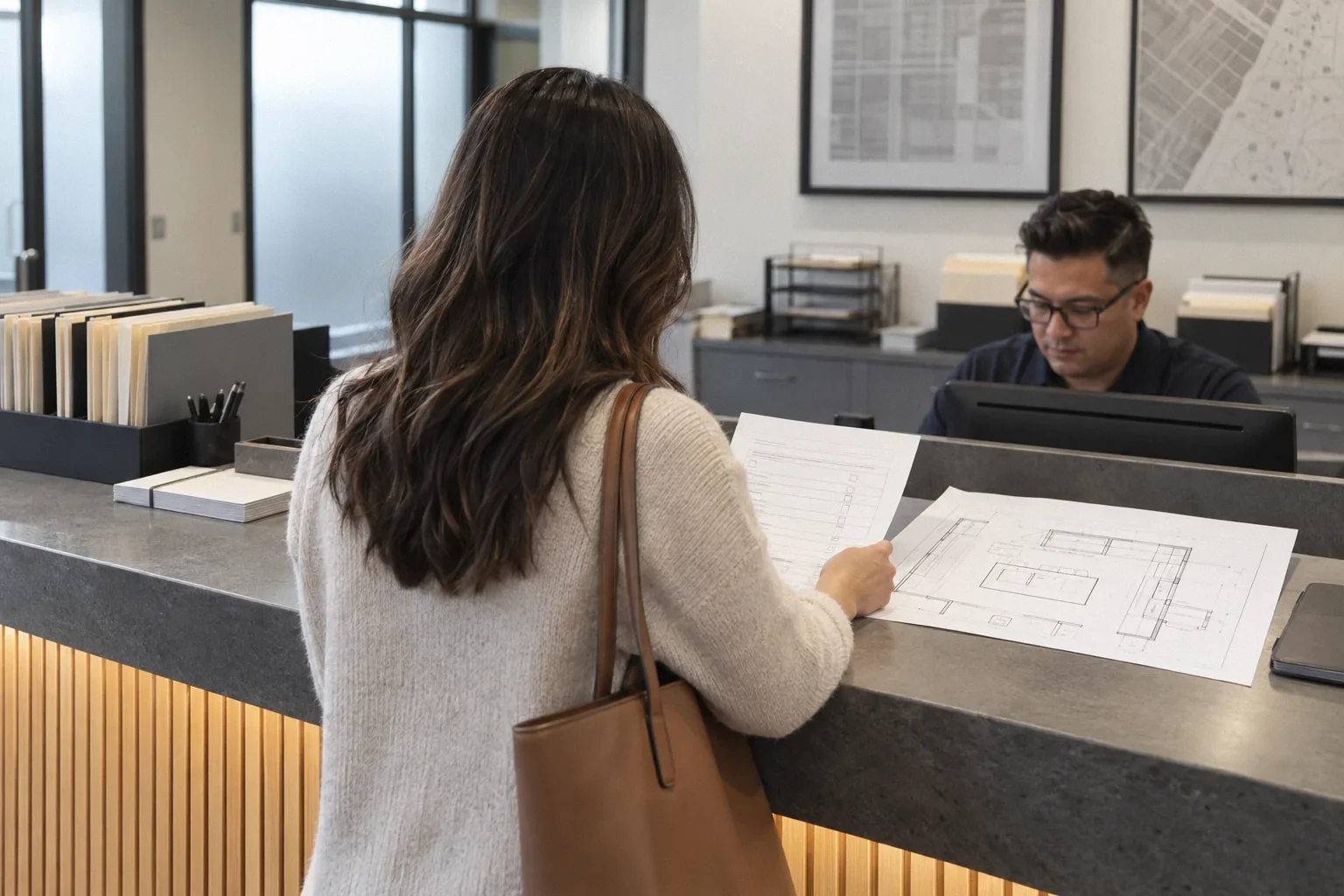
Short answer: if you pull a California building permit for an alteration, repair or addition worth more than $1,000, the building department may not sign off the work until you show that the home's required smoke alarms comply with state rules. That condition is written into Health and Safety Code § 13113.7. The 2025 California Residential Code, in effect for permits since 1 January 2026, sets where smoke alarms go and adds carbon monoxide alarm requirements for homes with fuel-burning appliances, fireplaces or attached garages. Smoke alarms are expected in every bedroom, outside each sleeping area and on every story. CO alarms are expected outside each sleeping area and on every occupiable level, and inside a bedroom only when a fuel-burning appliance is in that bedroom or its attached bathroom.
This guide explains what the law and the current code require, when battery-only alarms may be accepted, how departments verify compliance, and how to keep alarms working while a crew is in the house. It is general information current as of 3 October 2026, not code advice for your house.
How alarms come up in real projects
Homeowners often meet the alarm rule as a form at the end of a job. One California owner quoted a certification they signed after a permitted HVAC replacement, when every smoke and CO alarm in the house was replaced. Another asked whether a CO alarm belonged near a gas water heater, and a commenter described a CO alarm sounding after a heating appliance's exhaust was disturbed during service. A third owner of a recently renovated house reported smoke alarms that would not stop after a contractor's loose drain line leaked into a bedroom ceiling. These are personal accounts, not verified facts. They show that alarms touch permits, appliance work and leak repairs alike.
What state law requires
Smoke alarms and the $1,000 permit condition
Section 13113.7 says that for building permits issued after 1 January 2014 for alterations, repairs or additions exceeding $1,000, the permit issuer shall not sign off on completion until the permittee demonstrates that all required smoke alarms are approved and listed by the State Fire Marshal. Departments meet this with an inspection, an owner certification, or both.
Sealed 10-year batteries for battery-only smoke alarms
Health and Safety Code § 13114 provides that, from 1 July 2014, a smoke alarm that is operated only by a battery must contain a nonreplaceable, nonremovable battery capable of powering it for at least 10 years, and from 1 January 2015 smoke alarms must show a manufacture date, a place to write the installation date and a hush feature. The rule is about smoke alarms. The CAL FIRE/Office of the State Fire Marshal carbon monoxide FAQ says it is not aware of a 10-year battery requirement for standalone CO alarms, while a battery-powered combination smoke/CO alarm must meet the smoke alarm battery and labeling rules to be listed. Hardwired alarms with a backup battery are a different category.
CO alarms in existing homes
Health and Safety Code § 17926 has required owners of existing single-family homes with a fossil-fuel-burning heater or appliance, a fireplace or an attached garage to have State Fire Marshal-approved CO devices since 1 July 2011. The OSFM FAQ adds that CO devices are required outside each sleeping area, and recommends (but does not require) one in each sleeping room for extra protection.
At sale
Section 13113.8 requires the seller of a single-family home to give the buyer a written statement that the home has an operable smoke alarm meeting State Fire Marshal requirements. See California seller disclosures.
What the 2025 California Residential Code changed: section numbers
The 2025 code cycle reorganized the Residential Code. Smoke alarm provisions formerly in R314 are now in R310, and carbon monoxide alarm provisions formerly in R315 are now in R311. Older Bay Area handouts and forms still cite the old numbers. A current example of the new numbering is the City of Irvine's Form 65-43 (Rev. 12/25), which states that the 2025 CRC took effect on 1 January 2026 and cites R310.8.2 for smoke alarms on permitted projects valued at $1,000 or more and R311 for CO alarms. Irvine is in Southern California; we use its form only because it quotes the current state code clearly. Your Bay Area department may publish its own version and may have local amendments.
Where alarms go
| Location | Smoke alarm | CO alarm (homes with fuel-burning appliances, fireplace or attached garage) |
|---|---|---|
| Outside each separate sleeping area, in the immediate vicinity of the bedrooms | Yes | Yes |
| Each room used for sleeping | Yes | Only if a fuel-burning appliance is in that bedroom or its attached bathroom |
| Each story, including basements (not crawl spaces or uninhabitable attics) | Yes | Yes, on every occupiable level |
| Near bathrooms with a tub or shower | At least 3 feet horizontally from the door, unless that prevents a required placement | Per manufacturer's instructions |
The table follows the 2025 CRC language quoted on the Irvine form and matches the placement list in the San Francisco Fire Department's smoke and CO alarm notice. Split-level homes have a specific allowance, and the manufacturer's instructions control mounting details such as distance from cooking appliances, vents and windows.
Hardwired or battery-only?
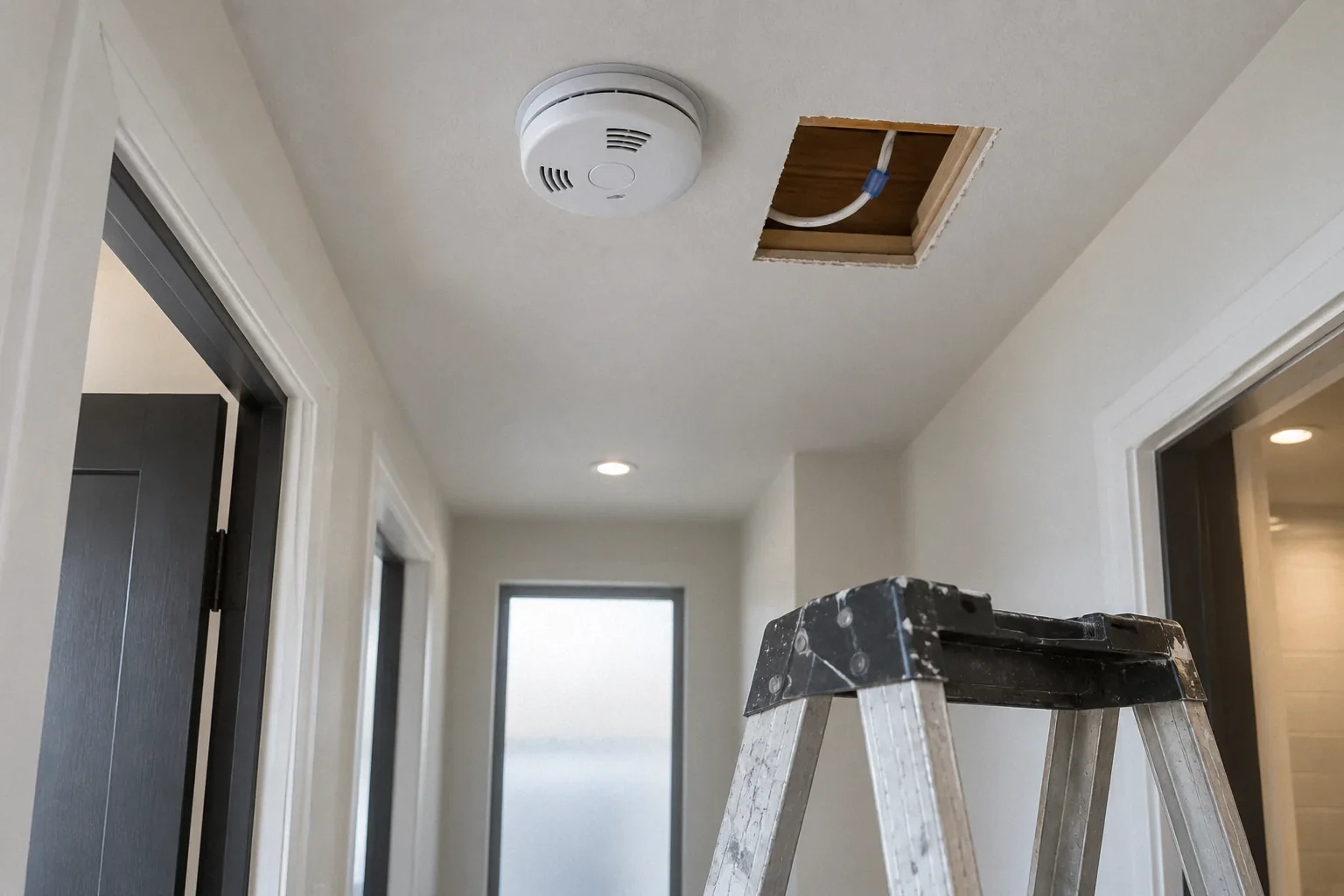
New construction and additions generally require alarms powered from the building wiring and interconnected so that one alarm sets off all of them. For existing homes being altered, battery-only alarms may be accepted only in limited situations. The Irvine form identifies scope of work, exposure of wall and ceiling finishes, and wiring access through an attic, basement or crawl space as factors in applying the 2025 CRC exceptions. These factors must be evaluated together for your installation; do not read one item as an automatic exemption. For CO alarms it adds that battery operation may be allowed in existing buildings built before 1 January 2011 under the stated exceptions.
That access condition matters. Keeping the drywall intact does not by itself guarantee a battery-only approval: if an electrician can reach the ceiling boxes from an accessible attic or crawl space, the inspector may expect hardwired, interconnected alarms. Contra Costa County's earlier residential alarm handout, written under the 2022 codes, shows how one Bay Area department described the same idea; check whether it has been updated for your permit. Ask the plan checker or inspector early which power option they will accept for your scope.
How departments verify it
- Certification at final. Pleasanton's kitchen alteration handout (JLA 01.26) lists smoke and CO alarm certification among final items. Other departments inspect alarms directly.
- Beyond remodels. The Irvine form applies verification to reroofs, window change-outs, water heater and furnace replacements, panel upgrades and re-pipes as well as interior remodels. Bay Area departments set their own lists, so ask.
- Age and listing. Alarms must be State Fire Marshal listed. SFFD advises replacing alarms every 10 years or per the manufacturer's instructions.
Keeping protection working during the job
Dust from demolition, sanding and drywall work can set off alarms or impair them, which tempts crews to pull them off the ceiling. If you live in the house during the work, working smoke and CO protection is needed whenever the home is occupied, not just at bedtime, and especially while gas appliances are being disconnected, moved or reconnected. Agree with the contractor in writing on how alarms will be protected or temporarily replaced during dust-producing work, following the alarm manufacturer's instructions, and who checks that every unit is restored and tested at the end of each workday. Do not paint over alarms; SFFD warns against it.
Alarm sounding versus chirping
- A CO alarm sounding its alarm pattern is an emergency signal, not a maintenance reminder. Kidde's CO alarm action page tells users to call 911 or the local fire department and move to fresh air immediately. Get everyone out, follow the dispatcher's and fire department's instructions, and do not go back in until responders say it is safe.
- A smoke alarm sounding: get out, stay out and call 911.
- A periodic chirp usually signals a low battery or end of life. SFFD says that if a sealed long-life alarm chirps for a low battery, replace the entire alarm right away; for alarms with replaceable batteries, replace the battery. Your alarm's manual explains its specific patterns.
- Repeated nuisance alarms after a leak or dust event: treat the alarm and its wiring as suspect and have an electrician or the alarm manufacturer's guidance address it. Never leave a sleeping area without protection while you sort it out.
Decision steps
- Map every bedroom, the areas outside them, each level and any basement. Mark fuel-burning appliances and whether the garage is attached.
- Record each existing alarm's type, power source and manufacture date.
- Ask the department which code edition and form apply, and whether it will expect hardwired, interconnected alarms given your open walls and attic or crawl space access.
- Put alarm supply, installation, protection during work and the final certification in the contract scope. See our contract checklist.
- Test every alarm, including interconnection, before the final, and keep dated photos of each location.
Checklist
- Smoke alarm in every bedroom, outside each sleeping area and on every story
- CO alarm outside each sleeping area and on every occupiable level, plus inside any bedroom with a fuel-burning appliance in the room or its bathroom
- Battery-only smoke alarms have sealed 10-year batteries and a manufacture date
- Power and interconnection approach confirmed with the department for your scope and access
- All units State Fire Marshal listed and within their replacement date
- Alarm protection plan agreed for occupied, dusty work
- Certification form identified at permit issuance and signed truthfully
Current as of 3 October 2026. The 2025 California Residential Code applies to permits from 1 January 2026; confirm local amendments with your building department.
Questions that come up next
Does a kitchen remodel permit require smoke alarms in the whole house?
Usually yes. Health and Safety Code § 13113.7 bars sign-off on permitted alterations over $1,000 until required smoke alarms are shown to comply, and the required locations cover every bedroom, the area outside sleeping rooms and every story, not just the remodeled room.
Do I need a carbon monoxide alarm in every bedroom?
No. CO alarms are required outside each sleeping area and on every occupiable level of homes with fuel-burning appliances, a fireplace or an attached garage. One is required inside a bedroom only when a fuel-burning appliance is in that bedroom or its attached bathroom. The State Fire Marshal recommends, but does not require, CO alarms in each sleeping room.
Can I use battery smoke alarms instead of hardwired ones in a remodel?
Sometimes. The existing-building exceptions depend on the scope of work, exposed finishes and available wiring access. Intact drywall alone does not guarantee approval if attic, basement or crawl-space access permits wiring. Confirm power and interconnection requirements with your building department before selecting alarms.
What should I do if a CO alarm goes off during or after construction?
Treat the alarm pattern as an emergency: get everyone to fresh air, call 911 or the fire department, and follow responders' instructions before going back in. A periodic chirp is different and usually means a low battery or end of life.
Sources and further reading
- California Health and Safety Code § 13113.7
- California Health and Safety Code § 13114
- California Health and Safety Code § 17926
- California Health and Safety Code § 13113.8
- CAL FIRE/Office of the State Fire Marshal: FAQ on Carbon Monoxide (CO) Devices (Aug 2020)
- San Francisco Fire Department: Smoke Alarms and Carbon Monoxide Alarms Save Lives
- City of Irvine: Smoke Detector and Carbon Monoxide Alarm Retrofit/Verification Requirements, Form 65-43 Rev 12/25 (2025 CRC R310/R311)
- Contra Costa County DCD: Residential Smoke and Carbon Monoxide Alarms (2022 code basis)
- City of Pleasanton: Residential Kitchen Alteration Requirements (JLA 01.26)
- Kidde: What should I do when my carbon monoxide alarm sounds?
Community questions behind this guide
These discussions identify homeowner concerns. Forum comments are personal accounts, not code or legal authority.