Short answer: often, yes. If your California house was built and available for use on or before 1 January 1994, and you pull a permit for an alteration or improvement, state law makes the final permit sign-off conditional on replacing every noncompliant plumbing fixture in the house, not just the ones in the room you are remodeling. The rule comes from Civil Code § 1101.4, added by SB 407 in 2009. Several Bay Area building departments, including Pleasanton, Palo Alto and Contra Costa County, enforce it with a signed owner certificate collected before the final inspection.
This guide explains which fixtures count as noncompliant, why the definition of a replacement fixture is stricter than many owners expect, how the rule interacts with San Francisco's own ordinance, and how to keep it from becoming a surprise at the end of a project. It is general information verified on 3 October 2026, not legal or code advice for your property.
Where the confusion comes from
Homeowners often think of a permit as covering only the room being remodeled. A San Jose homeowner, for example, asked what a city required when a kitchen and several bathrooms were being redone with new fixtures in the same locations. The fixture rule does not follow the room boundary: for covered single-family homes it reaches every noncompliant fixture in the house, and the departments we checked collect the certificate at final. Forum posts like this are personal accounts, not legal sources.
What the statute actually says
The rule sits in Article 1.4 of the Civil Code (§§ 1101.1 to 1101.8). Four provisions do most of the work:
- Scope. § 1101.2 applies the article to residential and commercial property built and available for use on or before January 1, 1994. A house built later is outside the article.
- Definitions. § 1101.3 defines a noncompliant fixture as a toilet using more than 1.6 gallons per flush, a urinal over 1 gallon per flush, a showerhead over 2.5 gallons per minute, or an interior faucet over 2.2 gallons per minute. A water-conserving fixture is one that complies with current building standards for newly constructed property of the same type.
- The permit trigger for houses. § 1101.4(a) says that for all building alterations or improvements to single-family residential property, as a condition of the certificate of final completion or final permit approval, the permit applicant shall replace all noncompliant plumbing fixtures with water-conserving ones.
- Exemptions. § 1101.7 excludes registered historical sites, property where a licensed plumber certifies that installing water-conserving fixtures is not technically feasible because of the age or configuration of the property or its plumbing, and buildings whose water service is permanently disconnected.
Two further points matter for owners who are not remodeling at all. § 1101.4(b) required owners of covered single-family homes to replace noncompliant fixtures by 1 January 2017, and § 1101.4(c) requires a seller to disclose that requirement and whether the house still has noncompliant fixtures. Multifamily and commercial buildings follow a separate set of triggers in § 1101.5, which this article does not cover.
The detail most people miss: the two thresholds are different
The statute uses one set of numbers to decide whether an existing fixture must go, and a different, stricter standard for what replaces it. The old fixture is noncompliant if it exceeds the § 1101.3 limits. The new fixture must meet current standards for new construction, which today are tighter than those limits. The City of Pleasanton's kitchen alteration handout (JLA 01.26) lists the replacement values it applies: toilets 1.28 gallons per flush, showerheads 1.8 gallons per minute, lavatory faucets 1.2 gallons per minute and kitchen faucets 1.8 gallons per minute.
| Fixture | Must be replaced if it uses more than (Civ. Code § 1101.3) | Replacement value listed in Pleasanton JLA 01.26 |
|---|---|---|
| Toilet | 1.6 gal/flush | 1.28 gal/flush |
| Showerhead | 2.5 gal/min | 1.8 gal/min |
| Bathroom (lavatory) faucet | 2.2 gal/min | 1.2 gal/min |
| Kitchen faucet | 2.2 gal/min | 1.8 gal/min |
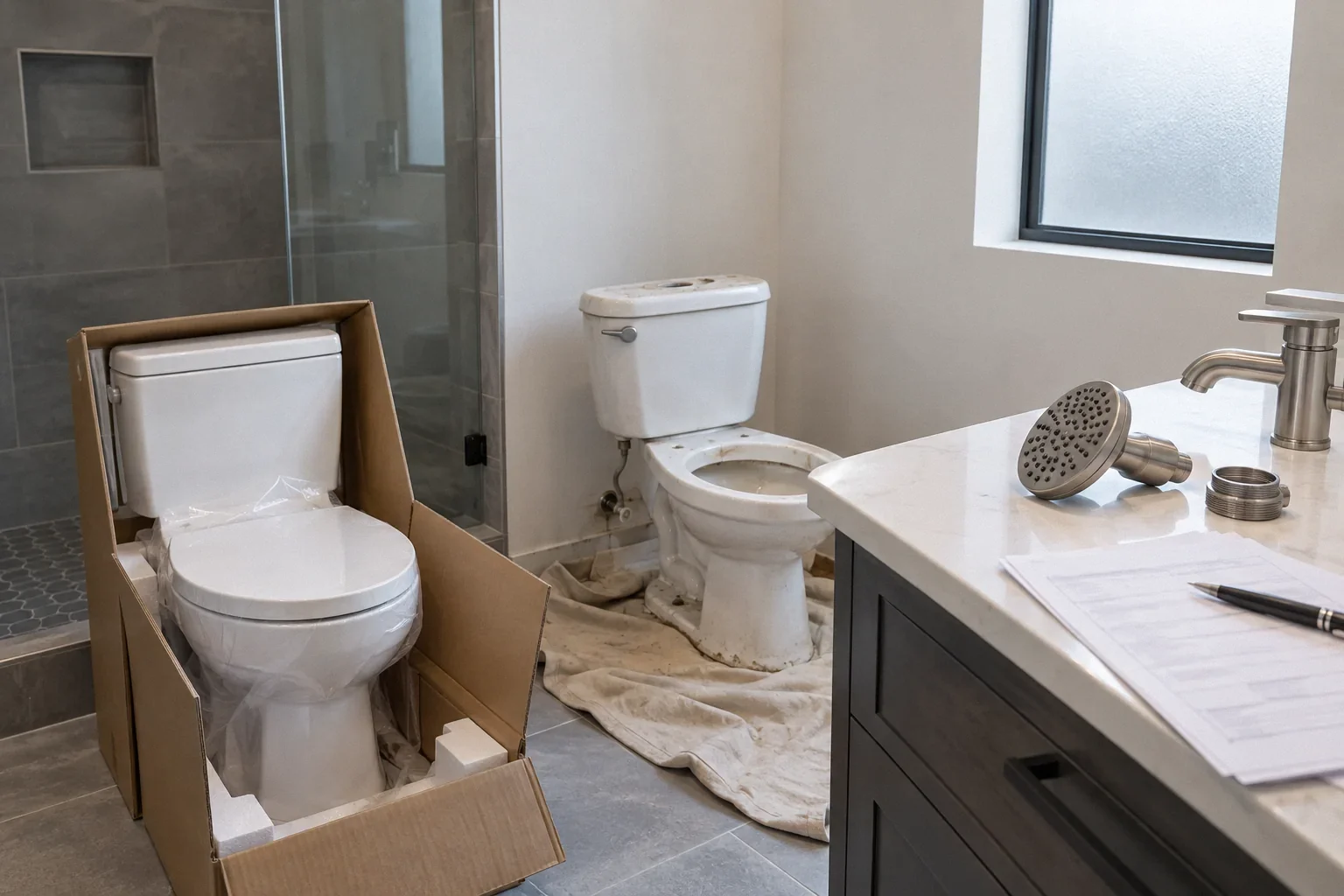
So a 1.6 gpf toilet from the late 1990s is not noncompliant under that state definition, though a stricter local ordinance can still require replacement, but a new toilet you buy for the project has to meet the current 1.28 gpf figure. A 3.5 gpf toilet from the 1980s must be replaced before final. Local forms can lag behind the code. The Palo Alto owner certificate we read, for example, still prints 2013-era replacement values such as 2.0 gpm showerheads. Use the values your department currently enforces, and ask if the form and the plan checker disagree.
How Bay Area departments enforce it
Enforcement usually happens at the very end, which is why it surprises people.
- Owner certificates. Palo Alto's form says in bold that the permit cannot be finaled until the certificate is signed and returned. It walks the owner through the exemptions, then asks the owner to certify under penalty of perjury that noncompliant fixtures have been replaced. Pleasanton's January 2026 Water-Conserving Plumbing Fixtures Certificate of Compliance carries the same warning, must be signed by the property owner before any final inspection is approved, and cites the 2025 Plumbing Code and 2025 CALGreen for its values. Contra Costa County's version, used in unincorporated areas, adds a written interpretation of which work triggers the rule (see below).
- Inspector verification. Some inspectors check fixtures during the final. Do not assume a signature alone is enough, and never sign a certificate you know is untrue. It is a declaration under penalty of perjury.
- San Francisco's separate ordinance. San Francisco layers its own rule on top of state law. The SFPUC and SF.gov explain that Chapter 12A of the Housing Code requires residential properties to meet water efficiency requirements when they are sold or remodeled. As of our check, the city lists 1.28 gpf toilets, 1.8 gpm showerheads and 1.8 gpm faucets and aerators, and notes that Housing Code updates effective January 2026 changed the rates required for existing fixtures. Compliance runs through DBI Housing Inspection Services, which issues a certificate. San Francisco owners should treat the city requirement as a separate item from the state rule.
Which permits trigger it? One county's written answer
The statute says "building alterations or improvements" without listing them, so departments interpret it. Contra Costa County's certificate packet is unusually explicit. It lists work it considers not to trigger the rule, including electrical service upgrades, HVAC or furnace replacement, water heater, piping and sewer line replacement, re-roofing, siding and stucco, window replacement, dry rot, termite and foundation repair, seismic retrofit, roof-mounted solar and EV chargers, with a final catch-all of "other work as determined by the Building Official." It also says work in a detached garage, shed or second unit does not trigger upgrades in the main house, and that a duplex is treated as single-family with alterations to one unit triggering upgrades only in that unit. On the other side of the line, Pleasanton's kitchen handout applies the fixture upgrade to remodeled kitchens, and Pleasanton's certificate names additions, alterations and improvements. Other Bay Area departments may draw the line differently, so ask your own building department when you apply rather than relying on another county's list.
Decision steps before you pull the permit
- Confirm the build date. If the house was built and available for use after 1 January 1994, the state article does not apply. County assessor records or the original permit can help; if they are unclear, ask the building department how it will treat your property before you budget.
- Inventory every fixture in the house. List every toilet, showerhead, bathroom faucet and kitchen faucet in the dwelling, including laundry rooms and any unpermitted rooms. Note fixtures in detached garages, second units or other structures separately, and confirm with your department whether they are in scope: Contra Costa County, for example, says work in one building does not trigger upgrades in a separate building. Many fixtures are stamped with their flow rate; if not, note the model or measure the flow.
- Mark which ones exceed the § 1101.3 limits. Under the state statute those are the fixtures that must be replaced. A local ordinance can be stricter (San Francisco's is), and any fixture you do replace, required or not, must meet current standards.
- Specify replacements at current values. Put the model numbers in the contract or allowance list. Our guide to home improvement contract contents explains why the description of materials matters.
- Check for an exemption honestly. A licensed plumber's technical infeasibility certificate is a real exemption, but it must be true for your plumbing, not a shortcut.
- Ask who signs the certificate. It is usually the owner. Get the form at the start and keep a copy with photos of each installed fixture.
- Plan for San Francisco or any city-specific rules separately if you are in a jurisdiction with its own ordinance.
Common mistakes
- Budgeting only for the room you remodel. § 1101.4(a) says all noncompliant fixtures. A kitchen permit can require work in a hall bath you were not touching.
- Buying replacement fixtures to the old thresholds. A 1.6 gpf toilet or 2.5 gpm showerhead bought as a replacement may not meet current new-construction standards.
- Treating the certificate as a formality. The certificate is signed under penalty of perjury and states that noncompliant fixtures have been replaced. Swapping in compliant fixtures for the final and reinstalling old ones afterward makes that statement untrue. Sign only what is accurate for the fixtures that remain in the house.
- Forgetting the seller disclosure. Under § 1101.4(c), sellers must disclose the replacement requirement and whether noncompliant fixtures remain. See our guide to California seller disclosures.
- Leaving it to the last week. Most fixture swaps are simple, but a toilet replacement can reveal a corroded flange or a leaking supply valve. Schedule it with the plumbing trim-out, not the day before final.
How this fits the rest of the permit
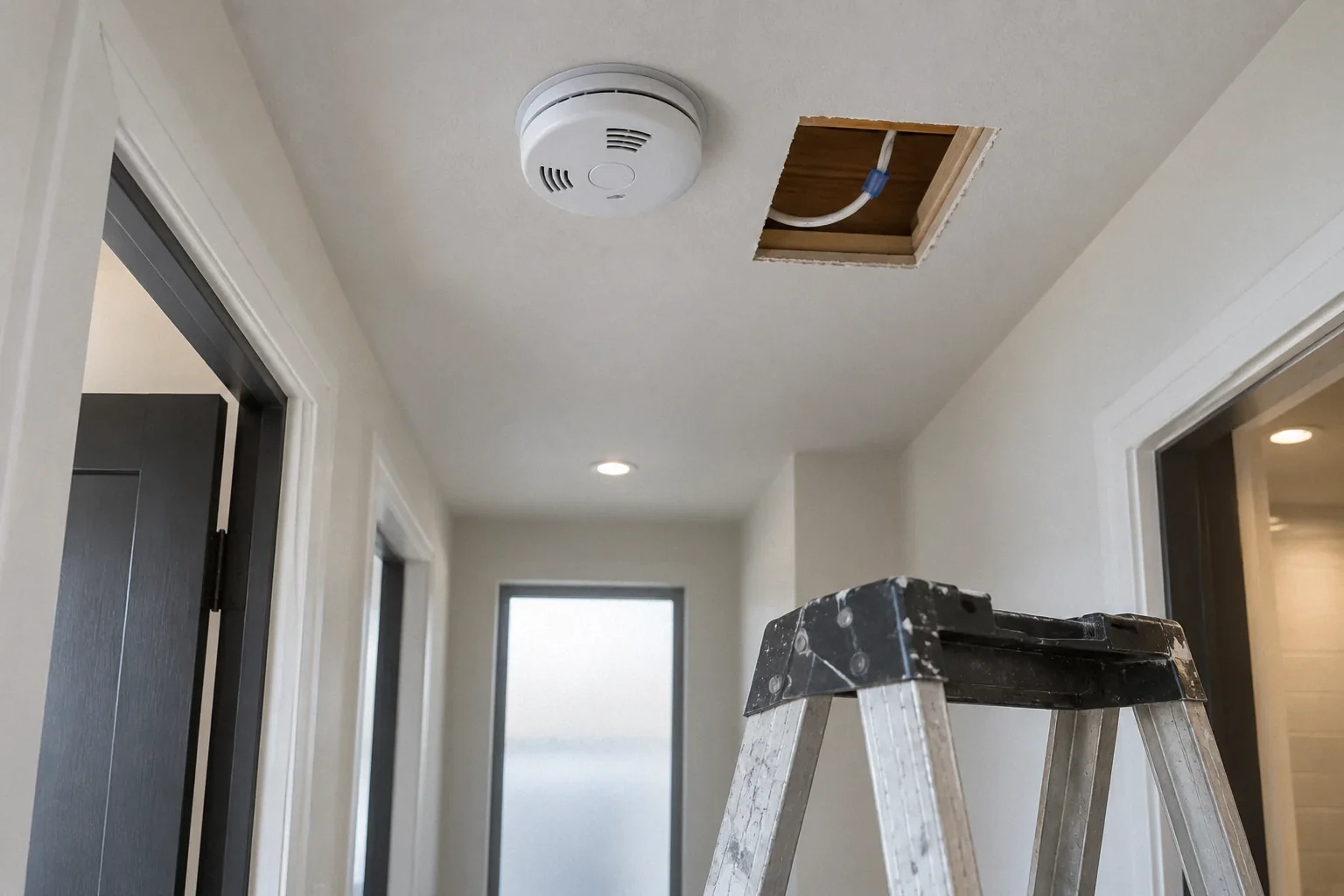
The fixture certificate is one of several whole-house items that alteration permits commonly bring in. Smoke and carbon monoxide alarm certification is another; see smoke and CO alarm requirements for remodel permits. Pleasanton's handout lists both, alongside the inspection sequence covered in our guide to remodel inspections. If the final is held up, what happens after a failed inspection explains how corrections and reinspections usually work.
Checklist
- House built on or before 1 January 1994? If yes or unclear, confirm with the department and plan for the rule.
- All fixtures in the dwelling inventoried with flow rates, including secondary baths; separate structures listed and scope confirmed locally
- Fixtures over 1.6 gpf, 2.5 gpm (shower) or 2.2 gpm (faucet) scheduled for replacement
- Replacement models meet the current values your department lists
- Local certificate obtained at permit issuance, not at final
- Photos and receipts kept for each installed fixture
- San Francisco: separate Chapter 12A compliance with DBI Housing Inspection Services
- Seller disclosure updated if you plan to sell
Current as of 3 October 2026. Civil Code § 1101.4 was last amended by AB 892 (Stats. 2019, ch. 310). Replacement flow rates come from the 2025 California Plumbing Code and CALGreen, in effect for permits since 1 January 2026, as cited on Pleasanton's January 2026 certificate. Codes change each cycle, so confirm values with your building department.
Questions that come up next
Do I have to replace all the toilets in my house if I only remodel the kitchen?
If the house was built and available for use on or before 1 January 1994, Civil Code § 1101.4(a) makes final permit approval for an alteration or improvement conditional on replacing all noncompliant plumbing fixtures in the house. A toilet is noncompliant only if it uses more than 1.6 gallons per flush, so newer low-flow toilets can stay. Stricter local ordinances may require additional replacements.
What flow rate does a replacement toilet or showerhead need?
The replacement must meet current standards for new construction. The City of Pleasanton's January 2026 kitchen handout lists 1.28 gallons per flush for toilets, 1.8 gpm for showerheads, 1.2 gpm for lavatory faucets and 1.8 gpm for kitchen faucets. Confirm the figures your own building department enforces.
Is my house exempt from SB 407?
The article does not apply to homes built and available for use after 1 January 1994, registered historical sites, buildings with permanently disconnected water service, or property where a licensed plumber certifies that water-conserving fixtures are not technically feasible because of the age or configuration of the plumbing.
Does San Francisco have a different rule?
Yes. San Francisco's Housing Code Chapter 12A also requires residential properties to meet water efficiency requirements at sale or remodel. As of October 2026, SF lists 1.28 gpf toilets and 1.8 gpm showerheads and faucets, with compliance certified through DBI Housing Inspection Services.
Sources and further reading
- California Civil Code § 1101.4 (single-family fixture replacement)
- California Civil Code § 1101.3 (definitions)
- California Civil Code § 1101.2 (scope: built on or before 1 Jan 1994)
- California Civil Code § 1101.7 (exemptions)
- California Civil Code § 1101.5 (multifamily and commercial)
- City of Pleasanton: Residential Kitchen Alteration Requirements (JLA 01.26)
- City of Pleasanton: Plumbing Fixture Certification (JLA 01/26)
- City of Palo Alto: Water-Conserving Plumbing Fixtures Certificate of Compliance by Property Owner
- Contra Costa County DCD: Certificate of Compliance for Plumbing Fixture Replacement (SB 407), with interpretation of triggering work
- SFPUC: Residential Water Conservation
- SF.gov: Comply with water conservation requirements
Community questions behind this guide
These discussions identify homeowner concerns. Forum comments are personal accounts, not code or legal authority.