Short answer: if you know about unpermitted work, plan to disclose it accurately and decide whether to legalize, correct or remove it. Do not invent a history for it. For transfers covered by California's disclosure article (see Civil Code § 1102 for scope; § 1102.2 lists exempt transfers), the statutory Transfer Disclosure Statement asks sellers whether they are aware of room additions, structural modifications or other alterations or repairs made without necessary permits or not in compliance with building codes (Civil Code § 1102.6). Those listed disclosures are a minimum. They do not limit other disclosure obligations that exist to avoid fraud, misrepresentation or deceit (§ 1102.8). Under Civil Code § 1710, deceit includes suppressing a fact by someone bound to disclose it, or giving other facts that mislead for want of that fact. A false story about who did the work is a misrepresentation, and it leaves the actual defects in place.
This is general information current to 3 October 2026, not legal advice. If you face a disclosure question in a real transaction, talk to a California real estate attorney.
The advice that keeps resurfacing
In a San Mateo County thread, an owner who had renovated three bathrooms without permits asked what would happen at their next permitted project and when they sold. A reply showing 78 upvotes when we read the thread was a single line: 'Repeat after me. It was like that when I bought the house.' Another commenter described telling a county inspector that a basement was finished before they bought. In the same thread, a licensed general contractor warned that a licensed contractor who skips a required permit risks the license, and that such contractors may be cutting other corners too. Another owner described paying a fine and legalizing the whole house over about two years with permits and plans. These are anecdotal accounts. They show two very different responses to the same problem.
Why 'blame the previous owner' is a red flag
- It is a misrepresentation if untrue. Telling an inspector or a buyer that work predates your ownership when it doesn't is not a technicality. Disclosure law and deceit principles are aimed at exactly that.
- The paper trail often contradicts it. Listing photos, prior disclosures, contractor invoices, neighbor knowledge, permit records and online reviews can show when work was done.
- It doesn't fix anything. If the shower waterproofing or wiring is defective, the story doesn't make it safe. The next owner, or you, still lives with it.
- It can make things worse. A misstatement discovered later can turn a manageable disclosure issue into a fraud claim. See defects found after closing.
- Even true, it is not a full answer. Unpermitted work that was there when you bought may still need disclosure when you sell, and the city may still require it to be legalized or corrected when it comes to light.
What sellers should do instead
| Situation | Honest options |
|---|---|
| You did the unpermitted work | Disclose accurately; consider legalizing before listing; or price and negotiate with the issue disclosed |
| A previous owner did it, and you know | Disclose what you know, including that it predates you; share any documents; consider a pre-listing inspection or contractor report |
| You suspect but don't know | Disclose the basis for your suspicion, such as 'county record shows 3 bedrooms; house has 4'; don't speculate beyond facts |
| Work is unsafe | Correct or remove; stop unsafe use; disclose |
Section 1102.4 limits liability only in defined circumstances. Under subsection (a), a seller or agent is not liable for an error, inaccuracy or omission that was not within their personal knowledge, was based on information timely provided by public agencies or by qualified experts described in subsection (c), and where ordinary care was used in obtaining and transmitting it. All of those conditions matter. Subsection (c) addresses information from licensed professionals, such as engineers, contractors and pest control operators, provided at request, for the items the expert's statement expressly covers. None of this protects a seller who withholds what they actually know. The section rewards accuracy and care, not ignorance.
For sellers who flipped
If you accept an offer within 18 months of acquiring title, Civil Code § 1102.6h requires disclosure of contractor-performed additions, structural modifications, other alterations or repairs since you acquired title, contractor contact information above the statutory threshold, and permits or where to find them. See the flipper disclosure law.
For buyers: signs of concealed or unpermitted work
- Patches of new paint, especially on ceilings under bathrooms or near windows
- New flooring in only part of a level
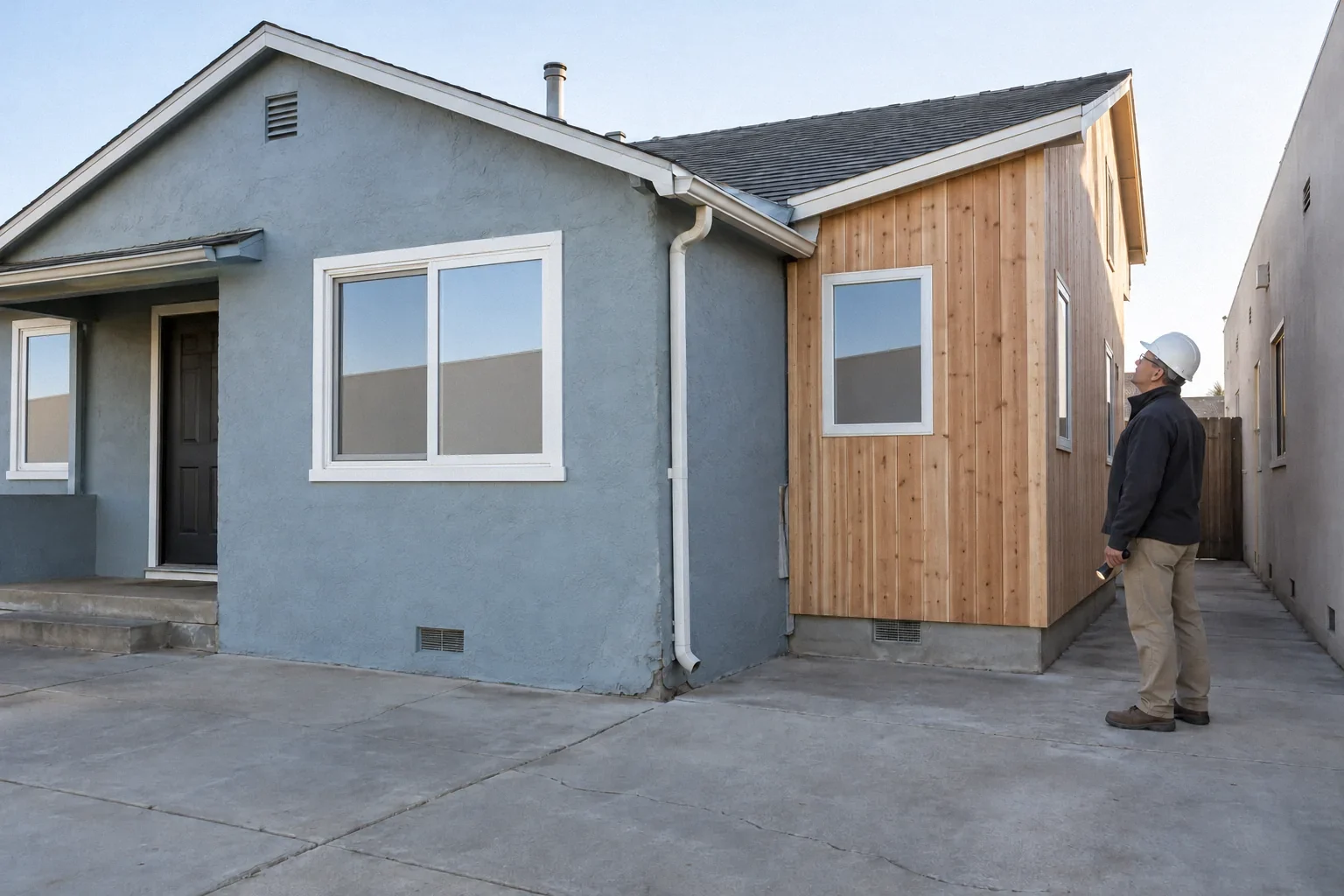
- A finished garage, basement or 'bonus room' with no permit record
- A room count higher than the county assessor's record
- Fresh caulk over old stains; new trim in odd places
- A seller story about work history that the documents don't support
None of these proves concealment, but each is worth a question in writing and, where appropriate, a specialist inspection. See buying with unpermitted work.
For owners planning permitted work now
If you are about to permit a new project and know about earlier unpermitted work:
- Talk to the department, or have your designer do so, about how it handles existing unpermitted work on the same property.
- Consider including legalization in the new permit, especially if walls will be open anyway. See legalizing unpermitted work.
- Do not 'stage' the house, for example by removing appliances before the inspection and reinstalling them after, to hide unpermitted work. It is deceptive and leaves the risk in place.
A worked example
Hypothetical. An owner retiled two showers without permits five years ago, using a contractor who called it cosmetic. Now they are selling.
- Disclosure: on the TDS, answer the unpermitted alterations question 'yes' and describe the work: dates, scope, contractor name, 'no permits pulled'.
- Documentation: provide the invoices and any photos taken during the work.
- Options: ask a licensed contractor to inspect visible conditions and comment, and price legalization. Some buyers will accept a credit; others will ask for legalization before closing.
- What not to do: tell buyers the showers were 'original', or tell an inspector they predate your ownership.
Insurance
Forum commenters claim that insurers look for unpermitted work when processing claims. How a particular policy treats unpermitted work depends on its terms and the facts. We cannot generalize. Ask your insurer directly, and don't rely on silence as coverage.
Bay Area applicability
Bay Area threads describe unpermitted work as widespread in some older neighborhoods. Even if true for a given area, that does not change any individual seller's disclosure duties or a building department's ability to require legalization. Permit records and enforcement practices are local, so involve the department with jurisdiction over your address.
Current to 3 October 2026.
Questions that come up next
Do I have to disclose unpermitted work when selling in California?
For covered transfers (some are exempt under § 1102.2), the statutory Transfer Disclosure Statement asks whether you are aware of alterations or repairs made without necessary permits or not in compliance with building codes. Listed disclosures are a minimum, and other obligations to avoid fraud or misrepresentation also apply. Get legal advice for your situation.
Is it OK to say unpermitted work was there when I bought the house?
Only if it is true, and even then you should disclose what you know. Saying it when untrue is a misrepresentation that can create liability and does nothing to fix underlying defects.
What if a previous owner did the unpermitted work?
Disclose what you know, including that it predates your ownership, and share any documents. The city may still require legalization or correction if it comes to light.
Should I legalize unpermitted work before selling?
It can reduce uncertainty for buyers, but it costs time and money and may uncover corrections. Compare legalization estimates with likely price effects, and ask your agent and attorney.
Sources and further reading
Community questions behind this guide
These discussions identify homeowner concerns. Forum comments are personal accounts, not code or legal authority.