Short answer: in California, a repair being "fixed" does not by itself take it off the disclosure. The Transfer Disclosure Statement (TDS) asks sellers about known defects and about specific history, including alterations or repairs made without necessary permits or not in compliance with building codes, and major damage from causes such as fire, earthquake or flood. Disclosures must be made in good faith, which Civil Code § 1102.7 defines as honesty in fact. A clear disclosure of what happened, how it was repaired, by whom, with what permits and documents, usually serves sellers better than silence: it lets buyers evaluate a closed issue instead of discovering an open question.
This guide explains which questions on the form tend to capture past repairs, how to decide what is material, and how to word a disclosure, with worked examples. It is general information current as of 3 October 2026, not legal advice. For your transaction, ask your agent and, where needed, a California real estate attorney.
Where sellers get stuck
In a San Mateo County thread, owners who had three bathrooms retiled years earlier asked whether future buyers would notice the work had been done without permits. A Bay Area owner described having to legalize a previous owner's unpermitted kitchen when a later permitted remodel brought in a plumbing inspector. And a buyer who knew about a shower leak before buying chose to accept it as part of a credit negotiation, which is the kind of informed decision a disclosure makes possible. These are personal accounts, not legal authority.
What the TDS asks that captures repairs
The statutory TDS format is set out in Civil Code § 1102.6, reproduced in the Department of Real Estate's current Real Estate Law excerpts. In the current form, Section II asks the seller several questions that reach past repairs:
- II.B: whether the seller is aware of significant defects or malfunctions in listed components, including interior and exterior walls, ceilings, floors, insulation, roof, windows, doors, foundation, slab, driveways, sidewalks, walls and fences, electrical systems, and plumbing, sewers and septics.
- II.C.1: environmental hazards, with examples that include asbestos, formaldehyde, radon, lead-based paint, mold, fuel or chemical storage tanks, and contaminated soil or water.
- II.C.4 and C.5: room additions, structural modifications, or other alterations or repairs made without necessary permits, and those not in compliance with building codes.
- II.C.6 to C.9: fill; settling, slippage, sliding or other soil problems; flooding, drainage or grading problems; and major damage from fire, earthquake, floods or landslides.
- II.C.15 and C.16: notices of abatement or citations, and lawsuits or claims, including construction defect claims under Civil Code §§ 910 or 914, affecting the property.
- II.D: certifications about operable smoke detectors and water heater bracing as of close of escrow. The form's notes also flag the water-conserving plumbing fixture rule in § 1101.4 and list water-conserving fixtures among property features.
The DRE's older consumer guide Disclosures in Real Property Transactions (2005) reproduces an earlier version without some of these additions, such as the reference to mold. Use the current form your agent provides and read every question as written. Several questions turn on history, not just current condition.
Deciding what to disclose: a working framework
| Question | If yes |
|---|---|
| Does a TDS question, read literally, describe this event or work? | Answer it and explain |
| Was the repair done without a required permit? | The form asks directly; disclose |
| Is the cause uncertain, or could it recur (drainage, settlement, roof flashing)? | Disclose the history and what was done |
| Was there related damage you did not repair, such as framing or subfloor? | Disclose what you know |
| Would a reasonable buyer want to know it to judge value or desirability? | Lean toward disclosure and ask your agent |
| Do you have documents (invoices, permits, reports)? | Attach or offer them |
Routine maintenance such as replacing a worn faucet cartridge rarely raises these questions. A leak that reached a ceiling, a shower that was rebuilt, a foundation or drainage repair, roof leak repairs, or termite damage repairs usually do. When in doubt, ask your agent; the law also gives some protection for honestly reported information. Under § 1102.4, a seller is not liable for an error or omission that was both outside their personal knowledge and handled with ordinary care, and delivering a qualified expert's report can satisfy the duty for that item. That expert-report protection has conditions: it applies to information within the scope of the expert's license or expertise, and it does not excuse what the seller actually knows. It is a reason to attach reports, not a blanket defense.
How to write it: worked examples
1. A repaired supply-line leak
Weak: "Minor leak, fixed."
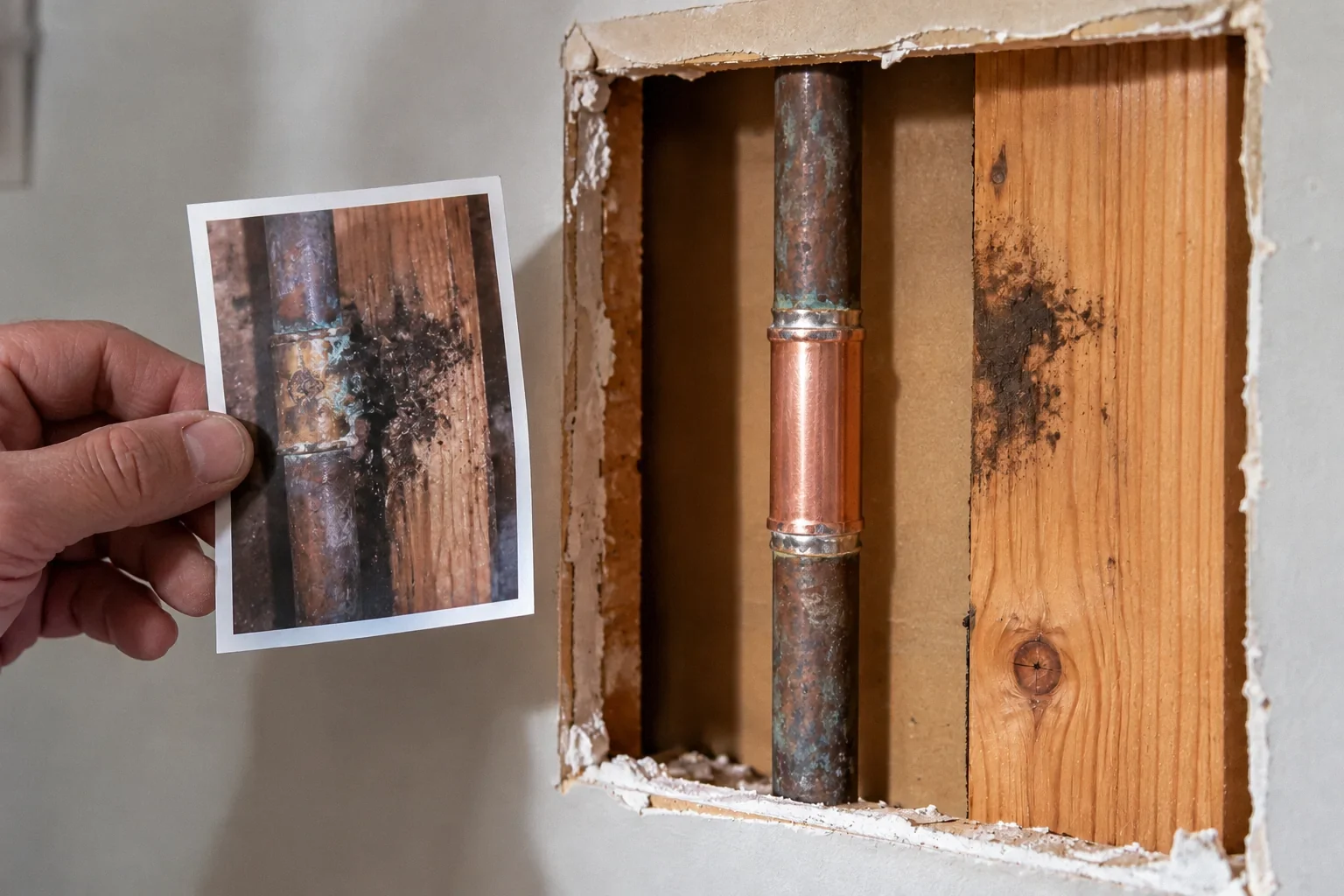
Better: "March 2024: supply line to upstairs hall toilet failed; water came through the living room ceiling. Plumber replaced the supply line and shutoff valve (invoice attached). Ceiling drywall replaced and painted by a drywall contractor. No further leaks observed since."
2. A shower rebuilt without a permit
Weak: leaving the permit question unanswered or describing it as "cosmetic update."
Better: "2019: primary bath shower retiled, including new pan, by [contractor]. We did not obtain a building permit; we have since learned one may have been required. Contractor invoice attached." Consider whether to legalize first; see legalizing unpermitted work.
3. Repairs by a prior owner you know about
Better: "Per the previous owner's disclosure when we bought in 2016 (attached), foundation bolting was performed in 2012 under permit [number]. We have no further information." Saying what you know, and what you do not, is consistent with good faith; "it was like that when I bought it" is not a substitute for disclosing what you actually know. See unpermitted work red flags.
4. A recurring condition
Better: "Window sills in the north bedrooms show condensation in winter; we wipe them and run a dehumidifier. Sill paint touched up in 2025." Ongoing conditions are part of the property's condition, not a past event.
Practical steps
- Gather records: invoices, permits, inspection and pest reports, insurance claim files, warranties, and photos taken during repairs.
- Pull your property's permit history and compare it with the work you know about. See open and expired permits.
- Draft disclosures with dates, causes, repairs, who did them and documents.
- If you are within 18 months of acquiring title when you accept an offer, also prepare the contractor and permit disclosure under § 1102.6h; see flip disclosures.
- If you learn something new after delivering the TDS, amend it in writing; § 1102.9 allows amendments, which can give the buyer a new termination window under § 1102.3.
- Ask an attorney about anything you are unsure how to describe.
Mistakes sellers make
- Treating "fixed" as "no longer relevant."
- Writing vague one-word answers that invite suspicion.
- Leaving permit questions blank or answering them inaccurately.
- Repainting stains right before listing without disclosing the cause.
- Relying on an as-is clause; the DRE guide explains that as-is does not remove the duty to disclose known material facts. See seller disclosures.
Checklist
- Every TDS question read as written on the current form
- Past leaks, rebuilt wet areas, roof, foundation, drainage and pest repairs listed
- Permit status of each repair checked
- Dates, causes, repairs, contractors and documents included
- Prior-owner information you know disclosed and sourced
- Ongoing conditions described
- Amendment plan if new information arises
Current as of 3 October 2026. Disclosure is fact-specific; get individual advice where stakes are high.
Questions that come up next
Do I have to disclose a leak that was repaired years ago?
Often it is wise to, especially if water reached ceilings, walls or floors, the cause could recur, or the repair was done without a permit. The current TDS asks about alterations or repairs made without permits, flooding and drainage problems, major flood damage, and environmental hazards including mold. Describe what happened, how it was fixed and attach invoices.
What if a previous owner did the repair?
Disclose what you know, cite your source (for example, the prior owner's disclosure), and say what you do not know. Good faith means honesty in fact, not guessing.
Will disclosing a past repair scare buyers away?
It may affect negotiations, but a documented, closed repair is easier for buyers to evaluate than a fresh paint patch they discover during inspection. Nondisclosure of known material facts creates legal risk.
Can I fix the disclosure after I give it to the buyer?
Yes. Civil Code § 1102.9 allows written amendments, and an amendment delivered after the offer can give the buyer a termination window under § 1102.3.
Sources and further reading
- California DRE: Real Estate Law excerpts, Civil Code § 1102.6 Transfer Disclosure Statement (current form)
- California DRE: Disclosures in Real Property Transactions (RE 6, 6th ed. 2005), historical context
- California Civil Code § 1102.7 (good faith)
- California Civil Code § 1102.4 (liability limits)
- California Civil Code § 1102.9 (amendments)
- California Civil Code § 1102.6h (flip disclosure)
Community questions behind this guide
These discussions identify homeowner concerns. Forum comments are personal accounts, not code or legal authority.