Short answer: a showroom visit or sample cabinet can reveal useful signs of construction quality, but it cannot prove long-term durability. Look at five things: what the case is made of and how its joints are built, how the drawer boxes are constructed, the hinges and drawer slides, the finish on the faces and the inside edges, and how the cabinet is meant to be fastened to the wall and to its neighbors. Then check two pieces of paper. A KCMA A161.1 certification means a sample of that cabinet line passed a published set of load, cycling and finish tests. A formaldehyde compliance label is required by California and federal rules for cabinets containing regulated hardwood plywood, particleboard or MDF, so its absence is itself a warning sign.
"Plywood good, particleboard bad" is too simple. Particleboard and MDF boxes from a disciplined manufacturer can outperform plywood boxes from a careless one. The real dividing lines are moisture exposure, joinery and hardware. This guide is general information verified on 3 October 2026.
What prompted this guide
Several kitchen discussions in our sample concern cabinet choices. One extensively discussed post in r/kitchenremodel was a before-and-after in which the owner described the old cabinets as homemade from 2x4s and planks, with contact paper on the shelves and no partitions between cabinets, so items fell under the dishwasher. At the other end, an owner who did a DIY kitchen used semi-custom ready-to-assemble (RTA) cabinets and said the labor savings paid for better appliances. Another large family remodel used IKEA boxes and put the budget into appliances and structural beams. An investor who remodeled a rental chose relatively inexpensive in-stock hickory cabinets from a big-box store. And a Milpitas owner doing a budget refresh kept the existing cabinets but replaced the wood under the sink because of water damage.
These are personal accounts from indexed thread snapshots, not product tests. Together they show the real decision: there is no single "good" cabinet tier. The goal is a cabinet built well enough for where it will sit and how it will be used.
The five physical checks
1. The case (box)
Most cabinet boxes are made from plywood, particleboard or MDF, usually with a melamine or veneer surface. What matters:
- Panel thickness and backs. Very thin backs that are only stapled on can rack or pull loose when the cabinet is screwed to an out-of-plumb wall. A thicker back, or a hanging rail at the top of a wall cabinet, gives the installer something solid to screw through.
- Joinery. Dadoes (grooves the panels sit in), dowels, confirmat screws or cam fittings are all workable when done well. Staples and glue alone at the main corners are a weaker sign.
- Edge sealing. Particleboard and MDF swell when water reaches an unsealed edge. Look at the bottom edge of the sink base and the cutouts for plumbing. Exposed raw core around a sink is where boxes fail first.
- Partitions. In face-frame cabinets, check whether each box is a complete box. The homemade cabinets in the thread above had no walls between units, which is why items fell under the dishwasher.
2. Drawer boxes
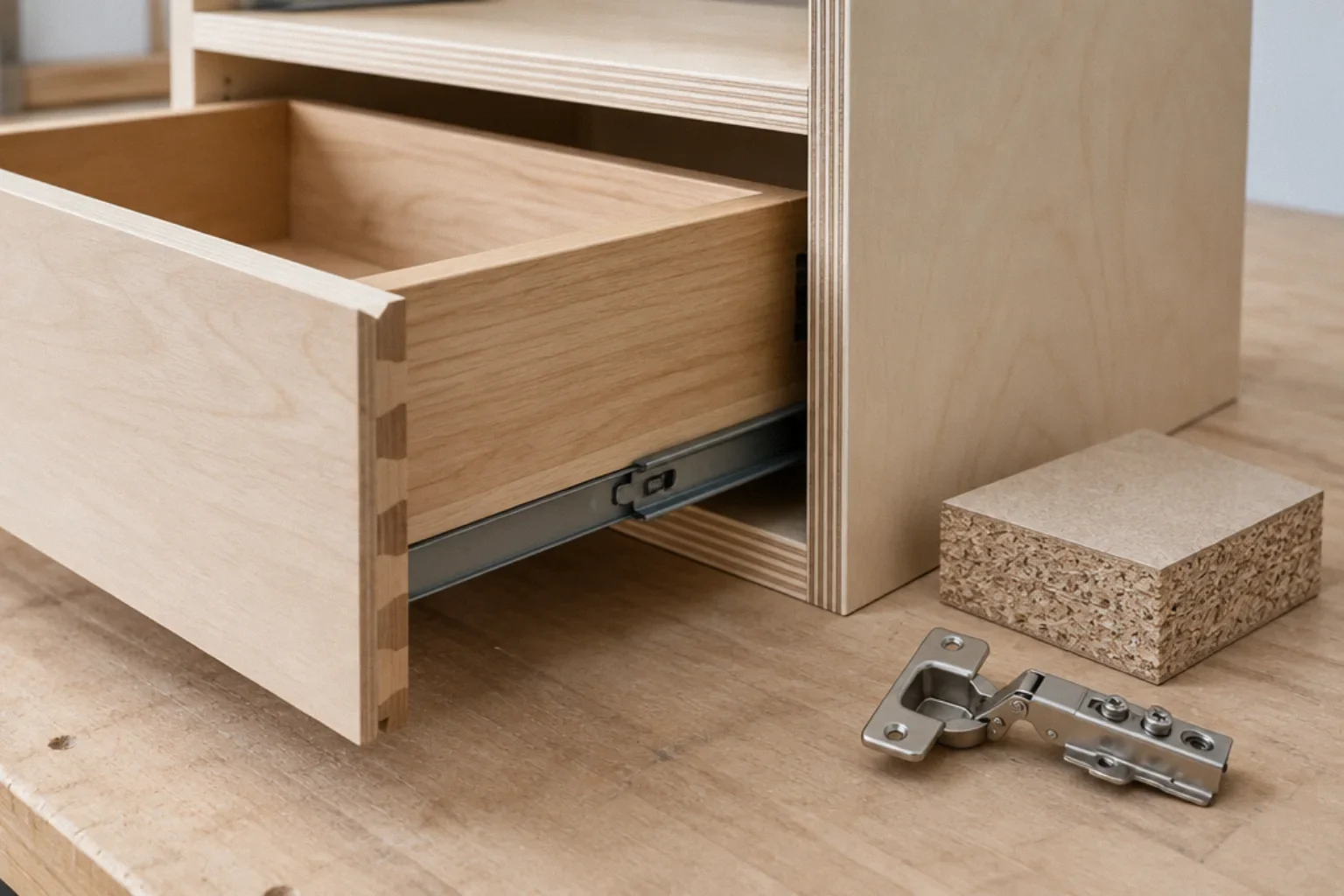
Drawers take the most abuse. Pull one out fully and look at the corners and bottom. Dovetailed or doweled solid wood, or a metal drawer system from a known hardware maker, generally holds up. Stapled thin-panel corners and a bottom that is only glued to the underside of the sides, rather than captured in a groove, are signs of a lower tier. Press down in the center of the bottom: it should not flex much when empty.
3. Hinges and slides
Look for adjustable concealed hinges, ideally with integrated soft-close, and full-extension slides with a stated load rating. Open a door and lift gently at the free edge: there should be no wobble at the hinge cup. Slides should run smoothly at full extension with weight in the drawer. Hardware is replaceable later, but a box that cannot accept standard hinges or slides limits your repair options.
4. Finish
Check the inside edges of doors, the inside of the case, and the corners of profiled doors, where paint and lacquer are thinnest. Painted MDF doors should have smooth, sealed edges. Painted solid-wood doors will show hairline cracks at the joints of five-piece doors as the wood moves seasonally. Minor joint lines can result from natural wood movement; excessive cracking or separation still warrants comparison with the manufacturer’s finish specification and warranty.
5. Installation provisions
Ask how the cabinets are fastened to studs and to each other, and whether the manufacturer publishes installation instructions. Ask, too, whether its warranty depends on following them. Even good boxes perform badly if they are shimmed poorly, hung on drywall anchors, or forced flat against a wavy wall.
What the KCMA seal means
The Kitchen Cabinet Manufacturers Association runs a certification program for the ANSI/KCMA A161.1 performance standard. KCMA describes certified cabinets as having passed 14 tests covering structural strength, drawer and door integrity, and finish durability, and states that 40% to 50% of cabinets fail their first certification attempt. KCMA's own test summary includes, among others:
| Test (per KCMA summary) | What is applied |
|---|---|
| Shelves and bottoms | 15 lb per sq ft held for seven days, checked for excessive deflection and joint separation |
| Wall cabinet mounting | Gradually loaded to 600 lb without visible failure of the cabinet or mounting system |
| Door operation | 25,000 open-close cycles through a 90-degree swing; a 65 lb door load test |
| Drawer operation | Loaded at 15 lb per sq ft and cycled 25,000 times |
| Finish: heat and cold | Hot box at 120°F and 70% relative humidity; hot-cold cycling down to -5°F |
| Finish: spills | Vinegar, juices, ketchup, coffee, olive oil and 100-proof alcohol for 24 hours; mustard for one hour |
| Finish: detergent | Door edge exposed to a standardized detergent for 4 to 24 hours depending on door type |
Read the seal for what it is. It is evidence that a cabinet line met a lab performance standard. It does not cover your installation, your plumbing leaks, or every line a manufacturer sells, so confirm that the specific series you are buying is certified. A cabinet without the seal is not necessarily poor, because certification is not universal. For uncertified products, the physical checks above and references from past clients matter more.
The formaldehyde label: a California rule that applies to cabinets
California's Air Resources Board regulates formaldehyde emissions from hardwood plywood, particleboard and MDF, and from finished goods made with them. CARB's Composite Wood Products program page lists cabinets among the finished goods covered. Under CARB's labeling FAQ, finished goods sold in California must carry the fabricator's name, the date of production, and a statement that Phase 2 emission standards are met, such as "California 93120 Compliant for Formaldehyde". The label goes on the product or on every box.
At the federal level, the U.S. EPA's consumer FAQ states that the federal emission standards are identical to CARB's Phase II standards, and that finished goods produced after 22 March 2019 must be labeled with the fabricator's name, the production month and year, and a TSCA Title VI compliance statement.
What to do with this: ask to see the label, or a photo of it, before you buy, particularly for imported RTA cabinets bought online. A missing label does not prove a product is unsafe, but it means you cannot confirm compliance, and that is a reasonable basis for walking away. Some products are labeled as made with no-added-formaldehyde (NAF) or ultra-low-emitting formaldehyde (ULEF) resins, which CARB's FAQ says can be stated on the label.
RTA, stock, semi-custom, custom: how the tiers differ
| Type | What it usually means | Watch for |
|---|---|---|
| RTA (ready to assemble) | Flat-packed boxes you or an installer assemble; quality ranges widely from flimsy to very good | Assembly quality is now your responsibility; check joinery method, back thickness and formaldehyde label |
| Stock (in-store) | Fixed sizes and finishes, often available quickly | Filler strips to fit your room; limited sizes can waste space in small Bay Area kitchens |
| Semi-custom | Standard boxes with size, depth and finish options | Lead time; confirm the exact box material and drawer construction for the series you order |
| Custom / local shop | Built to your dimensions | No universal standard; judge by shop drawings, sample doors, past work and the written spec |
Price does not map cleanly onto these tiers. A semi-custom RTA line can match or exceed a store-brand assembled cabinet. The physical checks are a better guide than the category name.
Mistakes homeowners report or risk
- Spending on doors and nothing on drawers. Doors are what you see. Drawers are what you use. If budget is tight, prioritize drawer boxes and slides in the most-used stack near the range.
- Ignoring the sink base. The Milpitas thread is typical: water damage under the sink is common. Ask for a water-resistant sink base option or a liner, and fix slow plumbing leaks promptly.
- Accepting a vague contract line. California requires a home improvement contract to describe the work and significant materials (BPC § 7159). Write the cabinet maker, series, box material, door style, finish and hardware into the contract or an attached specification, not just "kitchen cabinets".
- Ordering before field measurements. Verify dimensions, appliance clearances and the planned layout with the supplier before placing the order. Where concealed conditions prevent reliable measurements, agree on a final field-measurement stage and account for the resulting lead time before demolition. See our guide to ordering materials before demolition for the timing trade-off.
- Assuming a label you did not see. Confirm the formaldehyde label before installation, not after.
Bay Area considerations
The CARB labeling rule is California law and applies statewide, including to cabinets bought online and shipped into the Bay Area. Kitchens in many of the region's mid-century tract homes and older flats are compact, so box sizing and filler waste matter more than in a large suburban kitchen. Semi-custom sizes or a local shop may make better use of a narrow galley. Coastal areas have higher humidity than inland valleys, which affects solid-wood door movement and painted joints. Replacing cabinets like-for-like is often treated differently from a layout change by building departments, but cabinet work usually comes with electrical and plumbing changes, which do trigger permits. The City of Pleasanton's kitchen alteration handout states that a permit is required for all new, relocated or remodeled kitchens; other cities set their own rules, so check with yours. See kitchen remodel permit requirements.
Showroom checklist
- Case material and thickness, back thickness, hanging rail on wall cabinets
- Joinery at main corners (not staples alone)
- Sealed edges at the sink base and plumbing cutouts
- Drawer box corners and captured bottoms; bottom does not sag
- Adjustable concealed hinges; full-extension slides with a load rating
- Finish quality on inside edges and profiled corners
- Published installation instructions and warranty terms
- KCMA A161.1 certification for the specific series (if the maker claims it)
- Formaldehyde compliance label (CARB 93120 / TSCA Title VI) with fabricator and date
- Exact series, materials and hardware written into the contract
Questions that come up next
Are plywood cabinets always better than particleboard?
No. Plywood holds screws well and resists moisture somewhat better, but a well-made particleboard or MDF box with sealed edges, good joinery and solid hardware can outperform a poorly made plywood box. Moisture exposure, especially at the sink base, matters more than the core material alone.
What does the KCMA certification seal mean?
It means a sample of that cabinet line passed the ANSI/KCMA A161.1 performance tests, which KCMA describes as 14 tests covering structure, door and drawer cycling, and finish durability. It does not cover installation or every series a maker sells, so check the specific line.
Do cabinets sold in California need a formaldehyde label?
Yes, if they contain hardwood plywood, particleboard or MDF. CARB requires the fabricator's name, production date and a Phase 2 compliance statement, and federal TSCA Title VI rules require a similar label. Ask to see it before buying, especially for imported RTA cabinets.
Are RTA cabinets good enough for a remodel?
Some are. RTA quality varies widely. Check the joinery method, back thickness, drawer construction, hardware and formaldehyde label, and remember that assembly quality becomes your responsibility or your installer's.
What should the contract say about cabinets?
California home improvement contracts must describe the work and significant materials. Name the manufacturer, series, box material, door style, finish and hardware, or attach a specification sheet, rather than writing only 'cabinets'.
Sources and further reading
- KCMA: Cabinet Certifications (ANSI/KCMA A161.1)
- KCMA: Cabinets Certified to Last (A161.1 test summary)
- California Air Resources Board: Composite Wood Products Program
- CARB: Frequently Asked Questions, Labeling (composite wood finished goods)
- U.S. EPA: Frequent Questions for Consumers, Formaldehyde Standards for Composite Wood Products Act
- California Business and Professions Code § 7159
- City of Pleasanton: Residential Kitchen Alteration Requirements (JLA 01.26)
Community questions behind this guide
These discussions identify homeowner concerns. Forum comments are personal accounts, not code or legal authority.