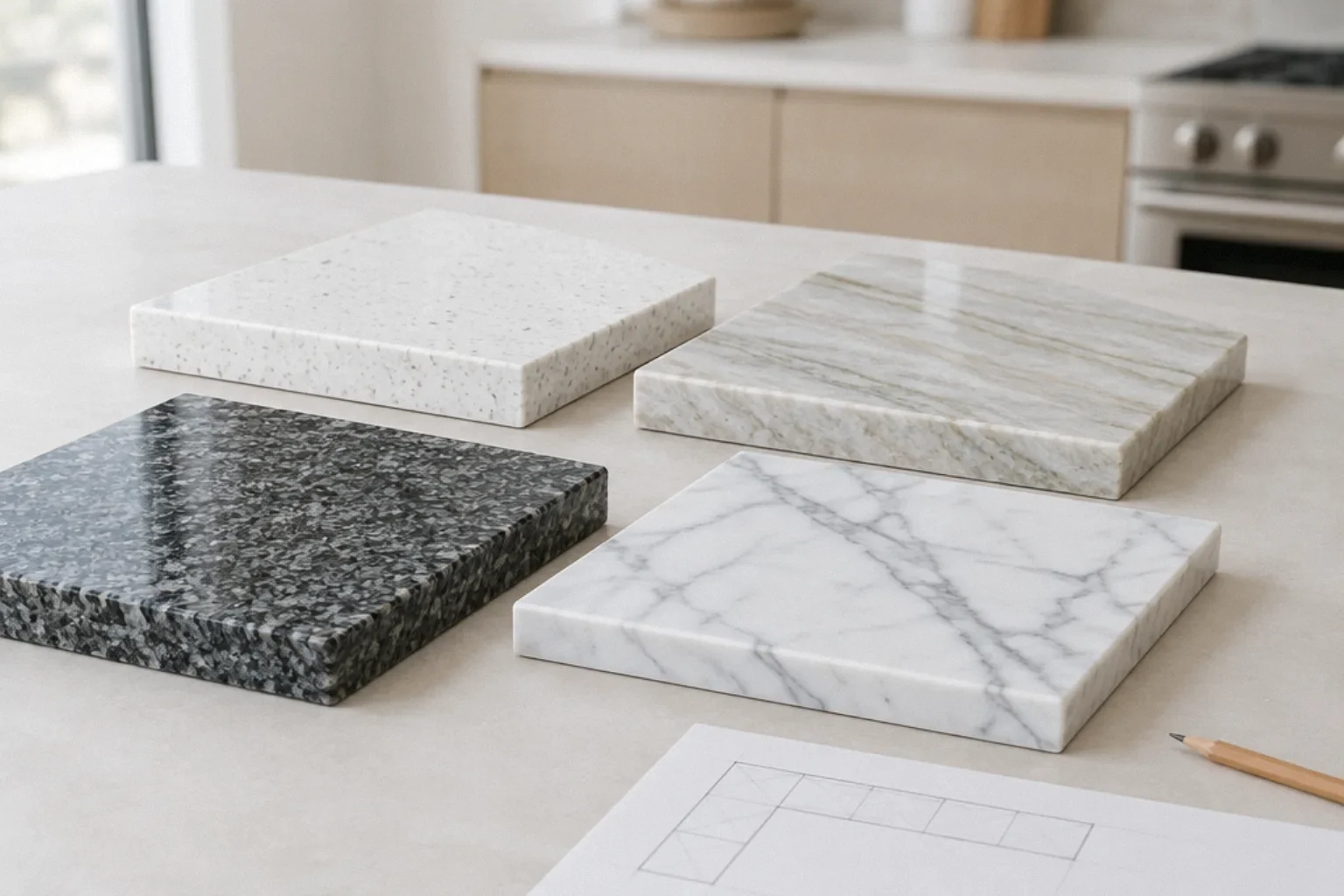
Short answer: choose the material whose weaknesses you can live with, verify that the slab is what it is sold as, and then spend as much attention on slab selection, seams, support and sink mounting as on the material itself. In broad terms, engineered quartz needs no regular sealing but has heat and chemical limits set by each manufacturer; calcareous natural stones such as marble are sensitive to acids and can etch; siliceous stones such as granite and true quartzite are generally resistant to kitchen acids, according to the Natural Stone Institute. Whatever you choose, protect every surface from hot cookware with a trivet. California's ongoing rulemaking on engineered stone fabrication is a separate factor in timing and supply; see engineered stone and silica rules.
This guide compares materials on the issues owners raise, shows how to check what you are buying, and walks through the fabrication decisions that often decide whether a counter is a success. It is general information current as of 3 October 2026.
What owners regret, and what they don't
In a thread about kitchen regrets, one owner called Carrara marble "not guest friendly" because every water mark and stain showed despite care. Another owner said white quartz was the one thing they would not repeat because they felt it scratched easily. An owner who hated a new kitchen blamed the combination of a sparkly quartz and a backsplash chosen in a hurry. Others were content: one owner dreamed of swirly marble but was happy with quartz, and a commenter on a planning thread argued for laminate over any quartz. These are personal opinions; they show that regret is usually about fit and execution, not one material being bad.
The materials compared
| Material | What it is | Watch-outs |
|---|---|---|
| Engineered quartz | Manufactured slab of stone aggregate and resin | Heat and chemical limits per manufacturer; light, uniform colors can show wear; fabrication subject to California silica rules |
| Granite (siliceous) | Natural igneous stone | Varies by slab; ask whether that stone benefits from an impregnator |
| Quartzite (true) | Metamorphic rock made almost entirely of quartz | Mislabeling risk; verify before buying (below) |
| Marble, limestone (calcareous) | Natural calcium carbonate stones | Etching from acids such as lemon and vinegar; staining |
| Porcelain and other manufactured ceramic or "sintered" slabs | Manufactured panels; composition and performance vary by maker | Check the specific manufacturer's data on heat, edges and repair; cutting still creates silica dust |
| Laminate, solid surface, wood, stainless | Various | Heat, seams, scratches and maintenance vary by product |
On natural stone care, the Natural Stone Institute recommends neutral cleaners, stone soap or mild dish detergent, and notes that sealing ("impregnating") makes stone more stain resistant, not stain proof, and that many stones do not need it.
Verify what you are buying
The Natural Stone Institute's consumer site describes quartzite as commonly mislabeled, with marble or dolomitic marble sometimes sold under that name. It describes simple tests: real quartzite scratches glass, and an acid such as lemon juice or vinegar produces no etch on quartzite but visible etching on marble and more subtle etching on dolomitic marble. Do these tests only on a sample or offcut you have permission to mark, not on a display slab. For any material, ask the supplier for the stone's name, origin and any technical data, and get the identification in writing on your invoice.
Test samples safely
- Use a disposable sample or offcut the supplier has agreed you can mark.
- Apply drops of lemon juice, oil, coffee and red wine; leave them for a set time, wipe, and look under your kitchen lighting at different angles.
- Do not test heat with a hot pan; it adds burn risk and tells you little. Rely on the manufacturer's or supplier's guidance and plan to use trivets for all hot cookware.
- See sampling finishes for viewing samples with cabinets and backsplash together.
The fabrication decisions that matter as much as material
| Decision | Why it matters | What to ask |
|---|---|---|
| Slab selection | Natural stone and many engineered patterns vary across and between slabs | Can I approve the actual slabs, and see the layout of where each piece will be cut? |
| Seam location | Seams are visible on many materials; Cambria, for one, notes its product is not seamless | Where will seams fall? Can they avoid the sink, cooktop and long unsupported runs? |
| Support and overhangs | Overhangs at islands and peninsulas need support appropriate to the material and thickness | What overhang is allowed for this material without brackets or corbels, and who supplies the support? |
| Cabinet level and flatness | Slabs need a flat, level base; out-of-level cabinets can stress stone | Who checks and shims cabinets before templating? |
| Sink mounting | Undermount sinks need an approved mounting and support system; the method affects long-term support | How will the sink be mounted and supported, and per whose instructions? |
| Cutouts | Cutouts for cooktops and sinks are stress points | Will cutouts be made in the shop, with what corner radius, following the cooktop's installation requirements? |
| Edge profile | Some profiles chip more easily depending on the material | Which profiles does the fabricator recommend for this material in a busy kitchen? |
A decision method
- Describe your kitchen honestly: who cooks, how often, with what (citrus, wine, tomato, oils), and whether children, renters or frequent guests use it.
- Rank what would bother you: etching, stains, scratches, visible seams, maintenance chores, or a surface that looks too uniform.
- Shortlist two or three materials whose watch-outs you can accept.
- Verify identification for natural stone and gather manufacturer care sheets for engineered products.
- Test samples safely as above.
- Approve slabs, seams, overhang support and sink mounting before fabrication.
Illustrative household preferences
These are examples of how preferences can map to choices, not a ranking of materials:
- A busy family that cooks daily and dislikes upkeep might lean toward a patterned surface that hides wear, with trivets at the range and a cutting board station.
- A baker who enjoys patina might choose a honed marble island and a more acid-resistant material at the sink.
- A rental owner might prioritize replaceability and cost, such as laminate or a mid-range granite.
- An owner planning a busy patterned backsplash might choose a quieter counter and review both together before ordering.
Checklist
- Use profile written down; tolerance for etching, stains, scratches and seams ranked
- Natural stone identity verified and written on the invoice
- Samples tested safely; no hot-pan tests
- Actual slabs and seam layout approved
- Overhang support and sink mounting specified
- Cutouts and edge profile agreed with the fabricator
- Fabricator asked about wet methods and regulatory timing
- Care instructions saved; trivets planned for all hot cookware
Current as of 3 October 2026. Properties vary by brand and slab; rely on the manufacturer's or supplier's documentation for your material.
Questions that come up next
Is quartz or granite better for a kitchen?
It depends on how you cook and what would bother you. Engineered quartz needs no regular sealing but has manufacturer heat and chemical limits. Granite is a siliceous stone the Natural Stone Institute describes as generally resistant to kitchen acids; some granites benefit from an impregnator. Use trivets for hot cookware on either.
Does marble etch even if it's sealed?
Yes, it can. The Natural Stone Institute says sealing makes stone more stain resistant, not stain proof, and calcareous stones such as marble are sensitive to acids, which can dull or etch them.
How can I tell if a slab is really quartzite?
The Natural Stone Institute's consumer site says quartzite is commonly mislabeled and describes a glass scratch test and an acid etch test: real quartzite scratches glass and shows no etch from lemon or vinegar. Test only an offcut you have permission to mark, and get the identification in writing.
Where should countertop seams go?
Ask the fabricator to show the seam layout before cutting and to keep seams away from sinks, cooktops and long unsupported spans where possible. Seams are visible on many materials.
Sources and further reading
Community questions behind this guide
These discussions identify homeowner concerns. Forum comments are personal accounts, not code or legal authority.