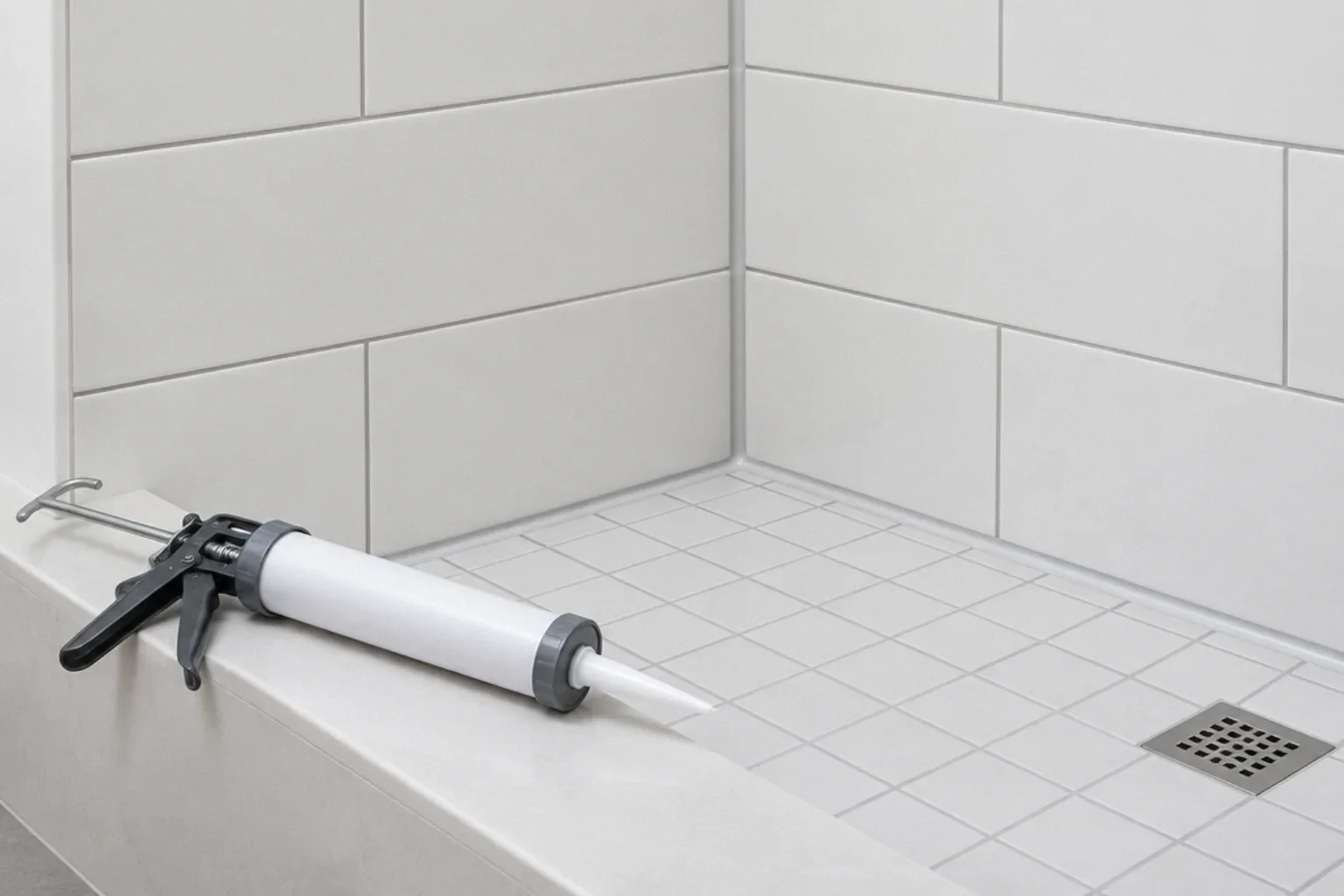
Short answer: in a tiled shower, cementitious or epoxy grout goes in the flat joints between tiles on the same surface. A flexible sealant (the product most people call caulk) goes wherever two planes meet or where tile meets a different material: inside corners where walls meet, the floor-to-wall joint, the joint where the curb meets the wall, around the tub or shower pan edge, and, in many assemblies, along perimeters where tile stops against another material. Proprietary trim profiles, drains, shower doors and niche systems can have their own joint details, so follow those manufacturers' instructions where they differ, including any drainage or weep paths they require. Tile industry guidance calls these movement joints and says they must not be filled with grout. The Ceramic Tile Foundation's explainer of the Tile Council of North America (TCNA) EJ171 guideline states that the sealant in these joints must be 100% silicone, urethane or polysulfide.
The more important point is this: neither grout nor caulk is what keeps water out of your walls. In a properly built shower, waterproofing sits behind or beneath the tile as a membrane or liner. Grout and caulk are the finish. If water is reaching a ceiling below, surface resealing does not establish the cause and may not repair it; supply or drain plumbing, the door or enclosure, the drain connection and the waterproofing layer are all possible sources. This article explains the difference and when a cracked corner is cosmetic and when it is a symptom. It is general information verified on 3 October 2026.
The problem homeowners keep running into
A recurring pattern in renovation forums is a leak that two people diagnose two ways. In one thread about a leaking upstairs shower, the owner described a leak detector pointing to the shower pan, then two separate contractors insisting it was DEFINITELY
grout. The shower was completely re-grouted, and the wet spot in the garage ceiling came back within days. Replies in that thread pointed out that a shower's waterproofing is contained beneath the tile and grout. In another post, a buyer who had accepted a known shower leak at purchase asked whether to reseal around the drain with grout or caulk; one commenter said grout should never be used against the plastic drain and recommended caulk, while another said the whole liner needed replacing. In a thread about a leak in a newly renovated shower, a reply noted cracked grout in a corner where color-matched caulk should have been, but added that unless something was missed there was a failure in the waterproofing behind the tile. And in a discussion of bathroom renovation regrets, one commenter warned that because a house moves, you will be constantly redoing cracked grout.
Forum accounts like these are anecdotal and are not technical authority; we cannot know from them what actually caused any particular leak. They are useful because they show two separate questions that are easy to confuse: which joints should be flexible, and what actually stops water.
Why corners crack: grout is rigid, buildings move
Cement-based grout cures hard. It bonds tile to tile across a narrow joint on one flat surface, where the tiles move together. At an inside corner, two different wall surfaces meet, often built from separate sheets of backer board fastened to different studs. Framing shrinks and swells with humidity, floors deflect under load, and the shower floor and walls expand at different rates when hot water hits them. A rigid material bridging two surfaces that move independently is prone to cracking, often as a hairline running up the corner or along the floor-to-wall joint.
EJ171 addresses this by requiring perimeter and change-of-plane movement joints. According to the Ceramic Tile Foundation summary, a change of plane joint (floor to wall or wall to wall) should be the same width as the grout joint but never less than 1/8 inch. For tile exposed to moisture, the preferred width is 1/4 inch and not less than 1/8 inch. Custom Building Products' technical bulletin TB100, which summarizes changes made in the 2017 edition of the TCNA Handbook, says perimeter and change-of-plane recommendations were clarified in that edition and that Class 25 sealant replaced Class 12½. That bulletin is historical; EJ171 is revised with new Handbook editions, so ask your installer which current edition and which product specifications they are following.
Which joint gets which material
| Location in a tiled shower | Material normally specified | Why |
|---|---|---|
| Flat joints between wall tiles on one wall | Grout (cement or epoxy, per tile and grout maker) | Tiles on one plane move together |
| Flat joints between floor tiles in the shower pan | Grout | Same plane; floor is sloped but continuous |
| Vertical inside corners where two walls meet | Flexible sealant | Change of plane; two surfaces move separately |
| Floor-to-wall joint all around the shower floor | Flexible sealant | Change of plane; floor deflects under load |
| Curb top and sides where they meet the walls | Flexible sealant at the change of plane | Curbs are a known weak point; corners move |
| Tile to tub, acrylic pan, window frame or metal trim | Usually a flexible sealant compatible with both materials, unless the trim or fixture maker specifies otherwise | Dissimilar materials expand differently |
| Shower door or glass panel channels | Per the enclosure manufacturer; some channels must be left partly unsealed so water can drain | Sealing every edge can trap water |
| Around the drain grate or drain body | Follow the drain manufacturer's instructions | Drain systems differ; some specify sealant, some integrate with a membrane |
| Penetrations: valve trim, shower arm | The gasket or sealing method in the fixture instructions | Different materials; trim plates are not waterproofing |
The drain row deserves care. A commenter's statement that the joint around a plastic drain should be caulk is a reasonable rule of thumb for a joint between tile and a different material, but the authoritative answer is the specific drain and waterproofing system installed. Bonded-membrane drains, clamping-ring drains used with liners, and linear drains each have their own instructions.
Not all caulk is the same
Hardware stores sell several products with similar labels. For shower movement joints, the EJ171 summary names 100% silicone, urethane or polysulfide. Acrylic latex caulk, including some sanded "tile caulk" sold to match grout color, is widely sold for showers but is not one of the sealant types the EJ171 summary lists. If your installer proposes a grout-matched sanded caulk at the corners, ask what standard it meets.
What a compliant product looks like on paper: Custom Building Products' Commercial 100% Silicone Sealant data sheet (TDS-100) describes it as permanently flexible and designed for coves, corners, changes in plane and expansion joints. It lists conformance with ASTM C920 Type S, Grade NS, Class 25 and states that it meets TCNA EJ171. Its data sheet also sets application conditions, including installing after the grout cures, joint preparation, a backer, and cure time before water exposure; whichever product you use, follow its own sheet rather than a summary.
The decision point for a homeowner is simple: ask what will fill the corners, and ask how the installer keeps the sealant from bonding to the back of the joint. The Ceramic Tile Foundation article explains that the sealant should bond only to the two tile edges so it can stretch. Caulk smeared thinly over a corner still packed with grout cannot move that way and is more likely to tear or lose adhesion.
What grout and caulk do not do
Grout is porous. Even with a sealer applied, water passes through cementitious grout and into the setting bed. Silicone at the corners sheds most of the water at the surface, but it is a maintenance item that will eventually need replacing. The shower stays dry inside the walls because of a waterproofing layer: a sheet or liquid-applied membrane on the backer board, or a pan liner beneath a mortar bed, tied correctly into the drain. Plumbing codes and manufacturer instructions govern that layer, and it is normally tested before tile goes on. Our guides to shower waterproofing methods and the shower pan flood test cover it in depth.
That is one reason a re-grout or reseal may not stop a leak: if the membrane, liner, curb or drain connection is defective, water can reach framing whatever is in the joints. Plumbing and enclosure leaks are other possibilities. The owner in another thread described three weeks of applying silicone while a leak continued into a kitchen ceiling, after structural work below the bathroom. A forum post cannot tell us the cause; the point is that surface sealing is not a diagnosis. A qualified professional can test the supply lines, drain, enclosure and pan separately to narrow the source.
When a cracked corner is cosmetic, and when it is a warning
Probably a finish issue
- A hairline crack in grout at an inside corner or floor-to-wall joint in a shower that otherwise shows no staining, odor, loose tile or damage below.
- The crack appears in an older shower that was grouted at the corners instead of sealed. Removing the grout and installing proper sealant is reasonable maintenance, done carefully: cut only to a shallow depth, avoid chipping tile edges, and never cut through to the backer or membrane behind it.
Look further before caulking over it
- Water stains, bubbling paint or soft drywall on the ceiling below or the wall behind.
- Tiles that sound hollow, move, or have cracked across the tile face, not just the joint.
- Grout that stays dark long after showering, especially along the curb or the bottom rows.
- A musty smell, or efflorescence (white mineral deposits) bleeding from joints.
- Cracks that reappear quickly after repair, or that follow recent structural work.
In the second group, a flexible sealant may hide the symptom and delay discovery. That is a bad trade in a wood-framed house. Diagnose first; see who to call for a leaking shower.
Mistakes to avoid
- Grouting every joint, including corners, for a uniform look. It looks tidy on day one but is prone to cracking at the corners.
- Caulking over cracked grout. Remove the corner grout first so the sealant bonds to clean tile edges. If you do not know how the shower was waterproofed or how deep the joint is, or if there is an active leak, get a professional assessment before cutting; an aggressive blade can puncture a membrane.
- Using a non-compliant caulk because the color matches. Check the product's data sheet for the sealant standard and wet-area use.
- Running water before cure. Follow the sealant maker's stated cure time.
- Treating sealant as the fix for a leak. If water is reaching framing, resealing joints does not identify the source, which may be plumbing, the enclosure, the drain or the waterproofing.
- Sealing the drain area without checking the drain system. Some drains need weep holes to stay open. Follow the installed system's instructions.
What to put in a remodel contract or scope
California requires a home improvement contract over $500 to describe the work and significant materials (Business and Professions Code § 7159). For a tile shower, that is a natural place to make movement joints explicit. Useful lines to request:
- "Movement joints at all changes of plane and perimeters per TCNA EJ171, filled with [named] 100% silicone (ASTM C920, Class 25) after grout cure."
- The named waterproofing system and a statement that it will be installed per the manufacturer's instructions, with a flood test before tile where the system or local inspector calls for one.
- The drain make and model, and that it will be integrated per its instructions.
If the bid simply says "grout and caulk," ask which joints get which product. A setter who understands EJ171 will answer that quickly.
Bay Area notes
Nothing about grout versus sealant is unique to the Bay Area. In any wood-framed house, and especially where a bathroom sits over living space, it is worth acting early on leak signs rather than resealing and waiting. And whether a shower re-tile needs a permit varies by city; see do you need a permit to retile a shower. Check with your own building department rather than relying on what a contractor or neighbor says.
Quick checklist
- Grout only in flat, same-plane joints
- Flexible sealant at inside corners, floor-to-wall and curb-to-wall joints, and tile-to-other-material joints, unless a trim, drain or enclosure maker specifies a different detail
- Sealant type: 100% silicone, urethane or polysulfide meeting ASTM C920 (check the data sheet)
- Old grout or caulk fully removed from the joint before sealing
- Backer or bond-breaker so the sealant bonds to two sides only
- Product cure time respected before showering
- Any leak signs investigated before resealing
Questions that come up next
Should the corners of a tile shower be grouted or caulked?
Industry guidance (TCNA EJ171, as summarized by the Ceramic Tile Foundation) treats inside corners and floor-to-wall joints as changes of plane that need a flexible sealant, not grout. The sealant should be 100% silicone, urethane or polysulfide, installed after the grout cures.
Is grout waterproof?
No. Cementitious grout is porous even when sealed. A shower stays watertight because of a membrane or pan liner behind and beneath the tile. If water reaches framing or a ceiling below, re-grouting does not identify the source; have plumbing, drain, enclosure and waterproofing checked.
Can I just caulk over cracked grout in the corner?
Sealant over grout is more likely to lose adhesion. Carefully remove the grout at the corner, without cutting into the backer or membrane, so the sealant bonds to clean tile edges, and use a backer or bond-breaker so it bonds on two sides only. If there are stains below, loose tiles or musty odors, diagnose the leak before sealing.
What should go around a shower drain, grout or caulk?
It depends on the drain system. A joint between tile and a different material is typically sealed with a flexible product, but bonded-membrane, clamping-ring and linear drains each have their own instructions. Follow the installed drain's documentation and keep any required weep holes open.
How long should silicone cure before I shower?
It depends on the product, temperature and humidity. Use the cure time on the specific sealant's data sheet or label; many list a period of at least a day before water exposure, and longer before continuous submersion.
Sources and further reading
- Ceramic Tile Foundation: Expansion Joints, Who Needs Them? (Scott Carothers, summary of TCNA EJ171)
- Custom Building Products TB100: Changes to the 2017 TCNA Handbook (EJ171)
- Custom Building Products TDS-100: Commercial 100% Silicone Sealant (published 8/28/2026)
- California Business and Professions Code § 7159 (home improvement contracts)
Community questions behind this guide
These discussions identify homeowner concerns. Forum comments are personal accounts, not code or legal authority.