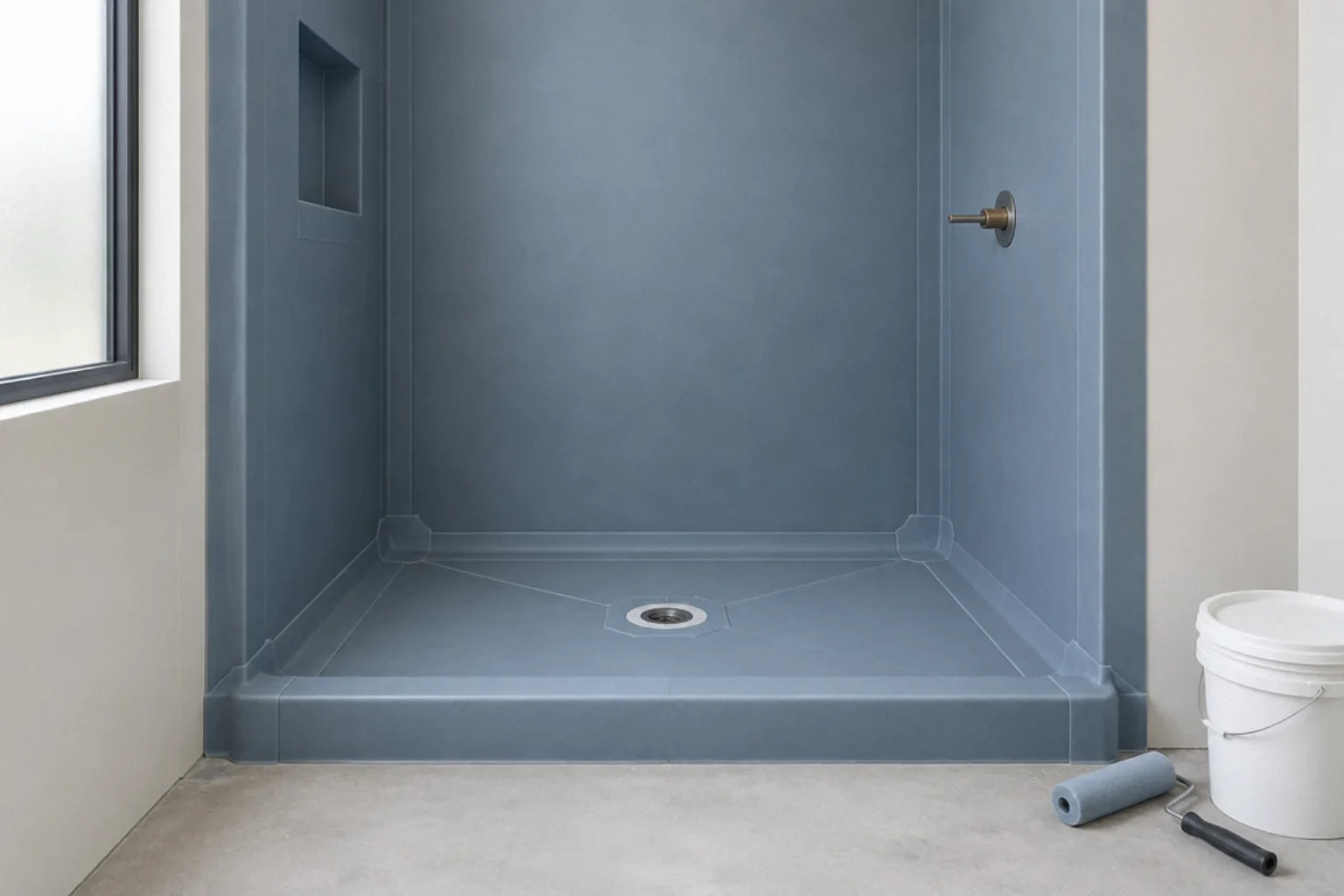
Short answer: there is no single best method, but there is a best practice: choose one complete, tested waterproofing system and install every part of it, from drain to walls to curb, according to that manufacturer's instructions. Grout and tile are not the waterproofing. LATICRETE's flood testing guide TDS 169 states that tile adhesives, underlayments, grouts, sealants and tile "are not substitutes for waterproofing materials," and that a dedicated waterproofing membrane is required. (Manufacturer-approved sealants still have a role at specified joints within a system; they just are not the waterproofing layer.) The two main approaches are a traditional shower pan liner under a mortar bed, with a drain designed to collect water through weep holes, and a bonded surface membrane applied directly under the tile with a drain designed for that membrane. Either can work. Problems tend to start when components from different approaches are combined in ways neither manufacturer allows, or when drains, corners, curbs and penetrations are not detailed.
This guide explains the two approaches, the code baseline, the questions to ask, and how to compare bids. It is general information current as of 3 October 2026.
What homeowners run into
A first-time remodeler asking what to watch for was advised in a reply showing +227 votes when indexed to ask in advance for a thorough explanation of the waterproofing spec and to check it against the manufacturer's or the Tile Council of North America's procedures, because "homebrew" approaches are common. An owner whose two contractors both blamed grout had the shower regrouted and the leak returned within days. An owner who paid for a diagnostic found no liner or waterproofing in the curb. A plumber and contractor commenting on a leaking second-floor shower listed a membrane not properly integrated with the drain outlet among common installer errors. These are personal accounts and opinions, not verified diagnoses.
The two main approaches
| Traditional liner ("water-in, water-out") | Bonded surface membrane | |
|---|---|---|
| Where the waterproof layer sits | Under a mortar bed on the floor; walls rely on a moisture barrier behind backer board that must lap into the pan liner as the approved assembly specifies, not hang loose behind it | Directly under the tile and setting mortar, on floor and walls |
| How water behaves | Some water passes through tile and grout into the mortar bed, then drains to weep holes in a clamping drain | Water is stopped at the membrane just below the tile |
| Drain type | Clamping-ring drain with weep holes; weep holes must stay clear | Drain with a bonding flange or clamping design specified by the membrane maker |
| Slope | Pre-slope under the liner and slope of the finished floor | Slope built into the substrate under the membrane |
| Details to ask about | How corners and the curb are folded or fitted; that no fasteners penetrate the liner below the height the instructions allow or through the curb; that weep holes stay clear; that a pre-slope is built under the liner | Thin spots, pinholes, untreated corners and seams, drain connection not per instructions |
Some surface membranes can also be used over a properly built mortar bed on a clamping drain; LATICRETE's HYDRO BAN installation instructions, for example, call for a clamping-ring drain with weepers, two coats with a checked wet-film thickness, pre-treatment of corners, seams, drains and penetrations, and a minimum slope to drains. That is the point: each product has its own required details. Do not combine a sheet or liquid membrane with a separate liner or vapor barrier unless both manufacturers' instructions allow the combination; an unplanned double barrier can trap moisture between layers.
The code baseline in the Bay Area
Codes set minimums; manufacturers set product details. Two Bay Area handouts illustrate both the requirements and how they change between code editions:
- Cupertino's bathroom remodel handout, based on the 2025 California codes, says shower surfaces shall be waterproof up to 72 inches above the drain inlet (citing CRC R327.2), and lists minimum shower size and door clearance requirements. That is a code minimum for the finished surfaces; it is not a statement of how far the concealed membrane must extend in every assembly. The waterproofing manufacturer's instructions govern membrane extent, and some designs, such as steam showers, have different requirements.
- Contra Costa County's bathroom remodel requirements, based on the earlier 2022 codes, summarize CPC 408.7 as requiring shower floors to be lined with an approved shower pan or an on-site built watertight approved lining, with on-site linings extending up the wall and sloped to weep holes, and list an underlayment and shower pan test inspection where applicable. Check the current code text and your department's handout, since reference points such as where liner height is measured matter.
Inspection practice varies by department; some inspect the pan or membrane before tile, and the inspector decides what test is acceptable for your system. See shower pan flood tests and permits for shower work.
Questions to ask every bidder
- Which waterproofing system will you use, by manufacturer and product name, for the floor, walls, curb and niches?
- Which drain will you use, and is it the one that system specifies?
- How will you treat corners, seams, the curb, the niche, the valve and showerhead penetrations?
- How will you build slope to the drain?
- Will you flood test before tile, per the system's instructions and the inspector's requirements, and can I see it?
- Will you provide photos of the waterproofing before tile and the product data sheets?
- What warranty do you give on leaks, and does the manufacturer offer a system warranty?
Worked example (hypothetical): comparing two bids
Bid A says "waterproof shower per code." Bid B lists a specific bonded membrane for floor and walls, the matching bonding-flange drain, factory corners for the curb and niche, a flood test before tile with the owner present, photos of the completed membrane, and a written leak warranty. Bid B costs more. The owner asks Bidder A to specify the same items in writing; Bidder A names a liner system with a clamping drain and pre-slope, a separate wall moisture barrier, and a pan test for the inspector. Now the owner can compare two defined systems rather than one defined system against a vague promise. Either could be acceptable; what matters is that each is complete and installed per its instructions. Our bid comparison guide has more.
Mistakes to avoid
- Accepting "waterproof" or "to code" as a specification.
- Treating grout sealer as waterproofing.
- Mixing parts of different systems without both manufacturers' approval.
- Covering the waterproofing before the inspection or test you agreed to.
- Using silicone or caulk to chase a leak instead of finding the failed layer; see grout vs caulk.
Checklist
- One named system for floor, walls, curb and niches
- Matching drain specified
- Corners, seams, curb, niche and penetrations detailed per instructions
- Slope method stated
- Flood test before tile per system and inspector
- Photos and data sheets provided
- Written leak warranty
- Permit and inspection sequence confirmed
Current as of 3 October 2026. Follow the current code adopted by your department and the specific manufacturer's instructions.
Questions that come up next
Is grout waterproof?
No. LATICRETE's flood testing guide states that tile adhesives, underlayments, grouts, sealants and tile are not substitutes for waterproofing materials, and that a dedicated waterproofing membrane is required.
Which is better, a shower pan liner or a surface membrane?
Both can work when installed as complete systems per the manufacturer's instructions. A liner sits under a mortar bed and drains through weep holes; a bonded membrane sits right under the tile. Ask your contractor to name the system and matching drain.
How high does shower waterproofing need to go in California?
Cupertino's 2025-code bathroom handout says shower surfaces must be waterproof up to 72 inches above the drain inlet, citing CRC R327.2. That is a finished-surface minimum; the waterproofing manufacturer's instructions govern how far the concealed membrane extends, and steam showers differ. Check your department's current requirements.
What should a contractor's waterproofing spec include?
The named system for floor, walls, curb and niches; the matching drain; how corners, seams and penetrations are treated; the slope method; a flood test before tile; photos and data sheets; and a written leak warranty.
Sources and further reading
Community questions behind this guide
These discussions identify homeowner concerns. Forum comments are personal accounts, not code or legal authority.