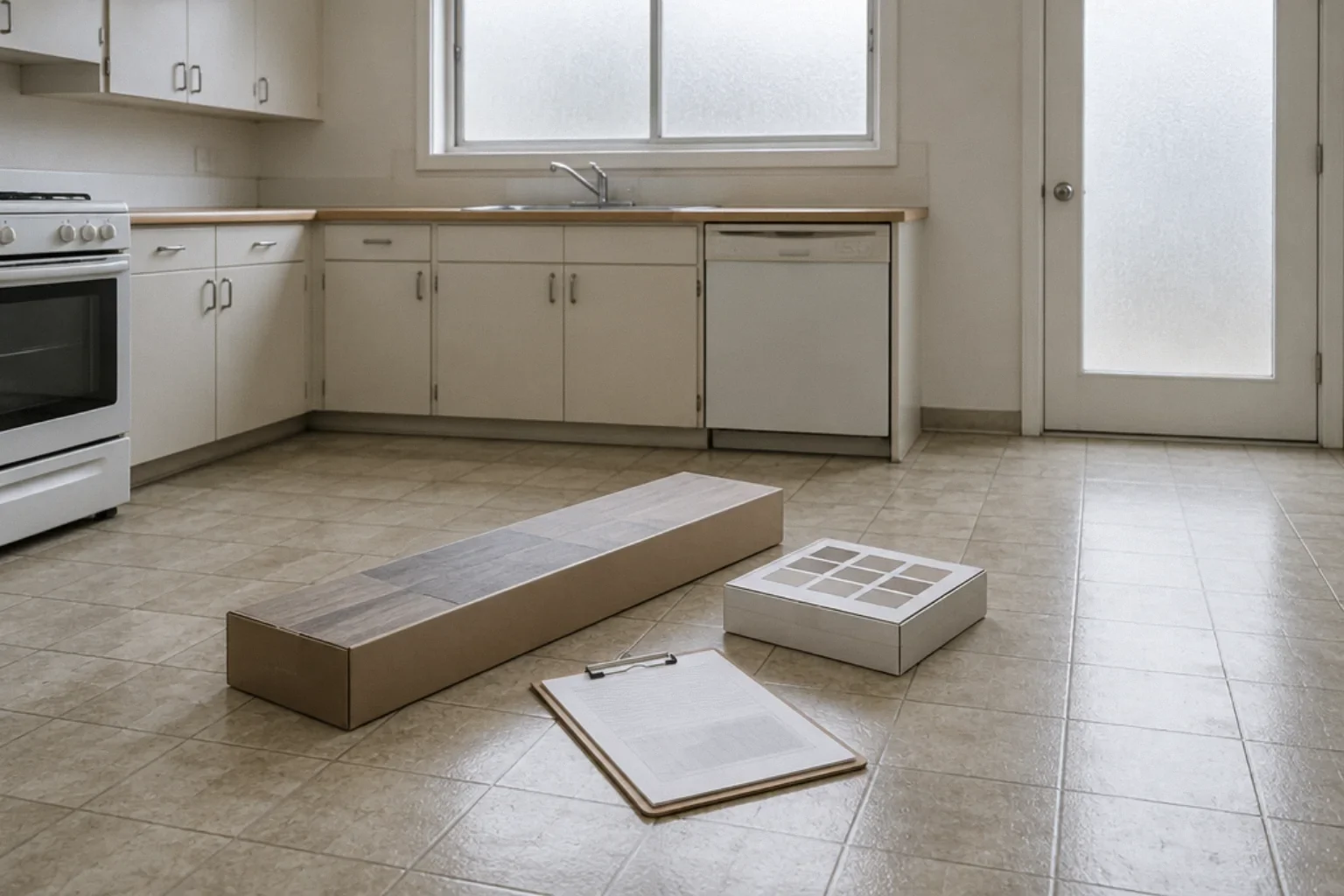
Short answer: sometimes, but only if the old floor and the new floor's preparation won't disturb it, and only if the new product allows installation over that surface. The U.S. EPA says that when asbestos flooring needs replacing, a new floor covering can be installed over it if possible, and warns against sanding, leveling or power-stripping such floors (EPA: Protect Your Family from Exposures to Asbestos). The catch is that many installations involve exactly those steps: scraping high spots, grinding adhesive, cutting tile at doorways, or screwing underlayment down through the old floor. Mohawk's SolidTech instructions warn not to mechanically chip or pulverize existing resilient flooring, backing, lining felt or asphaltic 'cutback' adhesives, and say to presume old material contains asbestos unless you know it does not (Mohawk SolidTech installation instructions). Before you plan the floor, get the suspect materials assessed by a qualified professional.
This is general information verified on 3 October 2026, not health, legal or abatement advice.
What owners describe
One owner installed thin click vinyl plank over old glue-down vinyl tile rather than removing it, and within months the planks began separating; the owner suspected the old floor was not flat enough. A 1957 homeowner assumed old vinyl in the laundry and under kitchen tile contained asbestos and said a flooring installer would remove the tile and backer but would not touch the vinyl. A buyer of a 1964 house was told by the inspector that some vinyl tiles might contain asbestos and was not sure how worried to be. Another owner learned after relatives had removed flooring and a wall that they did not know whether the old kitchen floor had been tested. A buyer of a 1961 house asked about vinyl and ceiling tiles before renovating. Forum accounts are anecdotal, and commenters' reassurances or alarm are not exposure assessments. Health questions belong with a physician and the agencies below.
Why the old floor matters for LVP
Two separate questions sit under one floor:
- Hazard: could preparing, covering or removing the floor disturb asbestos-containing material?
- Performance: is the old floor a suitable base for the new product?
Mohawk's instructions, as one example, allow installation over existing resilient flooring only if it is single-layer, not cushion-backed, fully adhered and smooth, with no moisture or alkalinity issues, and repairs to cuts, cracks and gouges. The same instructions say the installer decides suitability, and that where there is doubt the old floor should be removed or covered with an acceptable underlayment. Flatness requirements still apply. That means covering is not a shortcut around preparation; it changes what preparation is possible. See how flat a subfloor must be for vinyl plank.
Decision table: cover, abate, or reconsider
| Situation | Covering may be considered | Talk to an abatement professional first |
|---|---|---|
| Old floor intact, flat, well adhered, single layer | Yes, if the new product allows it and no disturbing prep is needed | If any scraping, grinding, cutting or fastening through it is planned |
| Tiles loose, cracked, crumbling or popping | Unlikely without repairs that may disturb material | Yes |
| High spots or ridges that need grinding | Only with a self-leveler or underlayment approach that avoids disturbance | Yes, before any mechanical leveling |
| Multiple layers or cushioned sheet vinyl | Often not allowed by product instructions | Yes, if removal is the likely path |
| Black adhesive exposed after earlier removal | Possibly, with a compatible cement-based underlayment per manufacturer | Yes; do not use chemical removers or grinding without professional guidance |
| Remodel also removes cabinets, walls or subfloor | Covering may not avoid disturbance elsewhere | Yes, assess the whole project scope |
Testing: who, what, and what a result means
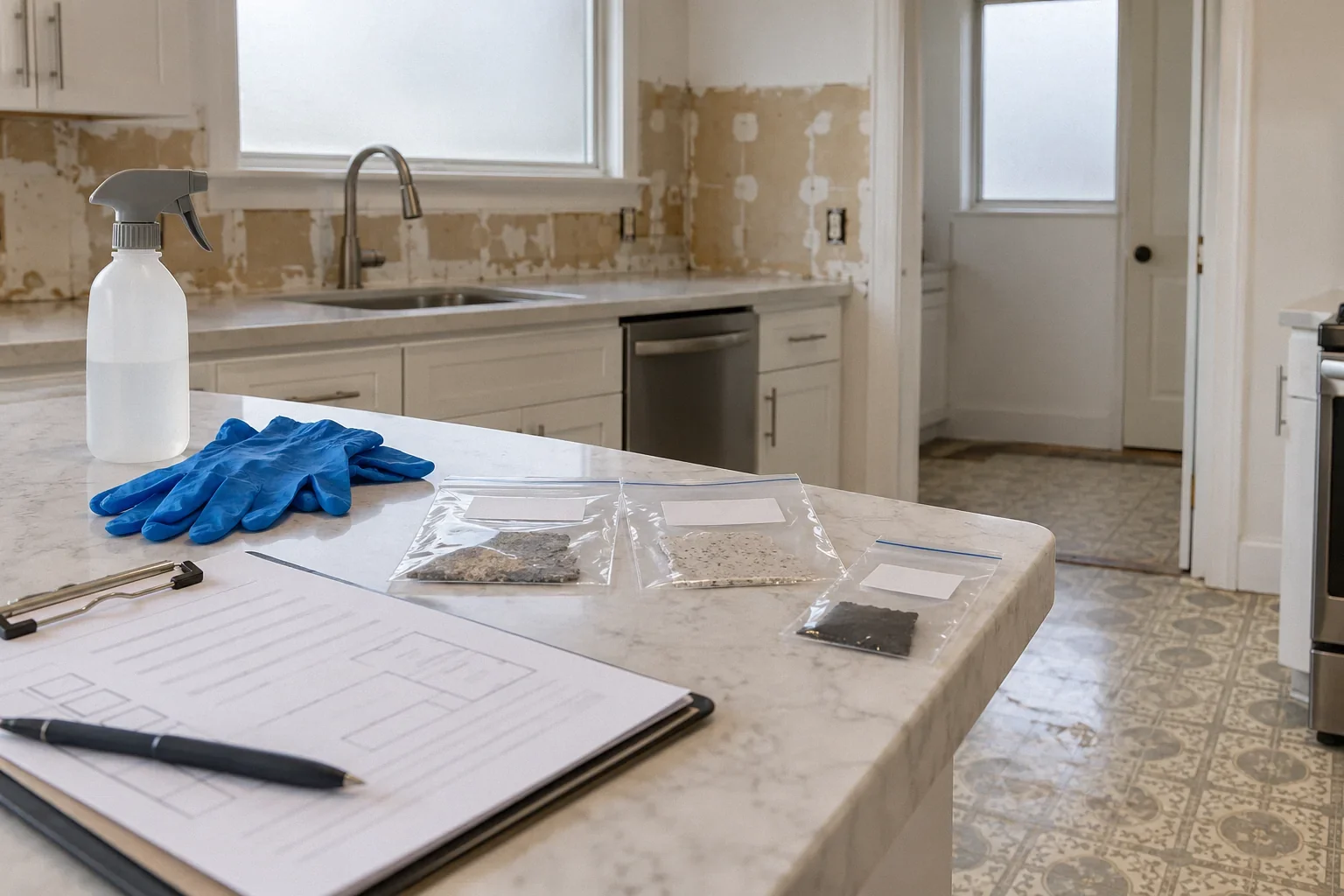
The EPA says taking samples yourself is not recommended and that sampling should be done by trained professionals; it also notes that if material is undamaged and will not be disturbed, testing may not be necessary. BAAQMD's March 2025 asbestos fact sheet says its Regulation 11, Rule 2 requires a survey for asbestos before demolition or renovation activity, performed by a Certified Asbestos Consultant certified by Cal/OSHA, and it advises against removing asbestos yourself (BAAQMD asbestos fact sheet). The Air District’s more specific residential FAQ distinguishes buildings with four or fewer units: a full survey is not required, but sampling and testing are required before removing or disturbing specified materials, including resilient flooring. That exception is not permission to scrape a suspect floor. Ask the consultant and Air District how the proposed covering or preparation affects your project; see the Bay Area survey, sampling and notification guide.
Points that are easy to miss:
- Each material is separate. Tile, sheet vinyl, backing, and adhesive layers can differ. A negative result applies only to the materials and locations actually sampled.
- The 1% figure is a definition, not a safety line. BAAQMD's rule defines asbestos-containing material as greater than 1% asbestos for regulatory purposes. That threshold decides which rules apply, not whether exposure is harmless. The fact sheet says there is no known safe level of exposure.
- Hidden layers. The floor you see may sit over older flooring. Tell the consultant everything you know about past flooring.
Who should do the work
Use a Cal/OSHA-certified consultant to assess, and a properly licensed and registered contractor for any abatement. The DIR Asbestos and Carcinogen Unit links to lookups for certified consultants and technicians and for Cal/OSHA-registered asbestos contractors. CSLB explains the C-22 Asbestos Abatement classification, which works within the contractor's DOSH registration. C-22 is not the only possible authorization: an ASB-certified contractor may work within its underlying license classification. Check the appropriate CSLB authorization and applicable DIR registration, not just a general remodeling license. A general flooring installer declining to touch suspect vinyl, as in the thread above, is a reasonable boundary, not obstruction.
Bay Area applicability
BAAQMD covers Alameda, Contra Costa, Marin, Napa, San Francisco, San Mateo and Santa Clara counties plus southwestern Solano and southern Sonoma; parts of Solano and Sonoma fall under other air districts, so confirm which agency covers your address. A home's age alone does not prove a floor contains asbestos, and a newer-looking floor may cover an old one. Keep consultant reports and abatement records; covered material remains in the house, and future owners and contractors will want to know. See what California sellers must disclose.
Walkthrough (hypothetical)
An owner of a 1960s house wants LVP in a kitchen with old 9-inch tile visible at a closet edge. Before getting flooring bids, they hire a certified consultant, who samples the tile, adhesive and a lower sheet layer found at a floor register. The report shows which layers contain asbestos. The flooring installer confirms the old floor is not flat enough without grinding, so the owner compares two paths: a licensed abatement contractor removes the affected layers before new underlayment, or a compatible cement-based underlayment is installed without mechanical disturbance where the product and consultant allow. The owner chooses after getting written scopes from both trades, keeps the report, and schedules cabinet work so no one cuts through the old floor later.
Mistakes to avoid
- Scraping, sanding, grinding or breaking suspect flooring or adhesive to 'just level it.'
- Using chemical adhesive removers on old adhesive, which Mohawk's instructions prohibit for its product.
- Screwing or nailing underlayment through suspect tile without professional guidance.
- Treating one negative sample as clearing the whole floor.
- Relying on forum reassurance instead of a consultant.
- Letting a handyman remove 'a few tiles' during a cabinet or appliance swap.
Checklist before flooring bids
- Suspect layers identified and assessed by a certified consultant
- Report kept, with materials and locations sampled
- New product's instructions checked for installation over resilient flooring
- Prep method chosen that avoids disturbance, or abatement scoped
- CSLB license and DIR registration verified for abatement contractor
- Air district confirmed for your address
- Other trades (cabinets, plumbing) told where the material is
Related: asbestos testing before a Bay Area remodel, dust control in an occupied home and flooring transitions.
Questions that come up next
Can I install LVP directly over old vinyl tile that might contain asbestos?
Sometimes. EPA says covering is an option when flooring needs replacing, but prep such as sanding, grinding or cutting can disturb it. The product must also allow installation over that surface. Have a professional assess first.
Should I take a sample myself?
EPA does not recommend homeowner sampling; it can release fibers. Use a qualified consultant. The Bay Area Air District distinguishes full surveys from required sampling in one-to-four-unit residential buildings; the exemption from a full survey does not exempt disturbing resilient flooring from required testing.
If my test came back negative, is the whole floor clear?
Only the materials and locations sampled. Tile, backing, adhesive and hidden older layers can differ.
Is material under 1% asbestos safe?
The 1% figure is a regulatory definition of asbestos-containing material, not a health threshold. BAAQMD's fact sheet says there is no known safe level of exposure.
How do I check an asbestos contractor in California?
Check CSLB for the appropriate C-22 classification or ASB certification within the contractor’s existing license scope, and verify applicable Cal/OSHA registration through DIR. Match the authorization to the actual abatement scope.
Sources and further reading
- U.S. EPA: Protect Your Family from Exposures to Asbestos
- Bay Area Air District: Asbestos Regulation fact sheet (March 2025)
- Mohawk SolidTech Uniclic Installation Instructions (08/2025)
- California DIR: Asbestos and Carcinogen Unit
- CSLB: C-22 Asbestos Abatement Contractor
- Bay Area Air District: Asbestos Frequently Asked Questions (updated 4 June 2025)
- CSLB: ASB Asbestos Certification
Community questions behind this guide
These discussions identify homeowner concerns. Forum comments are personal accounts, not code or legal authority.
- Click Vinyl Plank Floors are Seperating Because Floor Underneath was Not Flat Enough. Solutions?
- Is asbestos/lead abatement worth it when it's not an immediate problem?
- Help me get some perspective on asbestos risk in the house I just bought
- Major Asbestos Issue
- Buying a 1961 house that has barely been updated-asbestos and lead concerns and questions.