Short answer: use a moisture meter to compare, map and verify, not to diagnose on its own. Meters calibrated for wood, whether pin or pinless, can give a wood moisture content reading within their range when set and corrected as the manufacturer directs. On materials like drywall or masonry, many meters report on a relative or reference scale, not a literal percentage of water. Compare suspect areas with known-dry areas of the same material, take several readings, and follow the targets in your flooring manufacturer's instructions and the building code. When readings suggest a hidden leak, have a qualified professional investigate rather than opening walls or running uncontrolled water tests yourself.
This is general information verified on 3 October 2026.
Where owners run into readings
A buyer whose inspector found moisture at a shower pan quoted the report: a moisture meter reading of 100% and stains near the shower. Another owner hired a leak detector who used a moisture detection gun and suspected the shower pan, while two contractors later blamed grout. An Australian owner tracking a slow leak asked what meter could detect moisture behind tiles; replies mentioned a pinless meter and borrowing a thermal camera. A New Zealand thread on homeowners using moisture meters discussed cheap versus expensive meters and noted that thermal cameras can spot things meters miss but can be hard to interpret. A house hunter was told to bring a moisture meter and compare exterior and interior walls. Forum accounts are anecdotal, and the readings people quote are often misunderstood; the sections below explain why.
Pin and pinless meters
Delmhorst, a meter manufacturer, explains that pin meters measure electrical resistance between pins and, for wood, can provide moisture content readings within a calibrated range with species and temperature corrections; pinless meters use radio-frequency sensing to scan surfaces without damage, and for drywall and masonry may use reference scales (Delmhorst: pin and pinless meters for construction). Delmhorst also stresses that the best accuracy requires compensating for factors such as species, temperature and surface moisture (Delmhorst: what moisture meters can and cannot do).
| Pin meter | Pinless meter | |
|---|---|---|
| How it reads | Resistance between pins pushed into the material | Radio-frequency field through the surface |
| Best for | Wood moisture content (subfloor, framing, hardwood) within its calibrated range | Scanning walls and floors quickly; finding where moisture is |
| Damage | Small pin holes | None |
| Reading type | Wood moisture content with corrections; may be relative on other materials or outside range | Wood moisture content on wood settings for meters calibrated for it; often relative or reference scale on non-wood materials |
| Watch for | Species and temperature corrections; surface wetness; never push pins where wiring or pipes could be just below the surface | Metal, wiring or dense materials behind the surface can influence readings; depth of reading varies |
What does "100" mean?
On many meters, a high number on a non-wood mode is a top-of-scale or relative value, not a literal percentage of water. A high reading may indicate moisture, but metal behind the surface (such as corner bead, foil-faced insulation or pipes), salts and material density can also push readings up. Treat it as a flag: compare with nearby dry areas of the same material, look for a pattern, and have a professional confirm before drawing conclusions.
Targets that come from code and instructions
- Framing before enclosure. California's 2025 CALGreen code, as summarized by HCD, says wall and floor framing must not be enclosed when framing members exceed 19% moisture content, verified with a probe-type or contact-type moisture meter, with readings taken 2 to 4 feet from the grade-stamped end and at least three random readings documented for the enforcing agency; visibly water-damaged materials must not be installed, and wet insulation must be replaced or dried (§ 4.505.3) (HCD: 2025 CALGreen Residential Mandatory Measures). CALGreen's application to remodels depends on scope; ask your department.
- Wood subfloor before flooring. Flooring manufacturers set their own limits. Mohawk's SolidTech instructions, for example, list a maximum of 14% for wood subfloors and specify standardized tests for concrete (Mohawk SolidTech installation instructions). Follow your product's instructions; warranties often depend on it.
- Concrete. Handheld meters are generally screening tools on concrete; manufacturer instructions often call for specific test methods. Use the method your flooring maker requires.
A sensible routine
- Read the meter's manual and set the correct mode and species or material setting.
- Take baseline readings on the same material in an area you believe is dry.
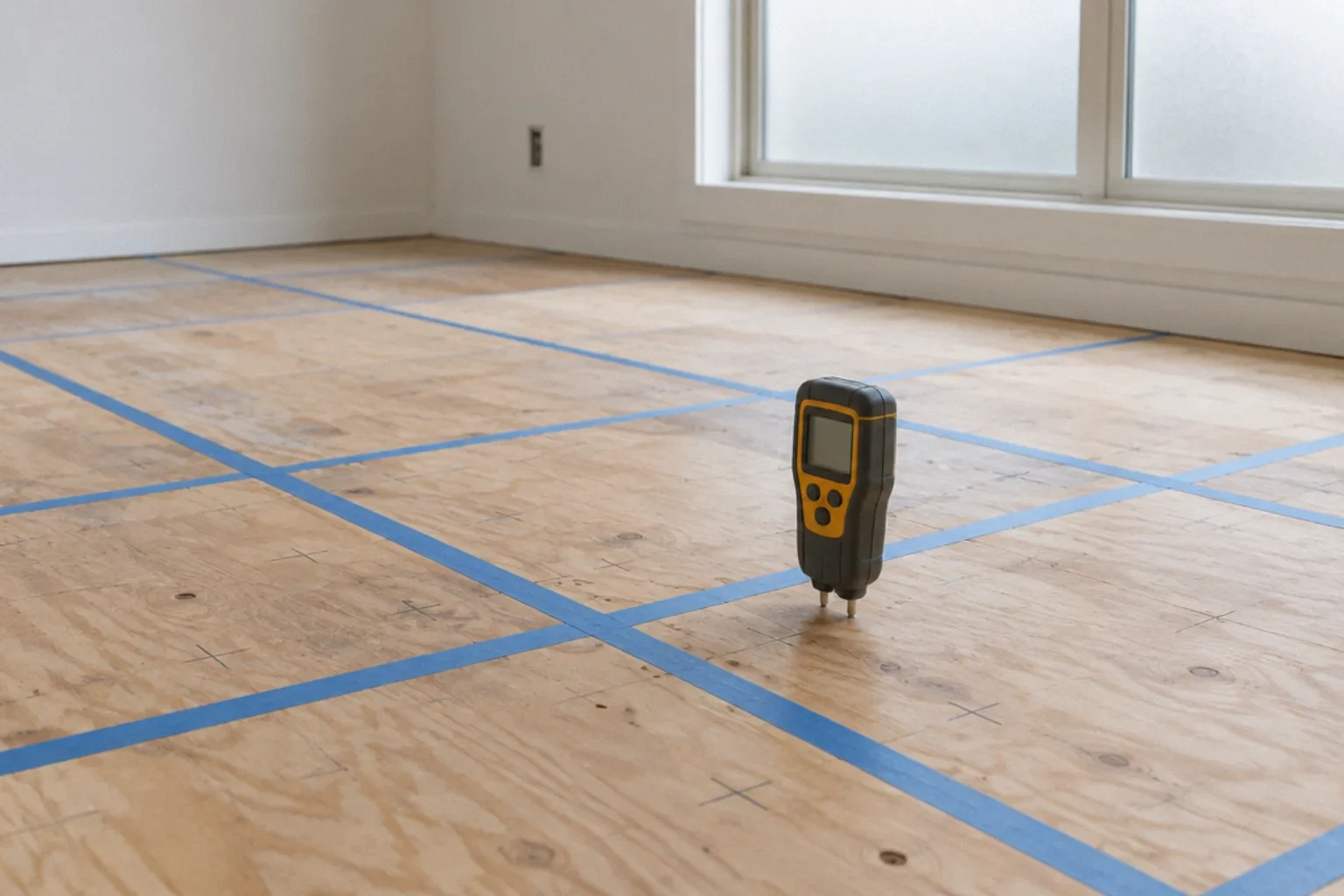
- Map the suspect area in a grid, recording readings on a sketch or photo.
- Repeat over time where no active leak is suspected. If you already suspect an active leak, stop using the fixture until it is checked, and let a professional run any controlled test.
- Look for patterns: readings that rise toward a fixture, a window corner or an exterior wall tell you more than one high number.
- Record and share the map with the professional you hire.
Leaks, condensation and when to stop
A wet reading can come from a plumbing leak, a failed shower assembly, exterior water intrusion, or condensation. Condensation itself can be a symptom of a building problem, such as an unvented bathroom or a cold, uninsulated wall, so it is not automatically harmless. For a known or suspected leak, do not run extended water tests that could cause more damage, and do not enter attics or crawlspaces that are unsafe to access; a qualified professional can test plumbing, drains and enclosures in a controlled way. See who to call for a leaking shower and signs of hidden water damage before buying.
Using a meter while house hunting
A meter can help you notice spots worth asking about: under windows, around tubs and showers, below upstairs bathrooms, and at exterior walls. Ask the seller or agent before taking readings, use non-invasive pinless mode on finished surfaces, and do not open, drill or enter spaces. Treat any high reading as a question for your inspector or a specialist, not a conclusion. A meter does not replace a professional inspection; see what home inspectors don't check.
Walkthrough: checking a subfloor before vinyl plank
A hypothetical owner is installing vinyl plank over a plywood subfloor in a 1960s house with a crawlspace. They read the flooring instructions, which list a wood subfloor moisture limit. Using a pin meter on the setting or correction the meter's manufacturer specifies for plywood panels, and avoiding areas where wiring or pipes may run, they take readings in a grid across the room and near the exterior wall and a bathroom. Most readings are well below the limit, but readings near the bathroom wall are higher. They stop, have a plumber check the toilet and supply connections, and wait to install until the source is fixed and readings fall within the manufacturer's limit.
Checklist
- Correct meter type and mode for the material
- Species or material setting and temperature considered
- Baseline readings on dry material
- Grid map of suspect areas, repeated over time
- Targets taken from your flooring instructions and applicable code
- No destructive testing or unsafe access
- Professional investigation for suspected leaks
Questions that come up next
What should a wood subfloor read before installing flooring?
Follow your flooring manufacturer's limit. Mohawk's SolidTech instructions, for example, list a maximum of 14% for wood subfloors. Use a pin meter set for the wood species and take readings across the room.
What does a 100% moisture meter reading on drywall mean?
On many meters it is a top-of-scale or relative value, not literally 100% water. It may indicate moisture, but metal, salts or dense materials behind the surface can also raise readings. Compare with dry areas of the same material, look for a pattern, and have a professional confirm.
Pin or pinless: which moisture meter should I buy?
Pin meters read wood moisture content with species corrections; pinless meters scan surfaces without damage and, when calibrated for wood, can also read wood moisture content. Some meters combine both. Choose based on whether you mainly check wood or scan finished walls.
Can framing be closed up if it is wet?
California's 2025 CALGreen code, as summarized by HCD, says framing should not be enclosed above 19% moisture content, verified with a moisture meter at specified points. Application to remodels depends on scope; ask your building department.
Can a moisture meter find a shower leak?
It can show where moisture is, but not why. Plumbing, drains, enclosures and waterproofing can all be sources, and condensation is another possibility. A qualified professional can test them separately without causing more damage.
Sources and further reading
Community questions behind this guide
These discussions identify homeowner concerns. Forum comments are personal accounts, not code or legal authority.